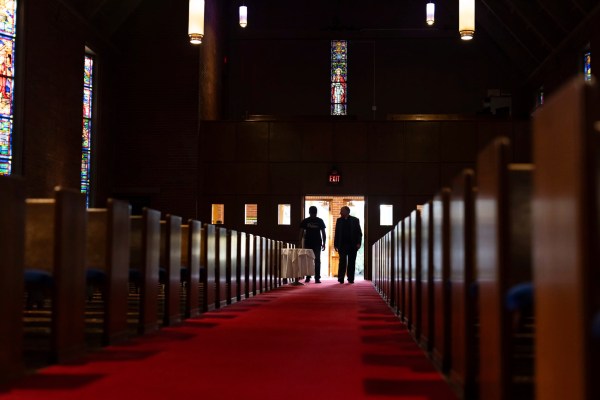
IT’S WELL KNOWN that tax-exempt organizations aren’t supposed to engage in politics. Federal law says they may not “participate in, or intervene in (including the publishing or distributing of statements), any political campaign on behalf of (or in opposition to) any candidate for public office.” The prohibition is absolute: A single endorsement by a tax-exempt entity can result in its loss of tax-exempt status, and may also force it to pay an excise tax. Walter B. Jones Jr., a Republican congressman from North Carolina, wants to loosen the law so that a certain group of public charities may engage at least to a certain extent in political campaigns, without risk of losing their tax-exempt status. The group includes religious entities only: churches, synagogues, and mosques. The Houses of Worship Political Speech Protection Act is the title of the Jones bill, and in mid-May it got what Jones long had sought: an actual hearing (from a Ways and Means subcommittee). Few observers think it has much chance of becoming law. Yet it raises key issues of church and state. The law Jones wants to amend wasn’t added to the tax code until 1954. From the nation’s founding until then, public charities, churches included, could engage in politics as much as they wanted, without fear of legal penalty. And of course our history contains examples of politicking from the pulpit that include what was made illegal in 1954: actual candidate endorsements. What happened in 1954 was an act of political revenge on the part of Sen. Lyndon Baines Johnson. Reacting to the opposition of Texas nonprofits in his primary, Johnson proposed the language that became law in a floor amendment. It was unanimously approved. There was no debate, and of course no hearings. Neither of the nonprofits that offended Johnson was a church, nor is there any evidence to suggest that he meant to target churches. Yet the Johnson amendment, reaching all tax-exempt organizations as it did, necessarily applied to “houses of worship.” For many years there was little enforcement of the Johnson amendment against houses of worship. Presumably, there wasn’t much to investigate or else the Internal Revenue Service looked the other way. (The IRS is loath to announce its probes, and unless those investigated announce the fact, or there is litigation, cases are unlikely to be made public.) In the past two decades, however, theologically conservative churches have complained about increasing scrutiny under the Johnson amendment, though very few have been penalized. The best-known case involved the Church at Pierce Creek in Binghamton, N.Y., which had its tax-exempt status revoked for sponsoring full-page ads in 1992 that ran in USA Today and the Washington Times. The ads identified as “sins” abortion on demand, homosexuality, and premarital sex, admonished Christians to oppose such sins, and–what drew the IRS’s attention–not to vote for presidential candidate Bill Clinton. Jones and his allies cite the Church at Pierce Creek case in charging unequal treatment: They say the IRS is more interested in policing churches identified with Republican causes and candidates than liberal churches, especially those in black communities that invite Democrats into their pulpits. An investigation two years ago by the Joint Committee on Taxation found no credible evidence of political motivation on the part of the IRS. Even so, as testimony on the Jones bill made clear, the service relies on complaints from citizens to enforce the Johnson amendment, and it appears that the complaints it receives come almost exclusively from the left. Americans United for Separation of Church and State has been particularly aggressive both in warning churches about the Johnson amendment and in reporting those it believes are violating it. Barry Lynn of Americans United says the group warns churches of all descriptions, not just conservative ones. Jones thinks Americans United, given its views, is more energetic when it comes to policing the right-leaning churches. But perhaps the most important point here is that there is no similar watchdog on the right–no organization identified with conservative causes that is sending out letters about the Johnson amendment. Why that is so is itself interesting: The secular and religious left tends to be content with the Johnson amendment, while religious conservatives tend not to be. The practical argument advanced by supporters of the Jones bill is one of legalization: There already is a good bit of political activity going on, in churches of all kinds, and while some of it involves actual endorsements, most of it doesn’t, and the parts that don’t nonetheless may draw IRS scrutiny because the service in assessing political activity weighs “facts and circumstances”–a loose standard that permits too much discretion. For example, the IRS may decide that the preparation and distribution of voter guides constitutes prohibited “political intervention” unless they address a “wide variety” of issues–as the service defines “wide.” The IRS’s approach creates anxiety and uncertainty for the churches–and that, say the bill’s supporters, needs to change. If the Senate of 1954 could be reconvened and asked–as it was not at the time–whether “houses of worship” should be prohibited from engaging in politics, it might have been forced to consider whether it wanted to deny what churches had been free to do for better than a century and a half. Certainly there is nothing in the Constitution that requires churches to refrain from such engagement. There are prudential and, from the perspective of the churches themselves, theological reasons they may not wish to be involved in politics–the Southern Baptist Convention, while supporting the Jones bill, encourages Baptist churches to speak freely on issues but to refrain from endorsing candidates–but the Constitution leaves it to churches to decide that. Unless, of course, there is some basis by which the state may regulate what would otherwise be untouchable First Amendment rights. According to the courts, the fact of tax-exempt status provides such a basis. In the full sweep of American history, the Jones bill actually contemplates a moderate result, since it would permit campaign involvement on the part of a church, not absolutely, as was the case before 1954, but only so long as it was “no substantial part” of its activities. That language comes from a provision in the code that limits how much “lobbying” or legislative activity a church may conduct. As that term has been interpreted, a church that devotes more than 5 percent of its time, money, and personnel to lobbying has crossed the line from insubstantial to substantial. The Jones bill thus would relax the absolute ban on political activity. Which is to say: There would be a qualified prohibition. This fact undercuts the rhetoric used by supporters of the Jones bill–that it would “restore the rights of religious organizations,” as though it would take us back to the pre-1954 good old days. Yet even this qualified prohibition is too much for the secular and religious left to abide. Most of their contentions are overblown, but there is a serious issue that Barry Lynn of Americans United has raised. Lynn argues that the qualified prohibition wouldn’t pass muster under the Supreme Court’s 1989 ruling in Texas Monthly v. Bullock. He is making that case to derail the Jones bill. But he could be right. Like many other states, Texas had a law that exempted religious publications from sales taxes. Texas Monthly, which was not entitled to the exemption because of its secular nature, challenged the law. The Supreme Court, by a vote of 6 to 3, held that it violated the First Amendment’s ban on establishing religion. In the opinion for the Court, Justice William Brennan said the exemption unconstitutionally favored religious over non-religious groups. In this Brennan tracked the understanding of the First Amendment first advanced by the Court in a landmark 1947 case, in which Justice Hugo Black declared that the Firs
t Amendment denied government the power to “aid all religions”–and thus to privilege religion over non-religion. Black’s insistence on absolute neutrality has proved controversial (to put it mildly), and some justices and some Court majorities have not agreed with it. Still, while the composition of the Court has changed since Texas Monthly, five justices (including Sandra Day O’Connor) are likely to favor it–and thus to find a problem with a houses-of-worship-only approach. Whether the Jones bill is passed–the House leadership would have to get behind it to get it to the floor–and whatever its fate might be in the courts, houses of worship certainly may engage in forbidden politicking even now. They just have to be willing to pay taxes, should the IRS look their way. Terry Eastland is publisher of The Weekly Standard.