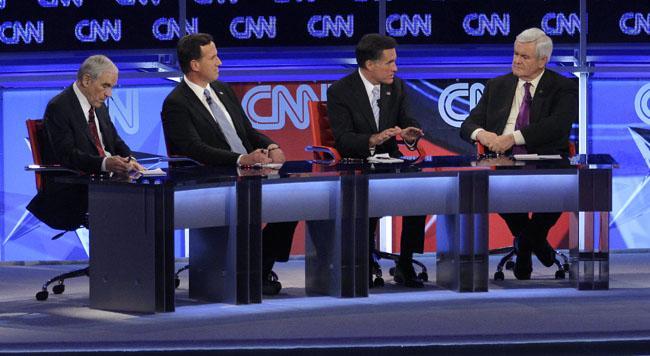
MESA, Ariz. — Rick Santorum suspects something is up between Mitt Romney and Ron Paul. Santorum had a tough night at the 20th, and likely last, Republican debate, held here at the Mesa Arts Center. He took a lot of attacks from Romney and a few from Paul, and he noticed that Paul and Romney didn’t seem to go after each other. When it was all over, and Santorum met reporters, he didn’t try to hide what he was thinking.
“You have to ask Congressman Paul and Gov. Romney what they’ve got going together,” Santorum said. “Their commercials look a lot alike, and so do their attacks.”
“They’ve got something going on?” a reporter asked Santorum.
“You tell me,” Santorum said.
Santorum’s aides have long suspected that Romney and Paul have some sort of deal by which they attack other candidates but not each other. “Clearly there is a tag-team strategy between Ron Paul and Mitt Romney,” top Santorum strategist John Brabender told reporters after the debate. “There’ve been 20 debates, right? Why don’t you go back and see how many times Ron Paul has ever criticized anything Mitt Romney has done.”
“Ron Paul has for all practical purposes pulled out of Michigan,” Brabender continued, referring to next Tuesday’s primary. “Anybody see him up in Michigan? And yet where is he running negative ads against Santorum? Michigan.”
A few feet away, Romney aides dismissed the accusations as “whiny silliness.”
“Oh, please,” said key Romney strategist Stuart Stevens. “The notion that Ron Paul would do anything but speak his mind is — if ever there was an iconoclast who got up there and said what he believes, it’s Ron Paul.”
Stevens pointed out that a number of candidates and committees have run ads attacking Romney. “The President of the United States’ political action committee is now running ads that are just like Rick Santorum’s,” Stevens said. “Is Rick Santorum coordinating with the President of the United States? I don’t think so. I think that’s a sort of whiny silliness.”
The bad blood in the spin room was just a continuation of what took place in a mostly negative and downbeat night on stage. After the introductions, Romney’s first opportunity to speak came when the moderator, CNN’s John King, invited him to attack Santorum. Romney accepted the invitation. And the first thing he attacked Santorum for was “voting for raising the debt ceiling five different times without voting for compensating cuts.”
Having lost his run for Senate in 1994, Romney has never had to vote for or against raising the debt ceiling. But he has many present and former members of the House and Senate who speak on his behalf in this campaign, and they have voted to raise the debt ceiling. And there aren’t many Romney observers who don’t believe that, had he served for years on Capitol Hill, he too would have voted to raise the debt ceiling. After the debate, a top Romney supporter here, Arizona Republican Rep. Jeff Flake, explained that in the most recent debt debate Romney, had he been in Congress, “would have insisted on some kind of spending cuts” to go along with a debt limit increase. Flake, a solid fiscal conservative who has nonetheless sometimes voted to raise the debt ceiling, conceded there have been such spending-restraint deals in past debt ceiling increases, but none worked very well.
Romney also attacked Santorum for voting for earmarks. When Santorum pointed out that Romney, as head of the 2002 Olympic Games in Utah and again as governor of Massachusetts from 2003 to 2007, asked for lots of federal earmarks, Romney defended the Olympic request and ignored the part about his record as governor.
The earmark debate went on for a long time, with Santorum explaining in perhaps too much detail how the process worked. When Santorum said to Romney, “I suspect you would have supported earmarks if you were in the United States Senate,” Romney responded by broadening his attack to include Gingrich, saying “the 6,000 earmarks that were put in place under the speaker’s term, for instance, were often-times tagged on to other bills.”
The crowd began to boo, leading to Romney to say, “I’m sorry. I didn’t mean to be critical.” It was one of the debate’s few funny moments.
Gingrich had his say a few minutes later when he defended Romney’s request for Olympic spending but ridiculed Romney’s attempt to criticize Santorum for doing what Romney had himself advocated. “I think it was totally appropriate for you to ask for what you got,” Gingrich said to Romney. “I just think it’s kind of silly for you to then turn around and run an ad attacking somebody else for getting what you got and then claiming what you got wasn’t what they got because what you got was right and what they got was wrong.”
Afterward, Stevens suggested it was up to Romney, as a governor, to ask for money, and it was up to Congress to say no. “I think it’s a laughable argument to say that governors are supposed to end earmarks, when Romney has never voted for an earmark, never been in Washington,” Stevens said. “Governors are going to ask for funds from the federal government. It’s up to Congress to decide how they allocate the money.” When it comes to earmarks, Romney’s argument was that it was perfectly fine for him to ask for the money and absolutely outrageous for Congress to give it to him.
Some Romney attacks were even more audacious. For example, he blamed the passage of Obamacare on Santorum because in 2004, “the senator you supported over Pat Toomey in Pennsylvania, Arlen Specter, the pro-choice senator of Pennsylvania that you supported and endorsed in a race over Pat Toomey, he voted for Obamacare,” Romney said.
That accusation is based on supposition that Toomey might have won the general election that year had he defeated Specter for the Republican nomination. Putting that aside, in the year Romney blamed Santorum for supporting the “pro-choice” Specter, 2004, Romney himself was pro-choice, having run for governor in Massachusetts in 2002 on a strongly pro-choice platform. But that didn’t stop Romney from slamming Specter as pro-choice and Santorum for supporting him.
Santorum had an off-key moment, followed by an awful moment, when moderator King asked the candidates to describe themselves in one word. Ron Paul said “consistent,” Romney said “resolute,” and the sometimes famously angry Gingrich brought the house down when, with perfect timing, he answered “cheerful.” And Santorum? He chose “courage,” which is not only not an adjective but is also the kind of word you want somebody else to use to describe you but which you shouldn’t use to describe yourself.
To make matters far worse, Santorum’s weakest moment came a few minutes later when he described an un-courageous moment in which he voted for George W. Bush’s No Child Left Behind initiative. Santorum was deeply apologetic. “I supported it,” he said. “It was the principle priority of President Bush…I have to admit, I voted for that. It was against the principles I believed in, but you know, when you’re part of the team, sometimes you take one for the team, for the leader, and I made a mistake.”
The crowd began to boo. Santorum didn’t stop. “You know, politics is a team sport, folks,” he continued. “And sometimes you’ve got to rally together and do something.” It was an almost self-flagellating moment for the former senator.
Later, Brabender tried to put the episode in the best possible light. How did a vote against his principles show that Santorum was courageous? “Let me tell you, it takes a lot of courage to stand up there and say, ‘I made a mistake,’ which is what he did,” Brabender answered. “I think that does take a lot of courage.” It remains to be seen whether voters will view Santorum’s performance as weak, or whether they will see it as refreshing in its honesty.
One last word. After all the recent controversy, who would have bet that the topic of contraception would not come up until well into the debate, that Santorum would answer it with restraint and grace, and that Romney would immediately adopt Santorum’s position as his own? It wasn’t at all likely, but it happened. And it was one of the best moments in a debate that had very few really good moments.
