

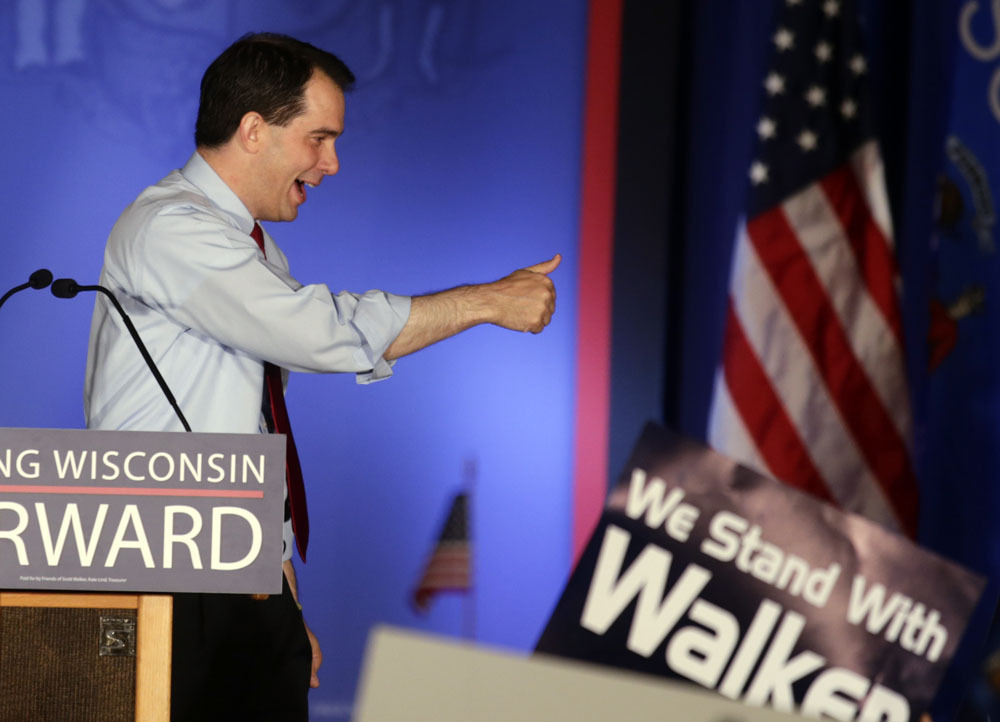
As this is written, the polls in Wisconsin have not closed, so we don’t know whether or not Republican Gov. Scott Walker will beat Milwaukee Mayor Tom Barrett and avoid being recalled. Polling has consistently showed Walker ahead, recently by an average of 6 points, but polls can’t predict turnout.
But we do know one thing. And that is that the Democrats and the public employee unions have lost the battle of ideas over the issue that sparked the recall, Walker’s legislation to restrict the bargaining powers of public employee unions.
That’s supported by a Marquette University poll showing 75 percent of Wisconsin voters favoring increases in public employees’ contributions for health care and pensions. It also showed 55 percent limiting collective bargaining for public employees and only 41 percent opposed.
But the strongest evidence is that Barrett and the Democrats have been avoiding the issue. They’ve been trying to make the election about anything else, such as an investigation of staffers for Walker when he was Milwaukee County executive.
If Barrett does upset the odds — put by the New York Times numbers cruncher Nate Silver at 95 percent — it will be for some reason other than Walker’s limits on public employee unions.
A defeat in a state where public employee union bargaining was authorized in 1959 has national implications.
Unions spent $400 million in the 2008 election cycle to elect Barack Obama and other Democrats. More than half of all union members nationally are public employees.
Public employee unions insist that dues money be deducted from members’ paychecks and sent directly to union treasuries. So in practice public employee unions are a mechanism for the involuntary transfer of taxpayers’ money to the Democratic Party.
Walker’s law ended this practice and gave public employees the choice of whether to pay union dues. The membership of AFSCME, the big union of state employees, fell from 62,818 to 28,785.
That’s what liberal columnist E.J. Dionne was referring to when he wrote last week that Walker’s laws “sought to undermine one of the Democratic Party’s main sources of organization.” Dionne wants continued taxpayer financing of campaigns — for his side only.
The battle of ideas in Wisconsin may have affected opinion nationally. The annual Education Next annual poll of opinion on teacher unions showed little change between 2009 and 2011 but this year the percentage with a positive view dropped from 29 percent to 21 percent. It dropped from 58 percent to 43 percent among teachers themselves.
The case for public employee unions has never been strong. Franklin Roosevelt opposed them and so did AFL-CIO founding President George Meany.
Public unions’ institutional incentives are to increase pay and benefits, which costs taxpayers money, and to limit employee accountability, which tends to reduce the quality of public services.
Union leaders claim they uphold professional standards. But aside from police and fire unions fighting dumbed-down hiring and promotion exams, it’s hard to find examples of this actually happening — much harder than finding incompetents and miscreants kept on the public payroll by their unions.
Perhaps the weakness of the case for public employee unions has kept Barack Obama from doing much to help them in Wisconsin. Or perhaps he’s preoccupied by the faltering economy or fatigued by the six fundraisers he attended last Friday when the dismal jobs numbers came out.
Whatever the reason, Obama did fly over Wisconsin from a Minneapolis fundraiser to his home in Chicago. And on Monday he tweeted his “backing” of Tom Barrett, although he didn’t use the full 140 characters.
It’s not the first time Democrats have stiffed their union funders. Obama and Speaker Nancy Pelosi pushed House members to cast tough (in some cases career-ending) votes for cap-and-trade and Obamacare.
But Obama didn’t push hard, or much at all, for the unions’ card check bill, which union leaders hoped would enable them to reverse the long decline in private sector union membership.
Now the public employee unions are threatened. A Walker victory in Wisconsin would show that the case against powerful public employee unions can be not only defended but advanced, in a state with a long progressive tradition which has not voted Republican for president since 1984.
That’s a lesson that may be taken to heart by governors, legislatures and voters in other states being pushed toward bankruptcy by union-negotiated benefits and pensions.
Michael Barone, The Examiner’s senior political analyst, can be contacted at [email protected]. His column appears Wednesday and Sunday, and his stories and blog posts appear on washingtonexaminer.com.
