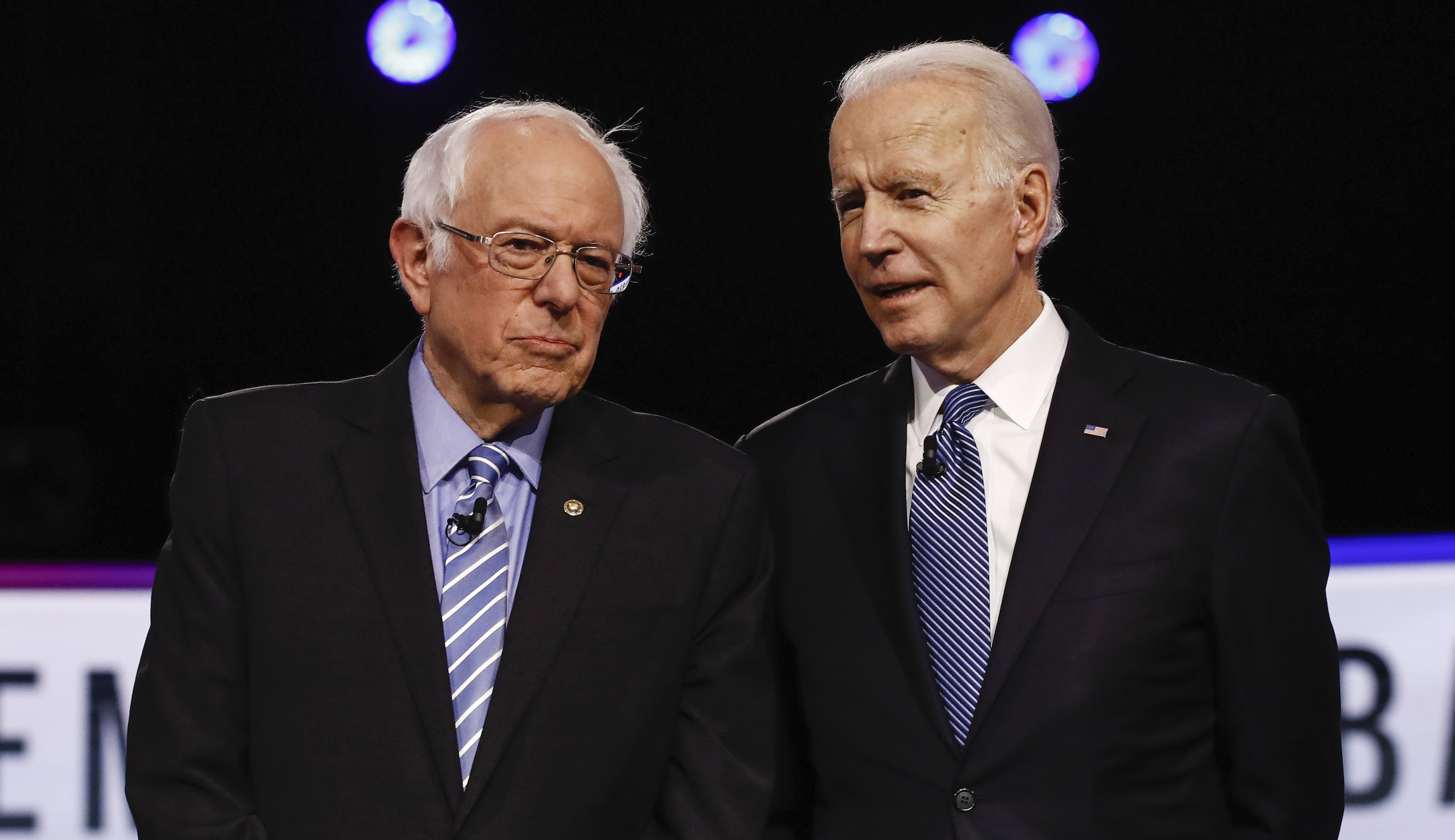
Bernie Sanders’s road to the presidency may have effectively ended, but that doesn’t mean he can’t pressure likely Democratic nominee Joe Biden to take up some of his policies. The question remains whether the former vice president needs to listen to the socialist senator from Vermont.
Sanders’s message is clear: I might not be able to win the nomination, but I still lead a sizable chunk of the Democratic Party. Most of my supporters are young, and you’ll need them to vote in 2020. The age gap between their bases is among the largest in modern political history. If Biden shuns Sanders voters, he risks losing the general election to an easily beatable opponent.
So far, Sanders has won roughly 30% of primary voters. Although that percentage is significantly less than during his 2016 run, when it was effectively a two-way race from the start, Democrats remain concerned that his supporters will simply stay home in November. Many establishment Democrats blame Sanders backers for Hillary Clinton’s loss in the last election, meaning they are particularly sensitive about any tensions that may arise this time around.
But the threat of four years of President Trump is no longer the abstraction it was in 2016, and Biden has amassed a large delegate lead early. The former vice president may have little incentive to budge on policy.
Biden supporters point to his resounding wins in states such as Michigan and Missouri, places Clinton lost or only narrowly won in the 2016 primaries. Likability, they say, means a lot more than support for trade deals or “Medicare for all.”
Following Clinton’s win four years ago, the Democratic National Convention made significant changes to the party platform. That included a clause calling for the abolition of the death penalty and the establishment of a $15 minimum wage. But Democrats didn’t adopt Sanders’s positions on everything then and likely won’t now if Biden is the nominee.
Already, Biden has signaled his opposition to government-run Medicare for All, the centerpiece of the Sanders campaign. In an interview with MSNBC earlier this month, Biden said he would veto any bill as president stripping private health insurance from the public, something Sanders’s bill would do.
“I would veto anything that delays providing the security and the certainty of healthcare being available now,” said Biden, even under a scenario in which a unified Democratic Congress managed to pass the law through both chambers.
That answer infuriated many progressives but also suggested that Biden feels no need to overextend himself in a primary that’s essentially over and risk being portrayed as a radical by Trump in the general election.
There are some signs that Biden does wish to show his progressive bona fides to skeptical members of the Democratic base, however. Last week, hours before his debate against Sanders, he came around to his progressive challengers’ positions on two issues.
Biden announced the inclusion of a policy proposal by Sanders that makes public colleges and universities tuition-free for all students whose family incomes are below $125,000. That move, however, falls far short of the far more radical, and popular, proposal of Sanders to eliminate all student debt.
That same night, Biden also said he would adopt Elizabeth Warren’s proposal to reform the bankruptcy system, a decade and a half after he led the charge in favor of a 2005 bill that made it significantly harder for people to declare bankruptcy.
Still, supporting a change to a byzantine system that few people know about is far from backing the “structural change” touted by the Massachusetts senator on the campaign trail.
Some polling suggests that Biden may have little to worry about in terms of Sanders supporters staying home. According to a CNN survey released at the beginning of March, only 8% of voters under 30 currently supporting Sanders said they don’t plan to vote for Biden in a general election.
