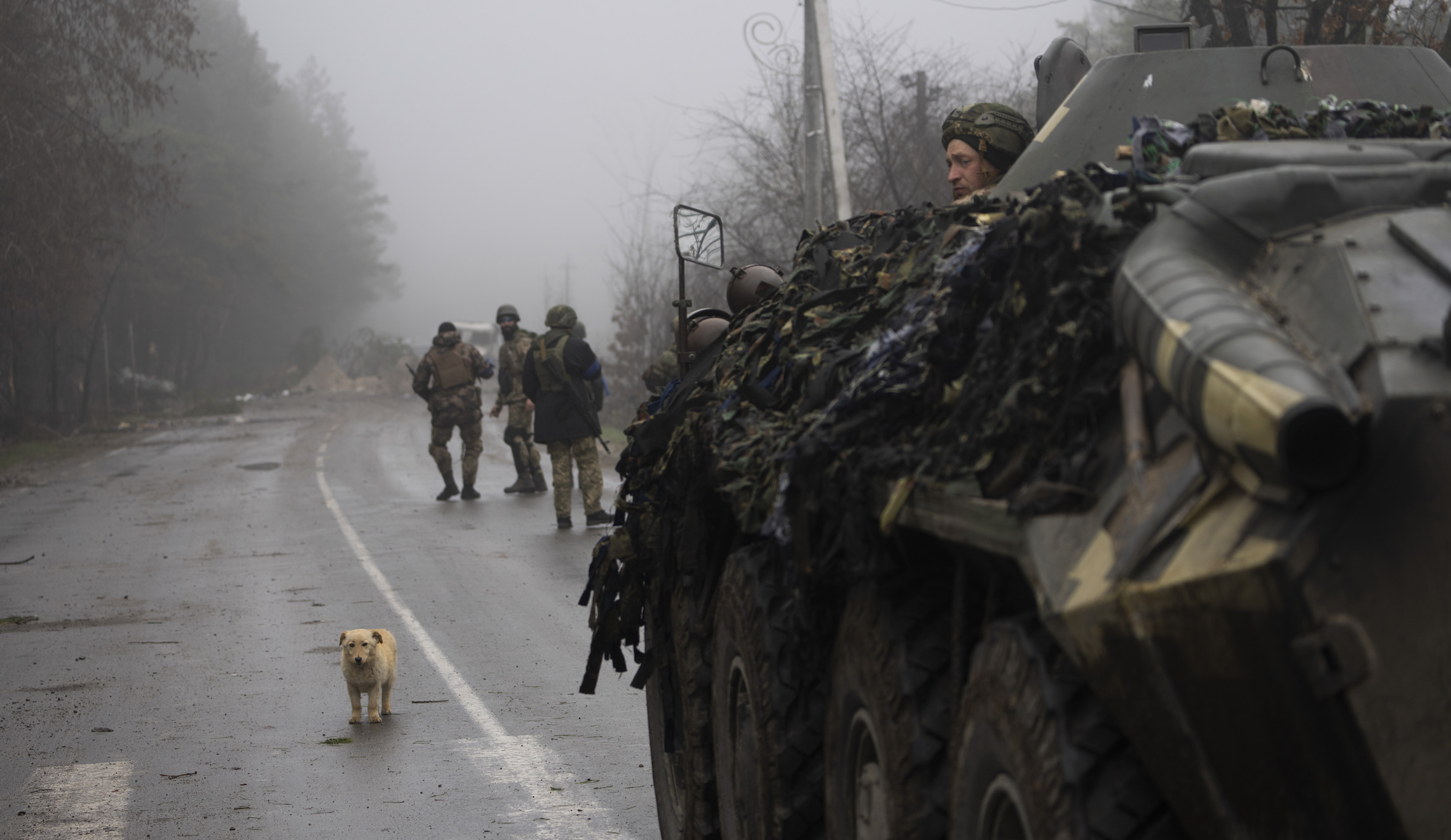
Diminished Russian force will try to carve off eastern Ukraine after setbacks

WARSAW, Poland Russian forces will attempt to “destroy” a huge component of the Ukrainian military in eastern Ukraine over the coming weeks, according to a Ukrainian official, who celebrated the Russian withdrawal from Kyiv but suggested that Moscow still hopes to overthrow Ukrainian President Volodymyr Zelensky.

“Even the negotiations in Turkey, it’s just ridiculous; they’re not going to bring any peace to Ukraine,” Oleksandr Danylyuk, a security adviser to the central government, told the Washington Examiner. “So, they’re looking for an opportunity to just to win some time, to mobilize their resources, to bring more troops, and at least to isolate the Ukrainian formation in Donbas, destroy that formation, and to use that defeat as a trigger for internal destabilization in the capital of Ukraine, which was actually their original plan.”

Danylyuk’s forecast added detail to Zelensky’s latest warning that Russian forces “are moving away from the areas where we are beating them” in order to strengthen their attack on “others that are very important.” Ukrainian and Western officials expect Russia to reinforce their two-pronged assault in eastern Ukraine, as the belligerents scratch for territory ahead of any ceasefire.

“The group of Ukrainian troops in Donbas, it’s about 60,000 troops, maybe a little bit more right now,” Danylyuk said. “So, for sure, they started concentrating most of their military efforts on the isolation of those troops.”

PENTAGON SAYS IT IS UNCLEAR WHETHER RUSSIAN CONVOY TO KYIV STILL EXISTS

That new focus appears to reflect a shift toward the kind of military operation that some Western analysts had expected the Kremlin to initiate, in line with Russian President Vladimir Putin’s late February statement that he would back “the independence and sovereignty of Donetsk People’s Republic and Lugansk People’s Republic” in eastern Ukraine, the Russian name for the entities on the Russian-controlled side of the line of contact that has divided Donbas since the beginning of the war in 2014.

Putin has cited those Russian proxies to deny Russian participation in the conflict since 2014, even though occasional statements from Russian officials confirmed their military presence in Donbas, but Russia didn’t send a large enough force to seize the entire region until the most recent phase of the war. The Russian military difficulties thus far reflect, in part, the consequences of the choice to attack Kyiv from Belarus rather than concentrate on the Donbas campaign, but the next phase of the war could be more advantageous to Russia, as even Zelensky has acknowledged.

“We know that they are moving away from the areas where we are beating them to focus on others that are very important, on those where it can be difficult for us,” the Ukrainian president said. “We all equally want to win. Equally! But there will be battles ahead. We still have a very difficult path to cover to get everything we strive for.”

The fighting over the last month has been a test of two competing wagers, according to Ukrainian and European officials. Russian military leaders hazarded to divide their forces and attack Kyiv as well as Donbas, while Ukrainian officials decided to resist the attacks on all fronts rather than concede territory in some areas in order to strengthen their defenses elsewhere and diminish the risk that their troops in Donbas would be surrounded.

“It was quite bold,” a senior Central European diplomat told the Washington Examiner. “But they managed to fend off the Russians from Kyiv, but at the same kept some positions in Donbas. So [the] Russians still have not accomplished their more moderate objectives.”

The recalibrated offensive likely will attempt to connect two prongs of Russian forces along a north-south line through eastern Ukraine. One line of attack will be anchored from the Russian city of Valuyki, Danylyuk predicted, and continue south through the Ukrainian cities of Izyum and Lozova, toward Polohy. In tandem, Russian forces in southern Ukraine can attempt to strike north through Enerhodar to complete the chain.

“I am pretty skeptical about their ability to achieve their goals right now, especially because they are demoralized and their most capable groups were destroyed in the first weeks,” Danylyuk said. “We will see. Again, I don’t want to be too optimistic because still, it’s a huge army, and they have a lot of military capabilities, and obviously, if it [were] a matter only of the number and quality of the equipment, they would win this fight. But the quality of the soldiers and generals — obviously lower.”

The process of withdrawing from around Kyiv and reinforcing the eastern attack is not a simple one, according to the U.S.-based Institute for the Study of War. “Russian efforts to redeploy damaged units from the Kyiv and Sumy axes to eastern Ukraine are unlikely to enable Russian forces to conduct major gains,” ISW analysts wrote in a March 31 assessment. “These units are likely heavily damaged and demoralized. Feeding damaged Eastern Military District units directly into operations in eastern Ukraine — predominantly conducted by the Southern Military District — will likely prove ineffective and additionally introduce further command-and-control challenges for the Russian military.”

The number of casualties that Russia has sustained over the last several weeks is unclear, but external analysts relying on photos and video from the conflict zone have confirmed that Russia has lost at least 371 tanks, including 151 that were captured by Ukraine. Russian commanders might feel those losses in the weeks ahead, as they target the more “moderate” set of goals that Russian leaders overshot last month.

“I expect that it still is going to be difficult for Russians to achieve their major breakthrough in Donbas,” the senior Central European diplomat said. “The problem is, they are not in the same position as they were in February, where they were more-or-less fresh forces … So, Ukrainians are likely to be able to defend. It’s going to be difficult, but with what they’ve shown so far, if they continue as they were, they may [stave] off the Russians’ Plan B, which is [taking] Donbas.”

The war could be entering a critical phase, if the timetables outlined by Danylyuk are correct. The Ukrainian security official estimated that it would take about two weeks for the Russians to bring all their available forces to bear in eastern Ukraine, while it will be “maybe two months” until Ukrainian reservists are prepared to join the war.

“We will have, like, 500,000 troops in our regular army, which is twice more than we had before the conflict,” Danylyuk said, estimating that Russia would need 2 million-2.5 million troops to overwhelm a force of that size.

Putin can’t order such a mass mobilization, Danylyuk surmised, without undermining state media accounts of the war thus far.

“Russians would need to mobilize a huge number of average Russians, and it will bring that reality to almost every Russian family,” he said. “And it could change their attitudes rapidly.”

CLICK HERE TO READ MORE FROM THE WASHINGTON EXAMINER

That assessment suggests that Russia could have a six-week window to press for a major victory in Ukraine before the reservists enter the fray. After that, the senior Central European diplomat agreed, Ukraine will “be able to saturate the battlefield with highly motivated light infantry with defensive systems.”

Related Content
