

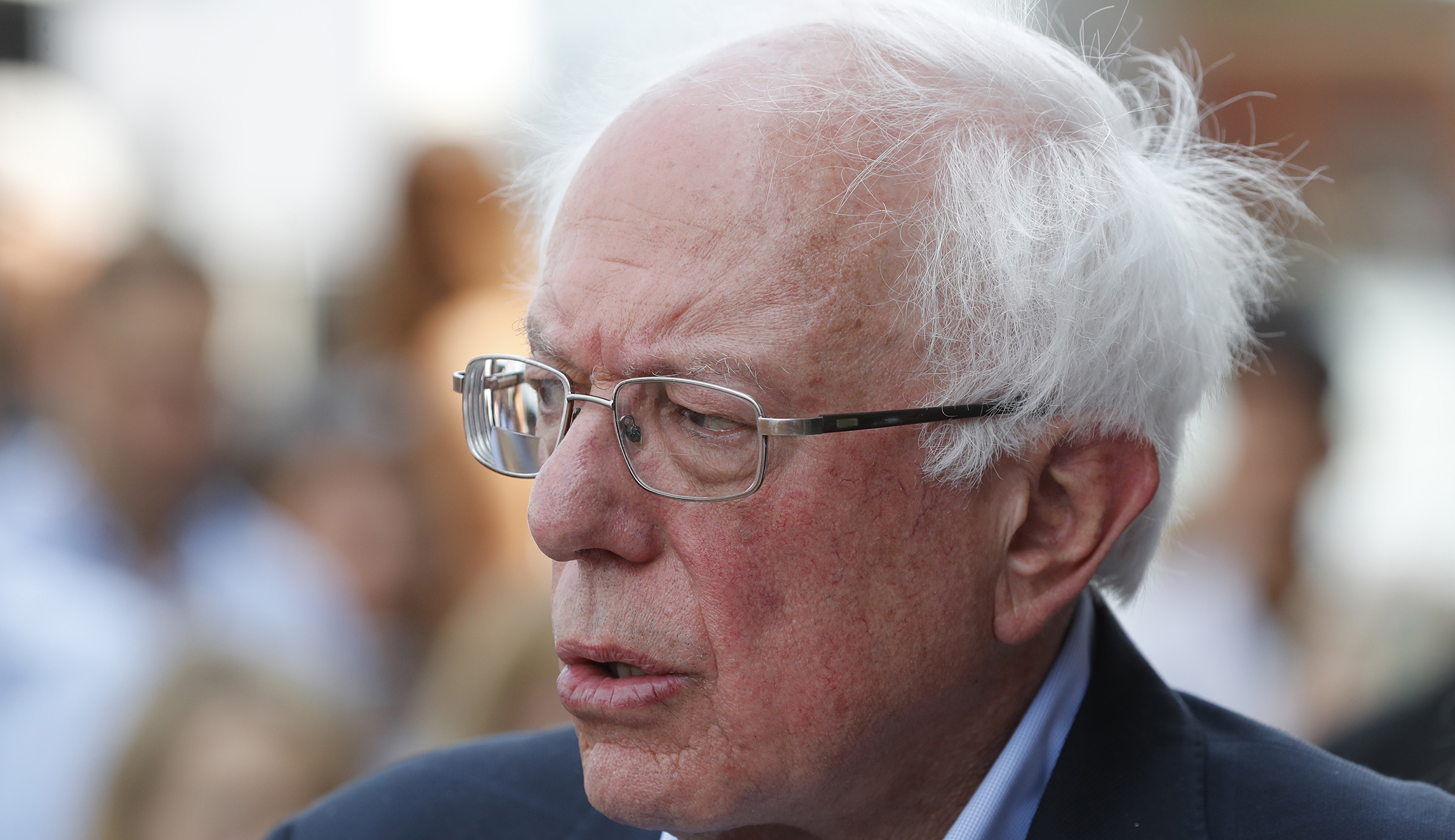
When it comes to how the federal government should financially aid families struggling to get through the coronavirus pandemic, Bernie Sanders is right: The government must do more.
This is not an endorsement of Sanders, his Senate proposal, or socialism. But Sanders does seem to understand that the extreme circumstance we find ourselves in right now must be met with an extreme solution, even if that means breaking with the usual fiscal rules.
Recommended Stories


“In this unprecedented moment in American history, we must act in an unprecedented way, no matter what it costs,” Sanders said during a campaign livestream this weekend. “And that means to guarantee to every man, woman, and child in this country that we will make them whole — that we’re not going to leave them out hanging while they’re losing their homes, getting evicted out of their apartments, and losing their ability to communicate.”
Many Republicans agree with Sanders’s sentiment, which is why they rallied behind Sen. Mitt Romney’s one-time direct cash payments to every American. The White House was reportedly considering adopting Romney’s approach until a few hesitant fiscal hawks convinced the Senate GOP to add means-testing to its $1 trillion stimulus package. Now, under the current proposal, direct cash payments will be phased out according to families’ 2018 tax returns.
Means-testing is problematic for several reasons — the most obvious being that past earnings are not necessarily a good indicator of one’s present financial situation. An auto industry worker who made six figures in 2018 could find himself unemployed for the next several months as the coronavirus forces plants to shut down temporarily. Under these rules, he would get nothing.
The kind of universal relief Romney proposed would make sure that everyone gets help while those who do not need financial aid would be socially encouraged to donate their direct cash payments to philanthropic organizations.
But for Sanders, this isn’t enough.
“I know some of my Republican colleagues have been talking about a one-time $1,000 payment. Really? Well, that will last you for two or three weeks. And what happens after that?” Sanders said.
Sanders’s proposal would have the federal government pick up the tab for people’s healthcare costs throughout the COVID-19 pandemic, and it would ensure that each household receives $2,000 each month until the crisis is resolved.
Sanders’s solution is much more expansive than Romney’s and therefore more problematic. We cannot completely abandon the private sector and expect the federal government to single-handedly sustain the healthcare industry for months on end. This would create a host of bureaucratic requirements that would bog down the industry’s efficiency and undermine the work private companies have done to expedite the testing and treatment of COVID-19.
The government can and should do more to ease health-related financial burdens. But it must do so by working with private health insurers rather than resorting to an emergency “Medicaid for all” program.
Sanders does have a point, however, when it comes to monthly payments. If this shutdown lasts for the next several months, which is what some health officials have predicted, a one-time payment will not be enough. The situation changes rapidly, so we might not need a long-term solution such as the kind Sanders has introduced. But it is time to start thinking about what the government should do if the worst-case scenario becomes reality.
Again, this is not an endorsement of socialism. Universal relief in this circumstance is not a bailout or an act of welfare, as some have claimed but rather an act of social solidarity and a necessary recompense: The government has rightly forced businesses to close, which has inadvertently left thousands unemployed in an attempt to flatten the curve.
These actions were justified, but they will also have consequences, and the government must now work to keep those consequences as small as possible.
