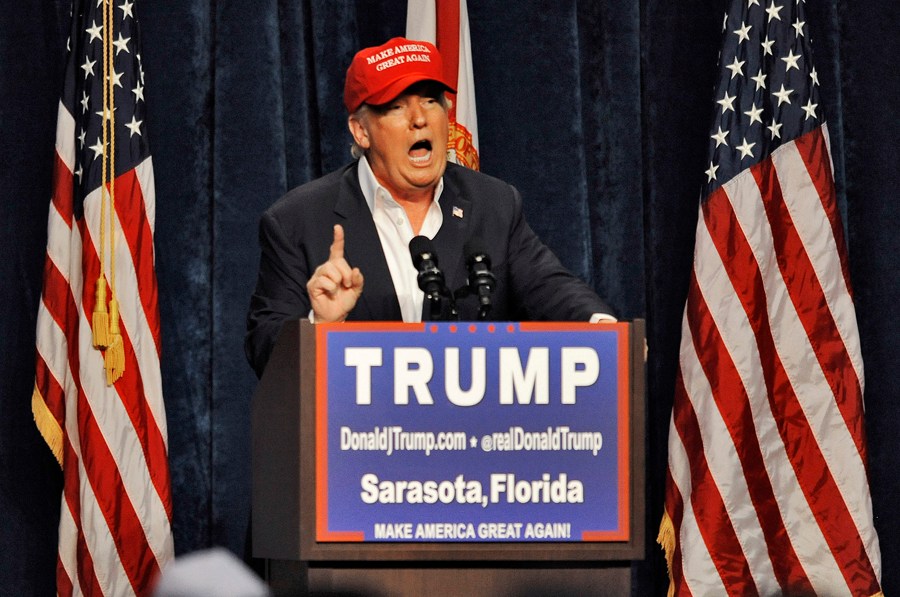
Even if Trump wins both Florida and Ohio, he’ll likely need until June to clinch the nomination, assuming Sen. Ted Cruz remains in the race.
Broadly speaking, the reason is that after March 15, the primary calendar becomes a lot more spread out. In the first two weeks of this month, 24 states will have voted, plus Washington, D.C. But between March 16 and June 6, just 16 states will be voting.
Here’s how that works out math wise. Let’s just say that Trump grabs the winner-take-all prizes in Ohio and Florida. And let’s just say he performs in the other places voting this Saturday (D.C. and Guam) and March 15 (Illinois, Missouri, North Carolina, and Northern Marianas) as he has in the other contests at this point, carrying 42 percent of all other delegates. In fact, let’s say he does a lot better, and carries 50 percent of delegates in those other contests.
In such a scenario, Trump would come out of next Tuesday still needing 499 delegates. But here’s the thing — before Indiana votes on May 3, there would only be a total of 490 delegates up for grabs. In other words, if Trump wins 100 percent of delegates, he still couldn’t mathematically clinch the nomination before May 3.
Assuming that doesn’t happen, for him to clinch the 1,237 delegates needed to win the nomination outright before June 7, he’d have to snatch 72 percent of delegates between March 16 and then. Whether the field remains divided, or Cruz is the only one left standing, Trump is unlikely to pull this off.
Here’s another thing to keep in mind. One of the biggest obstacles facing opponents of Trump has been time. It’s been difficult to sustain attacks with the primaries so scrunched together and so many candidates in the field. But with months to work, and Trump consistently under fire from all corners, it will be harder for Trump to wrap things up.
On June 7, there are five primaries with a combined 303 delegates up for grabs. Without any reliable polling at this point, Trump would have to be considered the early favorite in New Jersey, which is a large winner-take-all state with 51 delegates. But, given the relative weakness Trump has shown in the interior west and Midwest, Cruz would seem to be in a position to win the other winner-take-all states of Montana and South Dakota, which combine for 56 delegates. That leaves the proportional state of New Mexico (with 24 delegates) and the big prize of California, with 172 delegates. The nation’s largest state has 13 delegates that automatically go to the winner, and then 159 delegates that are winner-take-all in each of California’s 53 Congressional districts.
That means that political junkies may have to wait until the wee hours of June 8 east coast time to find out whether Trump has collected enough delegates to win the nomination outright.