
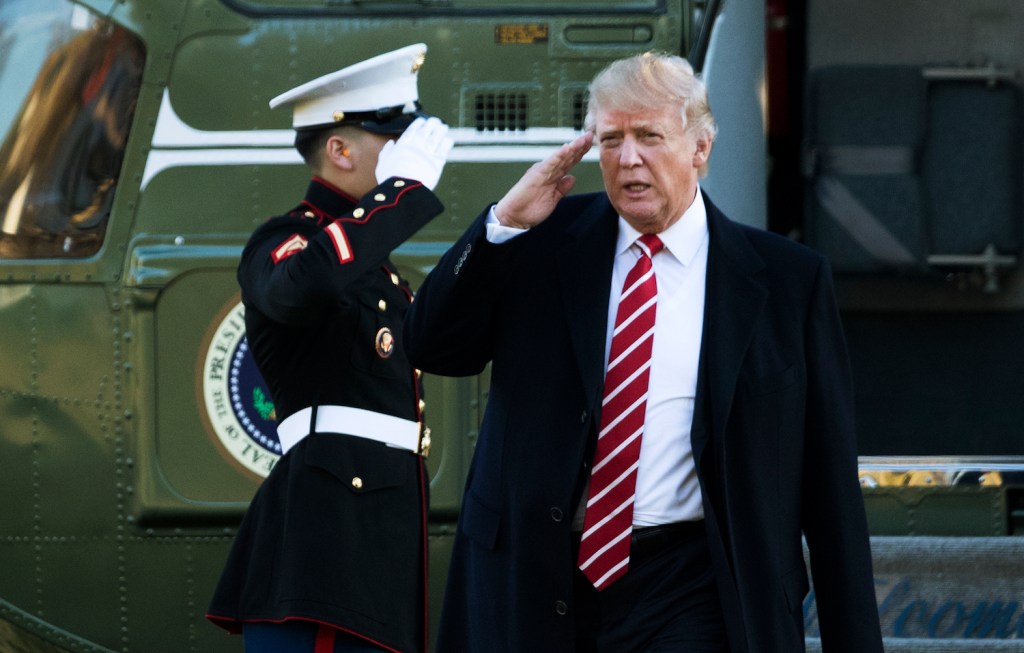
When prodded last weekend by Bill O’Reilly about Vladimir Putin being a “killer,” President Trump demurred, saying, “There are a lot of killers. You think our country’s so innocent?”
It’s the kind of relativist retort familiar to alumni of too many public high schools, readers of The Nation, and students at most universities.
Real journalism.Trusted by millions.
Unlimited access to in-depth reporting, expert analysis, and the stories that shape our country.
Already a member? Log in
Trump’s words also rang a bell for those of us who wince at the recollection of President Barack Obama’s world tour apologizing for America and the Christian West.
The former president confessed to Europe on his countrymen’s behalf in 2009 that “there have been times where America has shown arrogance and been dismissive, even derisive.”
At about the same time, in the Caribbean, Obama said, “I know that promises of partnership have gone unfulfilled in the past. We have at times been disengaged, and at times we sought to dictate our terms.”
And so he went on (and on) around the globe, talking to Turkey about “darker periods in our history,” and explaining in a 2009 op-ed that “the United States has not pursued and sustained engagement with our neighbors.” The op-ed ran in English, Spanish and Portuguese in domestic and foreign newspapers.
All this would have been acceptable, if unpleasant, if Obama had been a pundit rather than the president. But he was president, and presidents need to accept certain constraints, one of which is always to take America’s side. It’s part of the job description. Obama gave the distinct impression that he was the first president of this nation not reflexively pro-American, as he should have been.
Perhaps his most extraordinary moment of moral relativism came in 2015 after Islamic State jihadis burned a Jordanian pilot alive and put the video online to disgust the world. Obama instead, however, used the occasion of the National Prayer Breakfast to warn those at the gathering who might be indignant at this barbarism: “Lest we get on our high horse and think this is unique to some other place, remember that during the Crusades and the Inquisition, people committed terrible deeds in the name of Christ.”
And so it is worth returning to Trump’s line on “killer” America. His words minimized, almost excused, the Russian president’s murder of political opponents and critical journalists. It’s the same grotesque false equivalence that the Left peddled during the Cold War.
Trump’s inauguration speech, in which he repeated and hammered home his message that he would put “America First,” makes it plain enough that the new president is not anti-American, as does so much of what he has said during the past 20 months. But his suggestion of moral equivalence between the United States and Putin’s Russia throws his own country under the bus.
Trump is a Twitter gadfly, a tabloid fixture, a reality television star — an entertainer. But now he is president, and it is important for him to grasp that his latest job is not just one among many, but is by far the greatest of them, and requires him to behave in ways that the others do not.
He understands that Americans want a president who puts America first. He is right to do so despite the revulsion of the chattering classes. When you’re president, it is your job to put America first. And that is what he should have done in answering the question about Putin.
Whatever reasons he has for wishing to make nice with Putin — one can imagine a wide range of possibilities from the strategic to the venal, legitimate to alarming — Trump should not use America as a foil against which to burnish the reputation of another country.
The U.S. is the most successful, most inspiring, most moral country in the world. It has flaws, and in “America the Beautiful,” one of the nation’s favorite songs, we acknowledge that, asking God to “mend [our] every flaw.”
But cringing self-criticism of the Obama type is obnoxious in a president, and Trump should not stoop to that level again.