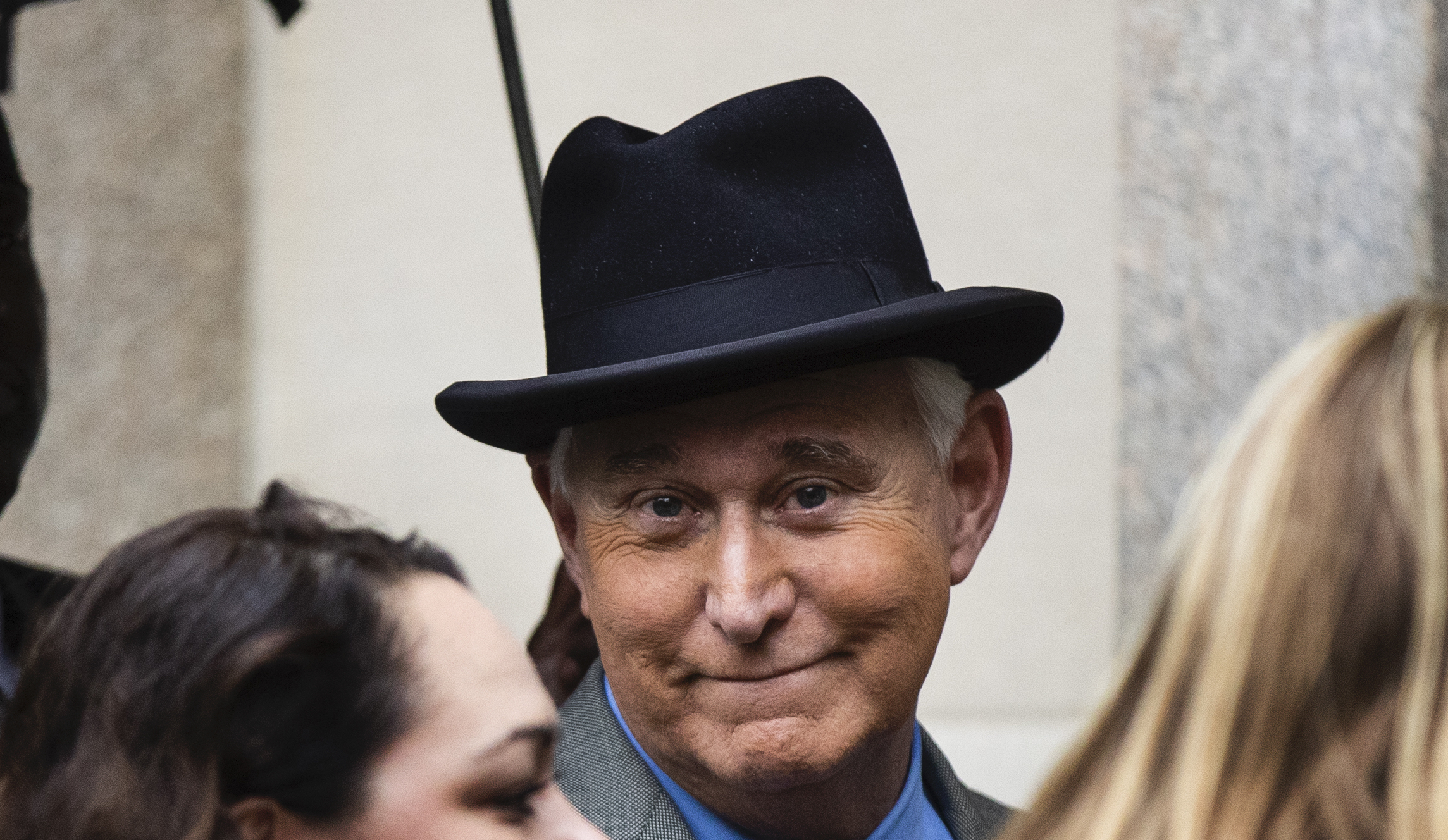
Roger Stone, the flamboyant “dirty trickster” and Republican operative, will not take the stand to defend himself against the Justice Department’s allegations he made false statements and obstructed justice concerning his interactions with WikiLeaks.
Stone’s defense team will instead play for the D.C. jury an hourlong portion of the testimony he gave in front of the House Intelligence Committee in September 2017 — testimony that led to his trial.
Prosecutors say Stone tried to contact Julian Assange by using conspiracy theorist Jerome Corsi and radio host Randy Credico as conduits but misled Congress in 2017 by telling the committee he’d only reached out to WikiLeaks through Credico.
According to the DOJ, Stone then worked to stop Credico from testifying to the House, including by calling him a “rat” and a “stoolie” and telling him to “practice your Frank Pentangeli,” a reference to a character in The Godfather: Part II who perjures himself to protect the Corleone crime family in front of a Senate committee.
The jury heard testimony from Rick Gates, former deputy campaign manager for President Trump and long-time business partner of Trump’s campaign chairman Paul Manafort, earlier Tuesday after witnesses including former FBI agent Michelle Taylor, Credico, one-time WikiLeaks lawyer Margaret Ratner Kunstler, and former Trump campaign manager Steve Bannon testified last week.
[Read: Rick Gates: Roger Stone told campaign and Trump himself about WikiLeaks disclosures]
Stone, who has a decades-long history of dramatic performances and bold pronouncements, will be conspicuously silent after deciding not to testify in the legal proceedings whose expected circus-like atmosphere never really materialized over the past week.
Stone, the on-again-off-again political ally and confidant of Trump for more than three decades, who by the summer of 2016 was an informal adviser with Trump’s campaign, attempted to reach out to Assange, who was suspected of having tens of thousands of stolen Democratic emails. Stone also communicated with the hacker Guccifer 2.0, a fictitious persona created by Russian intelligence that dealt with some of the purloined records. The U.S. intelligence community and special counsel Robert Mueller concluded that Russia hacked the Democratic emails and provided them to WikiLeaks.
The DOJ argued that Stone lied to Congress “because the truth looked bad — it looked bad to the Trump campaign, and it looked bad to Donald Trump.” Stone’s lawyers countered that Stone didn’t purposely mislead the congressional committee, claiming that the investigation’s publicly-stated scope “was about what Russia was doing — not about what WikiLeaks was doing.”
Judge Amy Berman Jackson, who has been presiding over the Stone case, poured some cold water over the defense team’s argument on Tuesday, stating that she believed an investigation into “Russian active measures” related to the hacking and dissemination of the Democratic emails would likely “include how it got public” through WikiLeaks.
