
Most experts believe the 2010 elections will mark the first time in three cycles that Democrats will not pick up more than a dozen House seats — a stratospheric political run.
Rep. Chris Van Hollen, who is in his second two-year stint leading the Democratic Congressional Campaign Committee, is charged with making the fall to Earth as soft as possible.
Recommended Stories

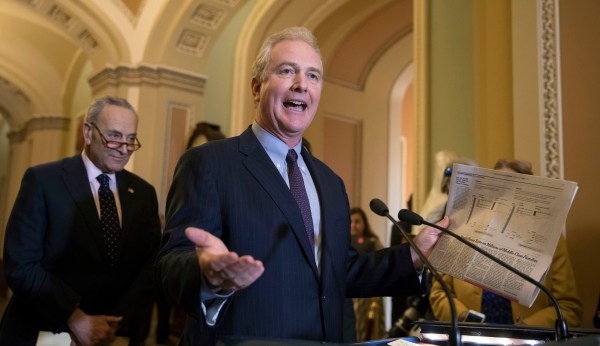

His job is to stave off the midterm election losses that historically have befallen majority parties with a first-term president of the same party.
In 1994, the first midterm election after President Bill Clinton was elected, resulted in devastating losses that handed the House majority to the Republicans for the first time in four decades.
Van Hollen, who led the DCCC’s effort that added 18 Democratic seats last year, said he has no intention of seeing 1994-scale losses in 2010, and most experts agree.
“This is not 2006 or 2008, so he can’t assume the same level of success, and anyone who thinks he has a three-peat, that’s not reasonable,” said Stuart Rothenberg, who publishes the Rothenberg Political Report. “But the DCCC is going to exit this cycle still having a big majority in the House.”
The DCCC lists 39 members as part of its “Frontline” program to help the most vulnerable Democrats get re-elected, but political experts such as Rothenberg list only about six true toss-up Democratic seats, two of them currently vacant.
Van Hollen has already dodged one problem: the difficulty of raising money in a tough economy and with donors tapped out from costly 2008 contests.
The DCCC announced Monday $17.2 million in fundraising for the first quarter of the year, compared with $12.5 million for the same period in 2005. The competing National Republican Campaign Committee, meanwhile, announced just less than $9 million in fundraising compared with $19.8 million in 2005.
But Van Hollen is facing disgruntled liberal groups that are targeting moderate Democrats in primary elections. Van Hollen recently warned the groups to “beware of forming a circular firing squad.”
The NRCC is watching with renewed optimism.
“[Democrats’] entire playbook for the last two election cycles consisted of running against the Republicans,” NRCC spokesman Ken Spain said. “Now they have to govern, and that is a much tougher task. It appears at this time that we are headed toward an economic election, and ultimately this race will be a referendum on President Obama and his handling of the economy.”