

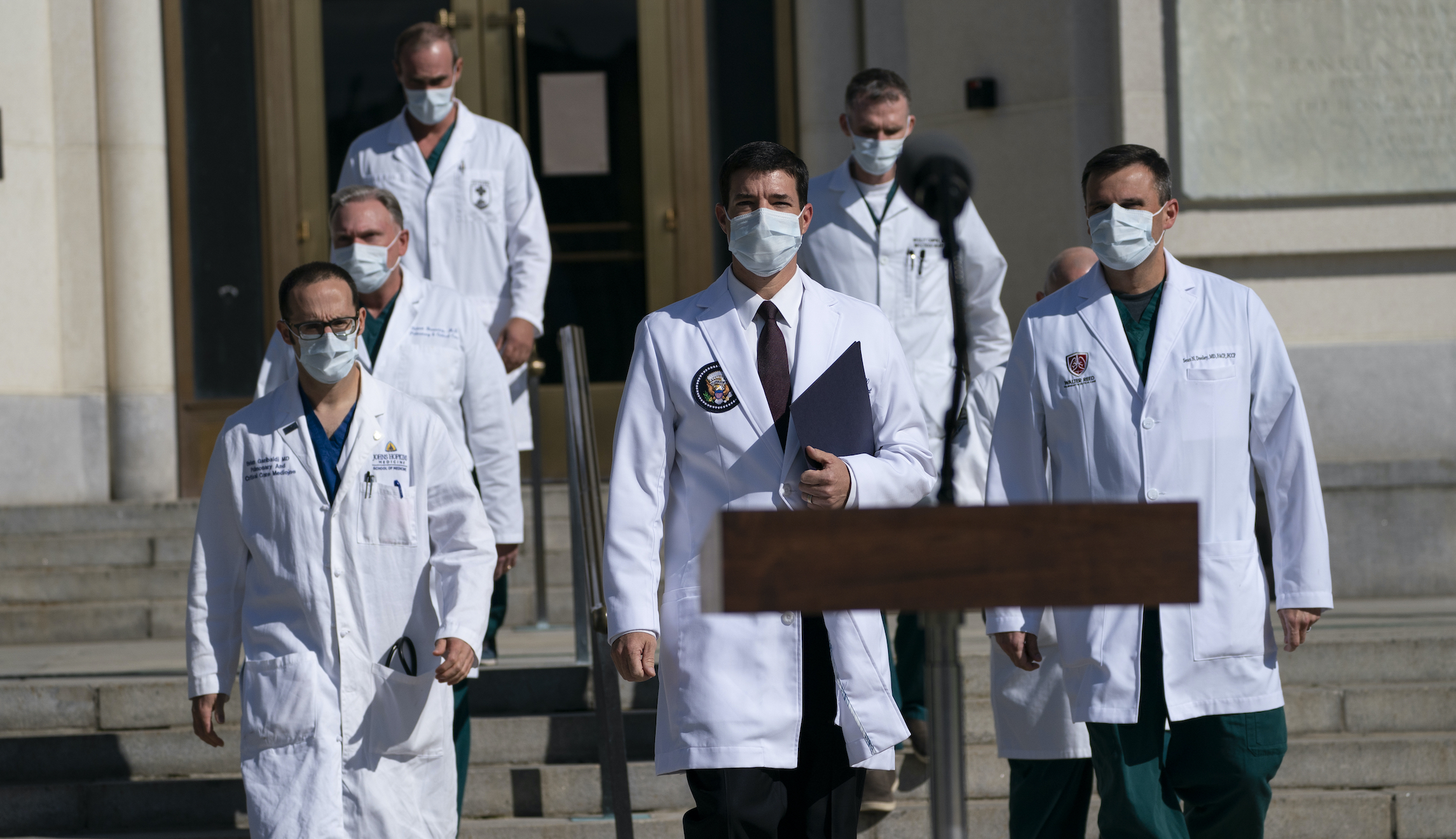
President Trump left Walter Reed National Military Medical Center Monday evening, where he was recovering from COVID-19, seeking to project stability amid a COVID-19 outbreak in his close circle. He is supposed to spend the remainder of his recovery at the White House.
When Trump announced earlier in the day that he would be leaving the hospital, he exhorted the nation to not live in fear of COVID-19. “Feeling really good!” he tweeted. “Don’t be afraid of Covid. Don’t let it dominate your life. … I feel better than I did 20 years ago!”
Recommended Stories


White House physician Sean Conley said he supported Trump’s plan to depart Walter Reed on Monday evening, “Though he may not entirely be out of the woods yet.”
“The team and I agree that all our evaluations, and, most importantly, his clinical status, support the president’s safe return home, where he’ll be surrounded by world-class medical care 24/7,” Conley said at a press conference Monday afternoon.
Trump’s doctors declined to share any information about the president’s lung health and the last time he tested negative for the coronavirus. They did say, however, that Trump received a third dose of the antiviral drug remdesivir and that he has continued to take dexamethasone, a steroid that has been shown to be beneficial to very sick COVID-19 patients.
A rapidly growing number of Trump’s aides and allies have tested positive for the coronavirus in the past week, including Trump campaign manager Bill Stepien, Sens. Mike Lee and Thom Tillis, who both attended last week’s Rose Garden ceremony, Republican National Committee Chairwoman Ronna McDaniel, Trump body man Nick Luna, and former New Jersey Gov. Chris Christie, who attended the Rose Garden ceremony and later helped Trump prepare for the first presidential debate.
The outbreak in the White House is ongoing. Press secretary Kayleigh McEnany tested positive for the coronavirus Monday. Two of McEnany’s deputies also tested positive for the virus.
Sen. Ron Johnson, who has also tested positive, said that he will go to the Senate “in a moon suit” to vote for Supreme Court nominee Judge Amy Coney Barrett.
Meanwhile, Joe Biden is headed to a campaign event in Florida, where he leads Trump by 1 percentage point and 9 percentage points naturally, according to Washington Post polling.
To date, nearly 7.5 million coronavirus infections and more than 210,000 deaths have been confirmed in the United States.
A new CNN/SRSS poll finds that 63% of respondents believe Trump behaved irresponsibly in handling the risk of coronavirus infection to the people who have been around him recently. One-third said he acted responsibly. Only 40% of respondents approve of his job performance, while 57% disapprove. Nevertheless, nearly 6 in 10 respondents say the remaining presidential debates should be held as scheduled, compared to 36% who say they should not.
The Centers for Disease Control and Prevention now says the novel coronavirus can be spread between people beyond 6 feet of distance under certain conditions.
Monday’s updated guidance is the latest in a series of frequent changes to COVID-19 guidelines. About three weeks ago, the CDC posted guidance that the virus could spread through “respiratory droplets or small particles, such as those in aerosols.” The CDC removed that guidance just days later on Sept. 21, saying it had been “posted in error.”
The updated guidelines posted Monday say, “There is evidence that under certain conditions, people with COVID-19 seem to have infected others who were more than 6 feet away.” The CDC also stresses that tiny particles hanging in the air are not the main way the coronavirus is known to spread.
Cineworld, the parent company of Regal Cinemas, will be “temporarily suspending operations” at all of its 536 Regal theaters in the country as of Thursday.
“This is not a decision we made lightly, and we did everything in our power to support a safe and sustainable reopening in the U.S.,” said Cineworld CEO Mooky Greidinger. The announcement compounds troubles for an already strained industry that has struggled to recover from the coronavirus — in some cities, movie theaters were prevented from opening until as late as September.
New York Gov. Andrew Cuomo shut down Mayor Bill de Blasio’s plan to close nonessential businesses in some New York City neighborhoods.
De Blasio had recommended reclosing businesses to address COVID-19 “hot-spot clusters” in Queens and Brooklyn. Cuomo refused to let the mayor go forward with that plan, and he also closed schools in NYC one day sooner than de Blasio had recommended.
“The state is going to take over the enforcement oversight and all the hot-spot clusters, OK? Local governments will need to provide us with personnel, but the state will take over the enforcement,” Cuomo said during a press conference on Monday.
De Blasio, however, promised to push ahead with his plan to shutter businesses in hot spots on Wednesday. He said during a press conference on Monday that Cuomo can modify his plan but that the city would not wait for his decision.
French authorities closed bars and banned festive gatherings in the Paris region in response to rising coronavirus cases. Restaurants, however, remain open.
An average of 3,500 new cases of COVID-19 is confirmed daily in the Paris region, said the director of the Regional Health Authority, Aurelien Rousseau. Additionally, 36% of ICU beds in the area are occupied by COVID-19 patients.
The United Kingdom’s Public Health England reported on Sunday that nearly 16,000 cases of COVID-19 went unreported after a technical error.
“A technical issue was identified overnight on Friday 2 October in the data load process that transfers COVID-19 positive lab results into reporting dashboards,” said PHE interim Chief Executive Michael Brodie.
The numbers were added to Saturday’s and Sunday’s numbers, and PHE said the issue has been resolved. Despite not being a part of the daily statistics, PHE confirmed that everyone who tested positive was still notified in the standard time frame.
