

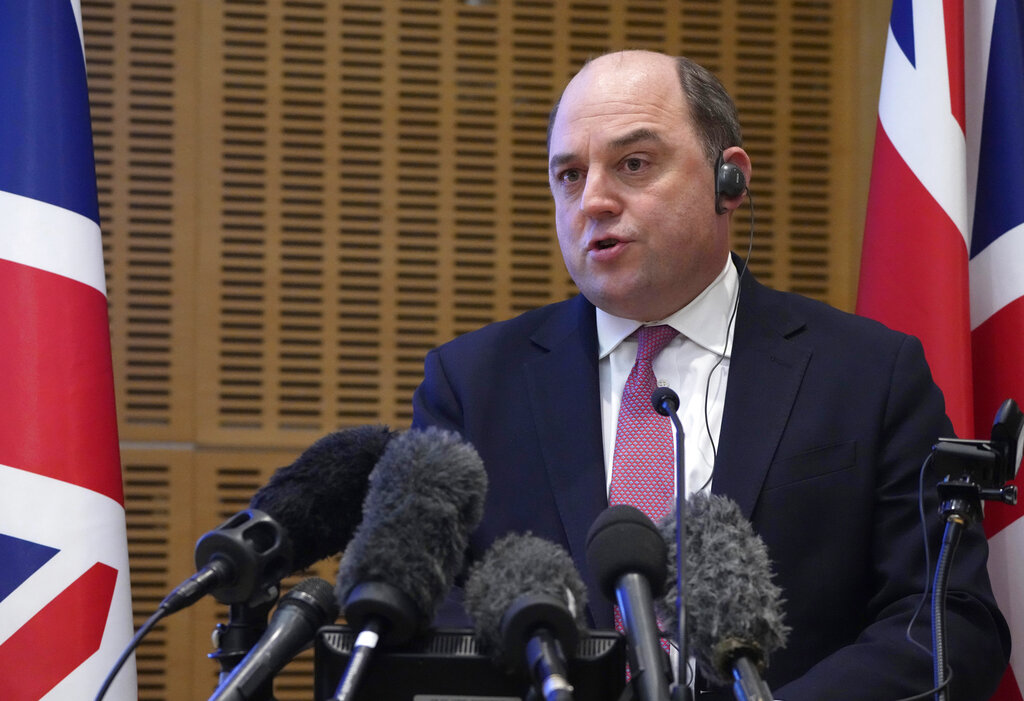
A top British official signaled an interest in intervening in the war in Ukraine as Western officials deplored Russian President Vladimir Putin’s “barbarian way of doing war,” while NATO leaders nonetheless maintained that the alliance must not fight Russia in Ukraine.
“We have to be very, very strong as an international community to remind the president that we are as NATO, 30 nations with huge amounts of capability, both conventional and we are a nuclear alliance,” British Defense Secretary Ben Wallace told reporters on Friday during a joint press conference with Danish and Swedish officials. “It is very, very important he understands that … he does, then also our friends who are not in NATO and we will also make sure we stand shoulder to shoulder with them.”
Recommended Stories


Putin’s nuclear saber-rattling has made explicit the risks of any intervention, and NATO leaders have emphasized their unwillingness to risk a direct conflict with Russian forces. Wallace aired that warning apropos of a condemnation of Russian attacks on civilian targets in Ukraine in an implicit indication that NATO power could provide security beyond NATO territory.
“It’s very clear that in our dealings with Mr. Putin, we are very much self-deterred, and we are self-deterred by his nuclear saber-rattling,” retired U.S. Air Force Gen. Philip Breedlove, who served as NATO’s supreme allied commander when Putin first seized Ukrainian territory in 2014, told the Washington Examiner in response to Wallace’s comments. “And it appears to me that our U.K. friends and decision-makers are beginning to look at maybe not being self-deterred. And I applaud their considering these matters, frankly.”
HEARTBREAKING IMAGE SHOWS UKRAINIAN FATHER MOURNING SON SHELLED WHILE PLAYING SOCCER
Yet Wallace’s statements do not reflect a change in the broader NATO alliance’s unwillingness to join the war in Ukraine, which is not a member of the security bloc and thus cannot invoke the collective defense provision that requires the allies to treat an attack on one as an attack on all.
“We will not be part of the conflict,” NATO Secretary-General Jens Stoltenberg told reporters Friday, following a meeting of the top diplomats of the trans-Atlantic alliance. “And that is the NATO position. And I conveyed that message because I strongly believe that if NATO becomes directly involved in the conflict will see more human suffering, more civilians killed.”
Ukrainian officials have accused Russia of using a thermobaric “vacuum bomb,” although U.S. officials have said they can only confirm that Russian “cluster munitions and vacuum bombs” have been deployed into Ukraine. Those reports have emerged alongside a multiplicity of footage on social media that shows the bombardment of civilian targets in cities around Ukraine, which has stoked outrage among Western officials.
“The Russians are bombing and shelling everything — hospitals, houses, schools, a lot of civilian casualties. This is a barbarian way of doing war,” European Union High Representative Josep Borrell told reporters Friday, following a meeting with Secretary of State Antony Blinken. “This is Putin’s war, and Putin has to stop this war.”
Putin has blamed the civilian casualties on the Ukrainian defenders, whom he portrays as neo-Nazis hiding behind human shields. Breedlove, observing the footage and reports emerging from Ukraine, argued that Putin is shifting toward the tactics that Russian forces used in the destruction of Grozny during Russia’s Second Chechen War and the razing of Aleppo on behalf of Syrian dictator Bashar Assad.
“His military operation has frustrated him so badly that he is now resorting to the Chechnyan Grozny, Eastern Syria style of fighting,” Breedlove told the Washington Examiner. “His actions, as it goes to these banned weapons, is criminal, and he should be brought up criminally for what he is doing, especially indiscriminately to the civilian populace.”
Blinken, who declared that Western governments are “committed to doing everything we can” during his appearance with Borrell, also emphasized that NATO must not risk the costs of a direct conflict with Russian forces over Ukraine.
“Ours is a defensive alliance,” he said in Brussels. “We seek no conflict. But if conflict comes to us, we are ready for it, and we will defend every inch of NATO territory.”
NATO is a consensus-driven organization, meaning that the decisions taken by the alliance must be adopted unanimously. While the newer members of the alliance, which gained their freedom following the collapse of the Soviet Union, tend to push for more hawkish policies regarding Russia and in support of Ukraine, even the eastern flank countries have signaled their opposition to any direct intervention in the war.
“I believe that all encouragements for NATO to get involved into the military conflict now are irresponsible,” Lithuanian Prime Minister Ingrida Simonyte said Friday.
CLICK HERE TO READ MORE FROM THE WASHINGTON EXAMINER
Wallace, the British defense chief, emphasized that Russian military attacks to seize control of Ukrainian nuclear facilities court a disaster for NATO allies.
“We call upon the Russian president to absolutely cease attacking sites such as that,” he said. “It’s incredibly dangerous. It’s not just dangerous for Ukraine and the Russians: It is dangerous for Europe. It is playing with fire.”
