

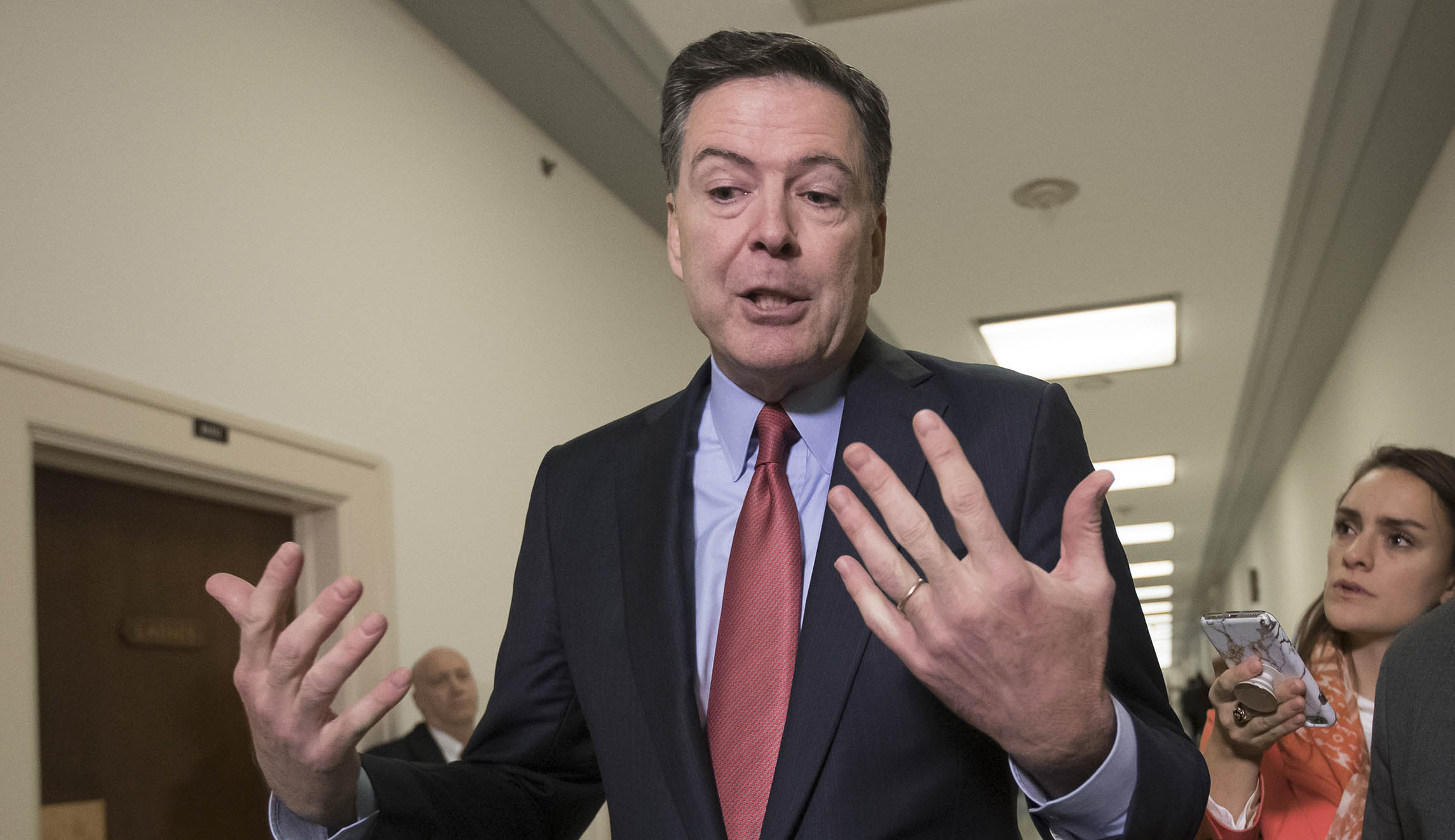
The Justice Department’s watchdog condemned fired FBI Director James Comey’s decision to leak contents from his memos to “force” the appointment of a special counsel, saying his scheme violated FBI rules.
The new 83-page report from DOJ Inspector General Michael Horowitz, which focused on Comey’s mishandling of the memos he made of conversations he had with President Trump in early 2017, harshly criticized Comey’s decision to remove those memos from the FBI after he was fired and to provide some contents to a friend to leak to the media. Comey testified to Congress in 2017 that he hoped leaking this information “might prompt the appointment of a special counsel.”
Recommended Stories


Comey explained to the inspector general that his desire for a special counsel stemmed from Trump tweeting that “Comey better hope that there are no ‘tapes’ of our conversation before leaking to the press!” And the former FBI chief told Horowitz that he hoped media reports about his memos would “force DOJ likely to appoint a Special Counsel to go get the tapes.”
But Horowitz said this reasoning by Comey violated the FBI’s guidelines, making it clear that it was unacceptable for Comey to use official FBI documents to take matters into his own hands or to advance his own goals, such as sparking investigations or vindicating himself in the press.
“Comey had several other lawful options available to him to advocate for the appointment of a special counsel, which he told us was his goal in making the disclosure,” Horowitz wrote. “What was not permitted was the unauthorized disclosure of sensitive investigative information, obtained during the course of FBI employment, in order to achieve a personally desired outcome.”
Comey began memorializing his conversations with Trump after their first one-on-one meeting in early January 2017 at Trump Tower in New York City, where Comey told Trump about some of the “salacious” information contained in the dossier compiled by British ex-spy Christopher Steele at the behest of the opposition research firm Fusion GPS, which was hired by the Clinton campaign in 2016. Comey created seven “Comey Memos” in all, spanning from Jan. 7, 2017, to April 11, 2017.
Comey was fired by Trump on May 9, 2017.
Two days after Comey’s firing, the New York Times published an article, titled “In a Private Dinner, Trump Demanded Loyalty. Comey Demurred,” which described information contained in Comey’s second memo related to a Jan. 27, 2017, one-on-one dinner between Comey and Trump at the White House. That article was based on two sources: One was Comey’s friend and attorney, Daniel Richman, and the other is yet unknown. This article was the basis of Trump’s “tapes” tweet the next day, on May 12, 2017.
Comey told Horowitz’s investigators that on May 16, 2017, he awoke in the middle of the night as if “struck by a lightning bolt” after realizing that if Trump had tapes of their conversations, then Comey’s version of events could be corroborated. Comey said he realized he could “actually do something” to make sure Trump didn’t destroy the alleged tapes and to ensure the tapes made their way to the Justice Department and to the public. That “something” was the leaking of information from his fourth memo to “change the game” and create “extraordinary pressure on the leadership” at the Justice Department, who Comey said he didn’t have faith in, to “appoint someone who the country can trust to go and get those tapes.”
Comey told Richman “to share the content[s] of this memo, but not the memo itself” with the New York Times, resulting in an article published that day titled, “Comey Memo Says Trump Asked Him to End Flynn Investigation.”
Deputy Attorney General Rod Rosenstein caved and appointed Robert Mueller as special counsel the next day, on May 17, 2017. Comey then provided copies of his second, fourth, sixth, and seventh memos to Mueller on June 7, 2017. Ongoing litigation has revealed the extent to which Comey’s memos were used during Mueller’s investigation, which lasted nearly two years, to look into connections between the Trump campaign and the Russian government.
Horowitz concluded Comey’s leaks were “an attempt to force the Department to take official investigative actions — to appoint a Special Counsel and preserve any tapes as evidence.” Comey defended himself to the inspector general by claiming this was “something I [had] to do if I love this country … and I love the Department of Justice, and I love the FBI.”
“However, were current or former FBI employees to follow the former Director’s example and disclose sensitive information in service of their own strongly held personal convictions, the FBI would be unable to dispatch its law enforcement duties properly,” the DOJ inspector general concluded.
The Justice Department declined to prosecute Comey.
