

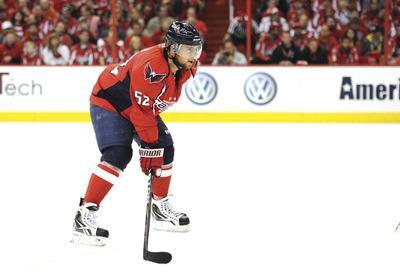
Defenseman trying to shed offensive-minded reputation Capitals defenseman Mike Green knows the reputation he still holds among some fans, media and even a few of his fellow players in the NHL: A breathtaking offensive talent, but one who too often early in his career focused on scoring goals rather than defending his own side of the blueline.
“I was on the same pace as always [last season] until I got injured,” said Green, who was limited to 49 games in the 2010-11 season because of a pair of head injuries and a shoulder injury. “If you knew the game, if you understood players and how the game works, you would understand my game better. But they don’t have a clue what they’re talking about.”
Recommended Stories


His own teammates and coaches understand why Green bristles. That reputation was reportedly part of the reason he was one of the last players left off the final roster for Canada’s 2010 Winter Olympic team, which eventually won the gold medal in Vancouver. That team didn’t need a power-play specialist. But after last season’s improvement in his own end, Green thinks of himself as far more than that — and has for a while.
| The Green file |
| » Green is a two-time member of the NHL First All-Star team and a two-time Norris Trophy runner-up for the NHL’s best defenseman. |
| » He is one of only two active NHL defensemen with a 70-point season on his resume. The other is perennial Norris Trophy winner Nicklas Lidstrom of the Detroit Red Wings. |
| » |
| The 6-foot-1, 207-pounder is a native of Calgary, Alberta. He was Washington’s first-round choice in the 2004 NHL entry draft, No. 29 overall. |
“Mike takes a lot of pride in it. He just doesn’t say anything about it, and he doesn’t get a lot of credit for it,” said Washington coach Bruce Boudreau, who has coached Green since their first year together at AHL Hershey in 2005-06.
Some around the NHL are starting to take notice. And the numbers — at least last season — do back up Boudreau, Green and Caps general manager George McPhee. For every 60 minutes Green was on the ice at even strength in 2010-11, the Caps allowed just 2.11 goals per game. That was a career-low and ranked third on the team among defensemen behind John Carlson (1.93) and Karl Alzner (1.90) and 51st overall among all NHL defensemen who played at least 40 games.
It was also a big step up from Green’s 2.37 goals against per 60 minutes in 2009-10. He did put up a 2.21 goals against per 60 minutes in 2008-09. That was the same season he scored 31 goals, the first time an NHL defenseman had done that since Washington’s Kevin Hatcher had 34 in 1992-93. But those exploits have long overshadowed his step forward defensively.
“We talked about it a lot last year during our coverage on NBC and Versus. That I felt anyways, until Mike Green got banged up, that I didn’t see a defenseman that improved more defensively in the entire National Hockey League,” NBC/Versus analyst Eddie Olczyk said. “Yes, his points suffered by it severely. But he became a better defensive defenseman, and I think he committed to being that way.”
And that’s the rub. Boudreau has long lamented Green’s propensity to put himself in difficult positions on the ice.
He suffered a shoulder injury in 2008 when then Anaheim Ducks defenseman Chris Pronger plastered him against the boards in an early season game at the Honda Center. Green missed two games with a shoulder injury again early last season, took a puck off the side of the head Feb. 6 vs. Pittsburgh and lasted two shifts into his return on Feb. 25 when New York Rangers forward Derek Stepan caught him with a shoulder to the jaw. He didn’t return until the Stanley Cup playoffs, where a hip flexor kept him out of the lineup for Washington’s final game of the season in the second round.
But — as unlucky as those two head injuries were — if Green wants to put together a perfect blend of two-way play and put himself back in the conversation for a Norris Trophy, he needs to stay in the lineup. He has twice finished runner-up thanks mostly to his offensive dominance in 2008-09 and 2009-10 when he posted 76 and 73 points respectively. Only two NHL defensemen in those years even managed to top 60 points.
“I think he’s much-maligned about it, and I’m glad somebody took notice and gave Mike some kudos for it,” Boudreau said. “We were in the top five defensive teams in the league, and I’m pretty sure we were No. 1 from the middle of December on. So when that happens you have to have defensemen playing pretty solid [with] Mike being the guy [who] played the most minutes.”
