
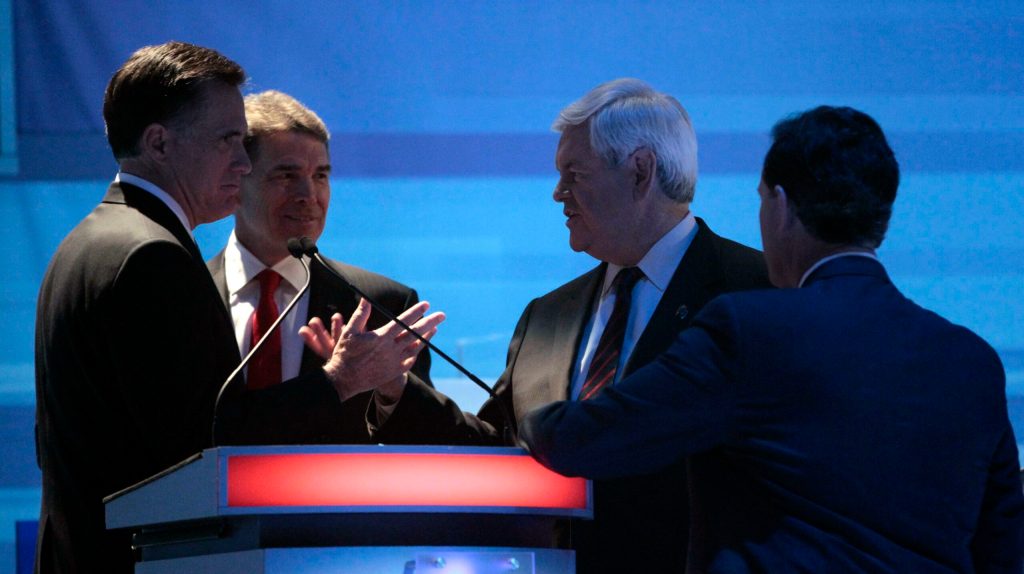
Will frontrunner Romney keep debating?

MYRTLE BEACH, SC — After a debate in which Republican frontrunner Mitt Romney faced attacks from all sides, the Romney campaign says it has not yet accepted invitations to participate in two high-profile debates leading up to the January 31 Florida primary, and a key Romney adviser is expressing fatigue and frustration over what he sees as a never-ending series of GOP debates.

“There are too many of these,” Romney strategist Stuart Stevens said after Monday night’s Fox News debate at the Myrtle Beach Convention Center.  “We have to bring some order to it.  We haven’t accepted Florida…It’s kind of like a cruise that’s gone on too long.”

Romney will participate in the next South Carolina debate, Thursday night in Charleston.  Asked by email about the candidate’s debate schedule after that, Romney spokeswoman Andrea Saul said, “I have no announcements to make on debates at this time.”

As part of his complaint against the current debate schedule, Stevens expressed lingering irritation at the January 7 ABC News debate in New Hampshire, in which Romney faced a long a tendentious series of questions about contraception.  (“It was such a lousy debate,” Stevens said.)  More generally, Stevens suggested that in the long course of the campaign, this year’s key issues have been exhausted.  “We’re down to the most obscure questions,” he said. “When more than ten debates mention Chilean models, and it’s not a fashion show, then something’s wrong.”

There’s no doubt the debate schedule has been intense. Seventy hours after the end of Monday night’s session, the second South Carolina debate will begin down the coast in Charleston. Then, 48 hours after the polls close late Saturday in South Carolina, there will be another debate, this one in Tampa.  Seventy-two hours after that, there will be yet another debate, this one in Jacksonville.  The Charleston, Tampa, and Jacksonville debates will be the 17th, 18th, and 19th of the Republican primary season.  Add that to the schedule of actual campaigning, and it’s a routine that is wearing down all the campaigns.

On the other hand, Stevens may have expressed frustration with the debate schedule because Romney is facing continuing questions on issues the campaign would rather not discuss.  On Monday night, Romney was hit with more attacks on his record at the private equity firm Bain Capital; more calls for him to release his income tax returns, and more criticism of his record as a “Massachusetts moderate,” in the words of Newt Gingrich.

In what was perhaps his weakest performance of the season, Romney didn’t really answer the questions so much as run out the clock.  Responding to a query about the fate of a Bain-acquired company called AmPad, Romney ignored the question of a reported $100 million profit for Bain in a deal that saw AmPad go bankrupt.  Asked about his tax returns, Romney seemed to search for an answer, finally saying he would “probably” release them in April.  And during a discussion of voting rights for felons — surely an odd topic to arise at a Republican debate — Romney made no effort to defend his record but instead argued that the Massachusetts legislature was so overwhelmingly Democratic that he couldn’t do much about the issue.

So it is perhaps not surprising that some of Romney’s aides have diminishing interest in future Republican debates.  In addition, it’s not clear what opponents Romney will face, beginning in the Florida debates. Tim Pawlenty, Herman Cain, Michele Bachmann, and Jon Huntsman are out of the race, and it’s entirely possible that another candidate, and perhaps two, might be gone by Florida.

The problem for Romney is that even if some in the campaign are tired of debates, the viewers — the voters — aren’t.  Television ratings for the debates have been quite high all year, and it’s likely that trend will continue for the South Carolina debates.  In addition, even at this late date, a lot of voters are just now tuning in to the Republican race.  In a casual conservation Sunday, a top South Carolina Republican recalled an extended-family dinner over Christmas in which he asked relatives whether they had watched the debates.  No one in the family — several dozen people — had watched even one.  Now, with the campaign in their state, they’re taking a look.

That phenomenon of late voter engagement and high ratings will likely continue, at least through Florida — provided, of course, the frontrunner decides to take the stage.

Related Content