
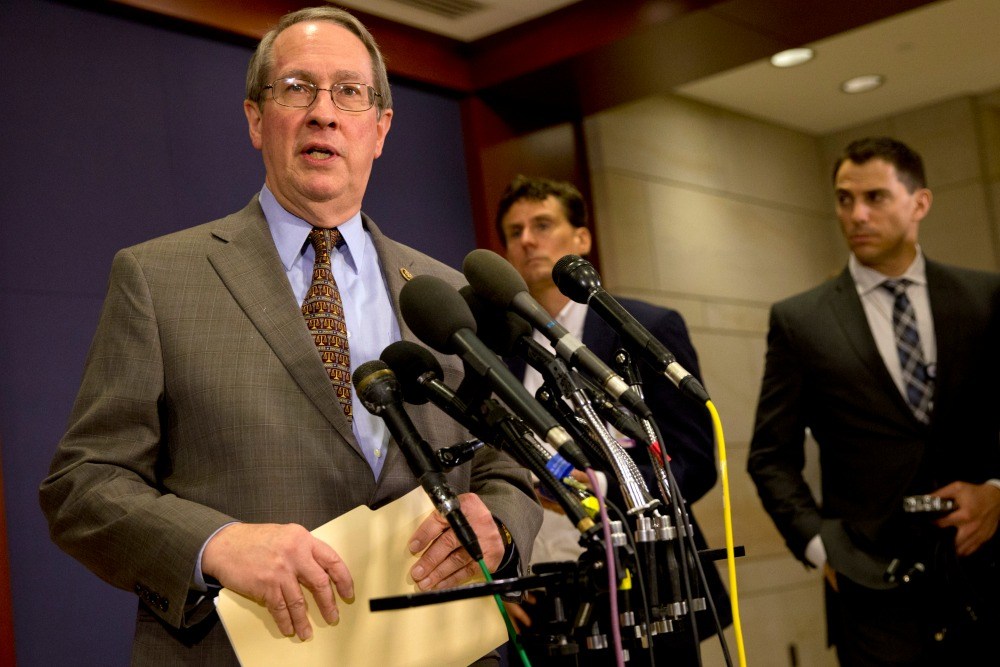
A pair of House committees is forming a bipartisan working group of eight lawmakers to prepare for possible legislation addressing how the widespread use of encryption affects law enforcement investigations.
“The bipartisan encryption working group will examine the issues surrounding this ongoing national debate,” House Judiciary Chairman Bob Goodlatte, R-Va., and House Energy and Commerce Committee Fred Upton. R-Mich., said Monday. As chairman of the two committees that have jurisdiction over encryption issues, Goodlatte and Upton are ex officio chairs of the working group. They released that statement jointly along with Michigan Rep. John Conyers and New Jersey Rep. Steve Pallone, the top Democrats on each committee.
Recommended Stories


The working group will attempt to develop bipartisan consensus in the House on an issue that has scrambled traditional party lines, especially since Apple CEO Tim Cook pledged to fight a court order that his company break into a cellphone owned by one of the San Bernardino terrorists.
FBI director James Comey had been negotiating behind-the-scenes for Apple’s cooperation while subtly lobbying lawmakers for assistance, but the issue broke out into the open when a judge ordered Apple to help. “The only way we know would be to write a piece of software that we view as sort of the software equivalent of cancer,” Cook said on Sunday. “We think it’s bad news to write, we would never write it, we have never written it and that is what is at stake.”
Comey regards unbreakable encryption as a product that tech companies have developed to boost their “business model,” one that now empowers terrorists such as the Garland, Texas, shooter to communicate in ways that law enforcement can’t find.
“That morning, before one of those terrorists left and tried to commit mass murder, he exchanged 109 messages with an overseas terrorist,” Comey told the Senate Judiciary Committee in February. “We have no idea what he said, because those messages were encrypted.”
The working group promised to keep both sides’ concerns in mind. “Members will work toward finding solutions that allow law enforcement agencies to fulfill their responsibility without harming the competitiveness of the U.S. technology sector or the privacy and security that encryption provides for U.S. citizens,” the leaders said Monday.
Four Republicans and four Democrats will participate in the group. They are Reps. Jim Sensenbrenner, R.-Wis., one of the lead authors of the Patriot Act, Darrell Issa, R-Calif., Zoe Lofgren, D-Calif., Suzan DelBene, D-Wash., Bill Johnson, R-Ohio, Adam Kinzinger, R-Ill., Yvette Clark, D-N.Y., and Joe Kennedy, D-Mass.