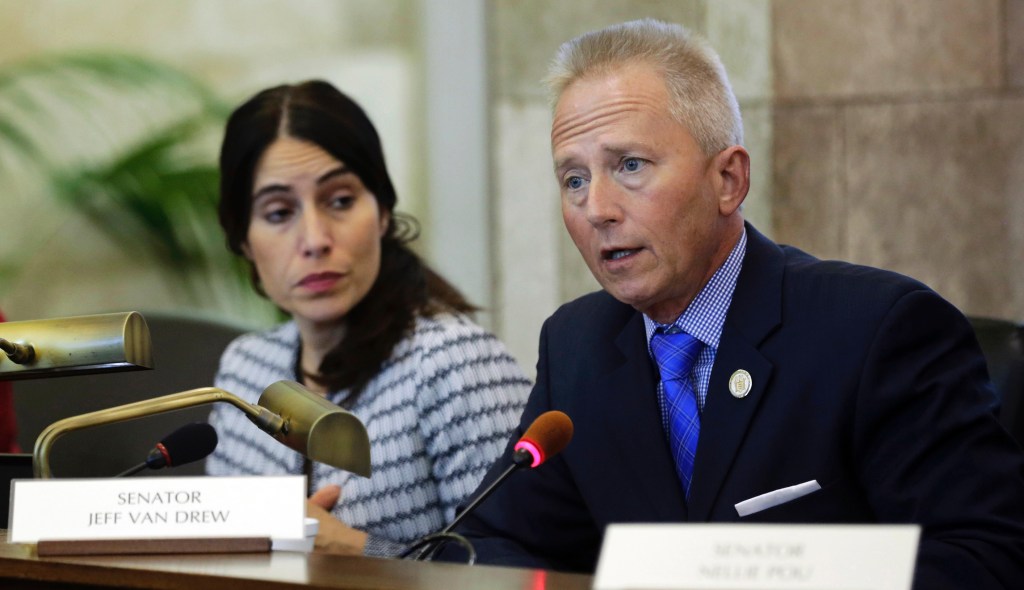
The Democratic Party has never liked Rep. Jeff Van Drew, the conservative New Jersey congressman expected to break with his party and join the GOP this week.
His opposition to impeachment has tanked Democratic support in New Jersey’s 2nd Congressional District — a red-leaning district the Democrats had been trying to win for years. And throughout his time in the state legislature, Van Drew supported Republican policies more often than Democratic legislation: He voted against gay marriage, a higher minimum wage, and several gun control initiatives.
This made him the perfect candidate in 2017, when the 2nd District’s longtime Republican incumbent, Frank LoBiondo, announced he wouldn’t seek reelection. The entire Democratic establishment rallied behind Van Drew and propelled him to Congress, where his support among his own party began to fade quickly.
Van Drew had made one too many appearances on Fox News and had been too willing to call impeachment what it is: a divisive, purely partisan process that amounts to nothing more than a campaign promise. New Jersey Democrats could have lived with this had his new national platform remained national. Instead, it began to affect local politics. A polling memo commissioned by Van Drew’s campaign found that only 24% of likely Democratic voters in his district wanted him reelected, while 58% said they’d support a different candidate.
It’s no wonder, then, that Van Drew is considering tossing his party affiliation and switching to the GOP. It’s unlikely the state party would have renominated him given his waning support, and as a Republican running with President Trump’s endorsement, Van Drew will secure the GOP nomination and stand a better chance at reelection.
The switch is undoubtedly motivated by political self-preservation. But Democrats decrying it as such forget that Van Drew’s departure might just help them. New Jersey’s 2nd Congressional District is not loyal to Van Drew or any political party, for that matter. Voters in the district, which includes the southern tip of Jersey Shore and Atlantic City, have supported both Republican and Democratic candidates: They elected Trump in 2016 by 4.6 percentage points and backed Barack Obama in 2012 by eight points. With the right candidate — Van Drew’s unpopularity proves he is not that — Democrats could hold onto the district.
Van Drew’s switch helps the GOP too, if only in appearance. He’s been critical of impeachment for months and was one of two vulnerable Democrats who voted against formalizing the House’s impeachment efforts in October. Attributing Van Drew’s exit from the Democratic Party to its attempts to remove the president from office is a solid rhetorical defense and one that could sway voters to oppose impeachment as well.
Van Drew’s decision, which will likely be announced this week, has less to do with principle than with politics. There will be plenty of critical Democrats who denounce it, and several skeptical Republicans, too, but keep in mind: Everyone involved benefits from this switch. They just won’t admit it.