
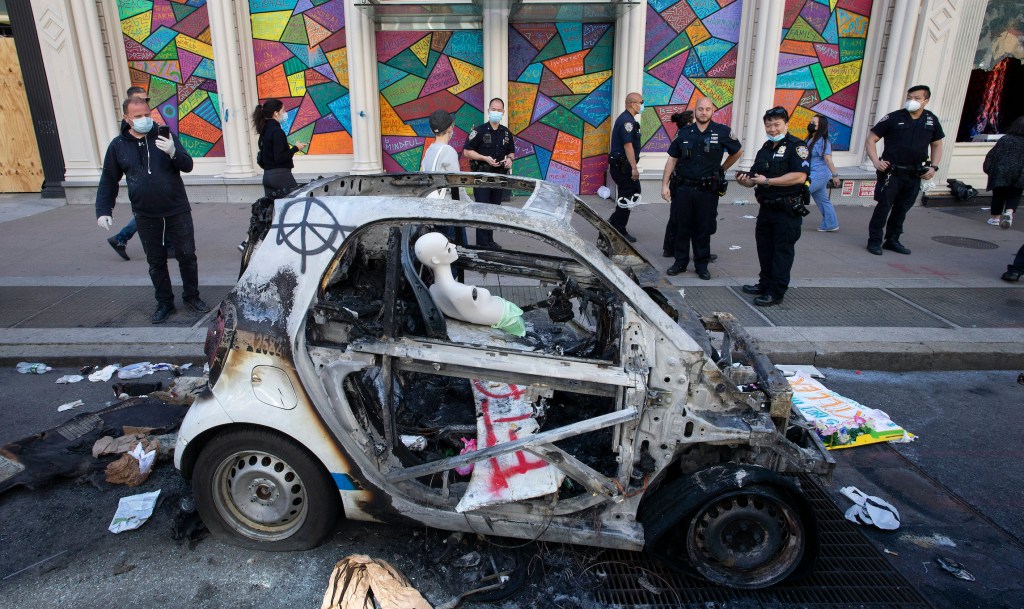
New York Gov. Andrew Cuomo on Saturday called on the state’s attorney general to review the encounters between New York City police and more than 3,000 demonstrators in Brooklyn Friday night that led to more than 200 arrests.
The protests were in response to the death Monday of George Floyd, in which a now-former Minneapolis police officer stands accused of his murder. The confrontations led to objects, including Molotov cocktails, being hurled at police and public officials observing the demonstrations being doused with pepper spray by law enforcement.
Recommended Stories
Cuomo, speaking at his daily COVID-19 briefing, also condemned the violent actions taken against police officers, saying those measures run counter to the objective of peaceful demonstrators. However, he’s also asking Attorney General Tish James to review law enforcement actions, saying the public needs answers and accountability.
James, a Brooklyn native, is independently elected into her position, and the governor said that puts her in a good position to provide an independent review.
“Let’s find out exactly what happened. What procedures were used. What was right, what was wrong,” said Cuomo, who wants James’ report within 30 days.
One step Cuomo, a former attorney general himself, said he would take is a change in Section 50-a of the state’s civil rights law. That section states personnel records of law enforcement officers, firefighters and corrections officers are considered confidential and cannot be reviewed, in most cases, without the individual’s permission.
Cuomo said he’s written opinions that state personnel records can be made public, but too often, political leaders use the law as a shield.
“Just to make it simpler, I would sign a bill today that reforms 50-a. I would sign it today,” he said. “So the legislature can now convene by Zoom or however they do it. Pass the bill. I will sign it today. I can’t be clearer or more direct than that.”
The governor said thereare commonalities between the Floyd case and COVID-19 in that both expose inequalities toward minorities in public systems. The Floyd case shows inequalities in the criminal justice system that have lingered for years nationwide, including in New York with the deaths of Eric Garner and Sean Bell.
COVID-19, meanwhile, exposed similar issues in the health care system. The 10 zip codes in New York City with the highest prevalence of COVID-19 cases represent some of the lowest-income communities in the city. The state will add one additional testing site in each of the 10 communities, which include six in the Bronx, three in Brooklyn and one in Queens.
One way New York will look to improve health care in those communities is to forge a partnership with Northwell Health, the state’s largest provider, to develop better connections.
“Where you see a high [COVID-19] death rate is where you have people with underlying illnesses,” Cuomo said. “If you have diabetes, if you have hypertension, if you are immune compromised, then you’re more likely to die. And that raises the question, well, why didn’t we address these health disparities better?”
Saturday marked day 91 of the coronavirus pandemic, and the state’s numbers continue to decline steadily. For the second consecutive day, the state recorded 67 deaths due to the virus.
Also at the briefing, Cuomo signed a bill into law that gives death benefits to the families of front-line workers who died during the COVID-19 emergency.
