

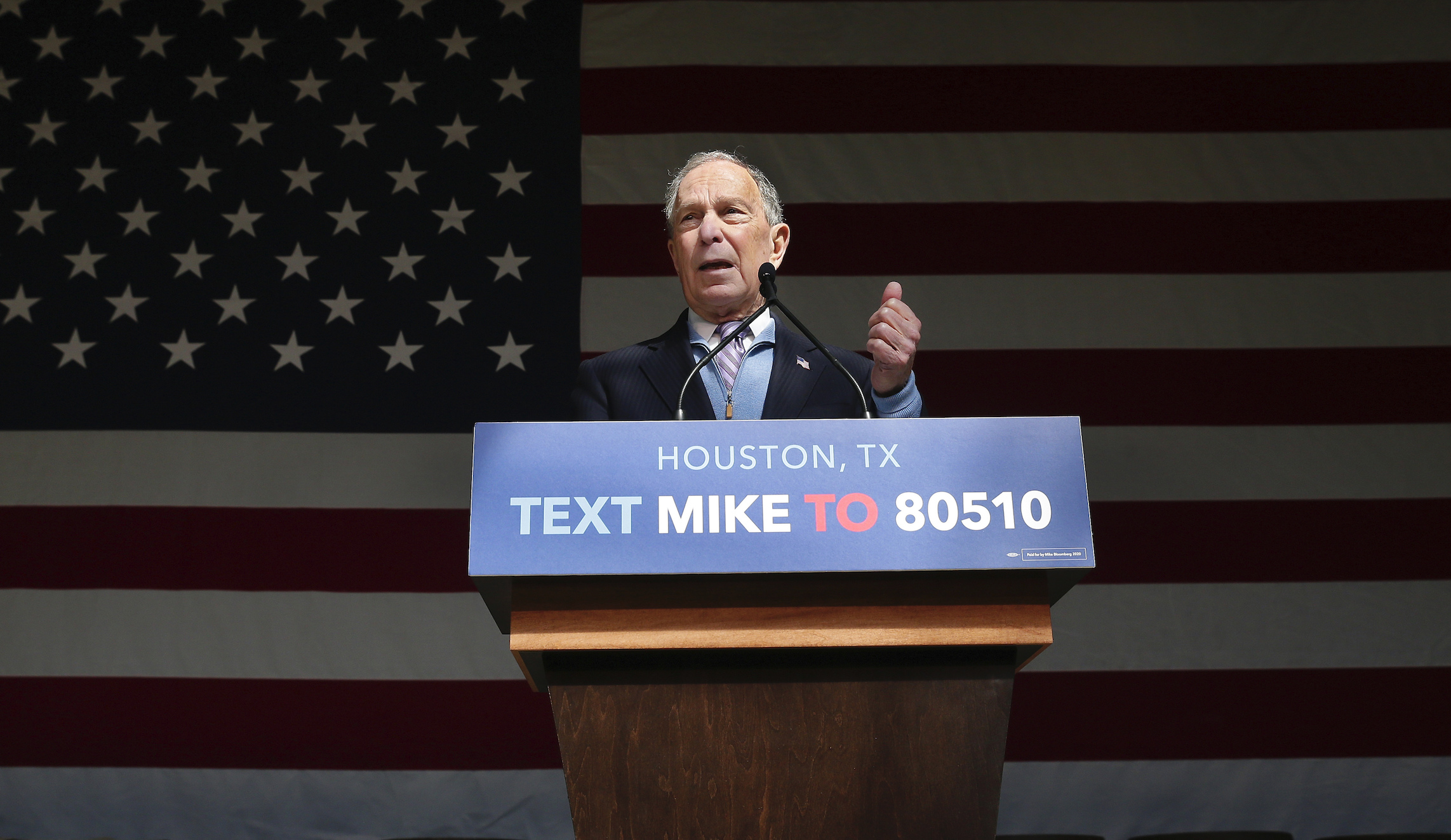
HOUSTON — Michael Bloomberg’s business acumen is one of the selling points of his White House bid, but Texas Democrats are warning him that his boardroom mentality could be ostracizing voters.
Bloomberg, 78, will compete in the 2020 Democratic presidential primary for the first time next week on Super Tuesday after spending more than $500 million on advertising since announcing his candidacy last November. He’s forgone the retail politics required to contest the early-voting states of Iowa, New Hampshire, Nevada, and South Carolina.
Recommended Stories



As a self-funder, he couldn’t qualify for the debates until a rule change before Nevada. But his decision to until recently shun traditional campaign tactics, including national media interviews and televised town halls, risks leaving a bad first impression as the last image Democrats have of the billionaire former New York City mayor before they weigh in on the race.
Bloomberg has acknowledged he didn’t have a good night in Nevada, the most-watched debate of the cycle with 19.6 million viewers. But supporters and undecided Democrats in Texas, where he’s trying to make a play, don’t think he’s done irreparable damage if he can drop his boardroom attitude.
With three days before Super Tuesday, Amy Ardington, 59, is still tossing up between Bloomberg and other center-left candidates such as Joe Biden and Amy Klobuchar. The retired lawyer from La Porte told the Washington Examiner the political culture in states that aren’t one of the early-nominating quartet is different from New Hampshire, where, for example, many voters didn’t make up their minds regarding for whom to cast a ballot until their debate.
Ardington added that, while she didn’t believe “debating skills necessarily translate to what’s necessary to do the job,” she conceded Bloomberg could have performed better.
“People reach that stratosphere where they aren’t challenged very often, and they lose the ability to respond appropriately, and humbly, maybe. He’s used to people saying, ‘Yes,’” she said.
For Dave Ofordile, 65, debates do matter because Elizabeth Warren’s reticence to go after Bernie Sanders in Iowa was one of the reasons he flipped from her to Bloomberg.
Ofordile noted Bloomberg, whose gun control and education advocacy he admires, doesn’t seem to want to “answer the questions they throw at him.”
“That’s my concern because people tend to place more emphasis on the debates. He’s still acting like he’s in the boardroom,” he said. “What he needs to do is, when they ask him questions and he doesn’t have effective answers, he can just say what he has done for women, etc.”
Although Ofordile insisted Bloomberg’s showing didn’t “turn him off” because he knows the former mayor’s “a new fighter. He’s a beginner in that aspect,” he was worried about his advisers.
“He has a lot of money to hire seasoned people,” he said.
Bloomberg first weaved self-deprecating jokes about his Nevada debate into his stump speech the day after during a speech in Salt Lake City. Then he latched onto the messiness of the South Carolina round to dig at rivals Bernie Sanders and Elizabeth Warren at a campaign stop in Houston.
“I’m not a typical politician. I think I showed that a week or so ago in the debate,” Bloomberg said this week of Nevada before turning to the first-in-the-South iteration. “I’ve never worked in a place where everyone talks on top of each other. I couldn’t believe it. My mother would have shot me if I’d done that.”
The information services entrepreneur and philanthropist went on to swipe at the senators for yelling about “slogans, even if they’re not true.”
Bloomberg raised eyebrows during the South Carolina debate for bristling at certain questions about his record, most notably regarding his nondisclosure agreements with women who complained of experiencing sexism at Bloomberg LP.
“We just cannot continue to relitigate this,” he said.
Pete Buttigieg, who, along with the rest of the field has been grilled by the press and voters for the better part of a year, countered, “If you get elected, you’ll relitigate this all year.”
Bloomberg exhibited a similar reaction during his CNN town hall, his first, when asked about stop and frisk, a policy that essentially racially profiled New York City residents, detaining people for short periods of time to ensure they weren’t carrying weapons or other contraband.
“I don’t want to get down in the weeds and talk about it. We made a mistake. We did too much of it, and I cut back to almost zero, and we’re not doing it again,” he said.
After reporters grumbled about his lack of media availability, he sat for interviews this week with MSNBC’s PoliticsNation and the PBS Newshour, among others, with a segment dedicated to him in the coming installment of CBS’s 60 Minutes.
