
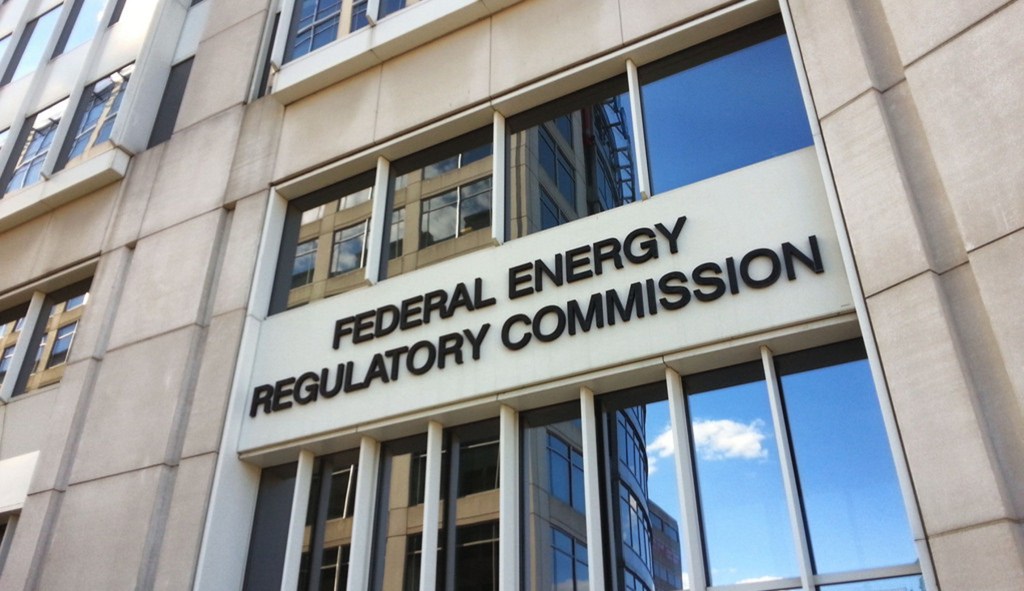
Members of the Federal Energy Regulatory Commission are hinting that the independent government agency likely will take some type of action to better value the resilience that certain power plants provide to the electric grid, based on what grid operators report this week.
The nation’s federally overseen grid operators, which run about 70 percent of the nation’s power supply, will report to FERC Friday on the state of the nation’s grid resilience, or its ability to bounce back from a major disruption such as this year’s bomb cyclone in the Northeast.
“Only hypothetically is nothing an option. I would be very surprised if we go through all that process and take no action,” FERC Chairman Kevin McIntyre told reporters during an appearance Wednesday at the CERAWeek energy conference in Houston.
McIntyre, a Republican, suggested the commission would like to more fairly value the resilience attributes that power plants provide to the grid, based on the energy source they use.
“The compensation side is tricky and critical,” McIntyre said. “If there are power plants — big, small or otherwise — that are making valid, resilience-focused contributions to our grid, essentially helping to keep the lights on in a way that shores up resilience, but are not being compensated for those attributes that they are providing to the grid, that is automatically of concern to FERC.”
In a highly anticipated decision, FERC in January voted unanimously to reject a proposal from Energy Secretary Rick Perry to provide special payments to struggling coal and nuclear plants in the name of resilience and reliability.
Perry asked FERC in September to rewrite the rules governing wholesale power markets to reward power producers in the Midwest and Northeast that are able to store enough fuel for 90 days of generation on-site. Only coal, nuclear, and some hydropower plants can fulfill that condition, which FERC considered to be an arbitrary metric that does not necessarily translate to resilience.
FERC, in rejecting Perry’s plan, directed regional transmission operators to provide more information about resilience to help the commission examine the matter “holistically.”
The commission gave the grid operators, such as the Northeast’s PJM Interconnection and the Midcontinent Independent System Operator, 60 days to submit information on resilience challenges in their markets.
The comment period ends Friday.
Republican FERC commissioner Robert Powelson said Thursday he expects the regional grid operators to present different feedback, depending on their market characteristics.
“Some regions will come back and say, check the box, we are good on resilience and reliability and let us go about our business,” Powelson said during an appearance at CERAWeek. “Others may come back with valuing attributes of resources within that market, and we will seriously look at that.”
Powelson praised Perry for recognizing the challenges associated with a transitioning grid. Retiring coal and nuclear plants, traditional “baseload” power sources that operate around the clock, are being replaced by natural gas and intermittent wind and solar. As that happens, the grid may struggle to provide power quickly during an extreme weather event or other emergency, Perry argues.
And as the grid changes, states are increasingly writing their own policies to favor certain energy sources over others, often with the goal of reducing carbon emissions.
Powelson said he supports states making policy, but argued that policy-makers sometimes lose sight of grid resilience when they set an agenda.
“I am very supportive of markets,” Powelson said. “It’s in our DNA. But these state interventions come with consequences to reliability. I can’t argue with [Perry’s] point that these markets are not pure. The policies all sound good. I respect those. But the reality is the policies are not synchronizing with the system, and therein lies a significant challenge.”
He said FERC would take a fuel-neutral action that recognizes resilience attributes offered by all kinds of energy sources, including battery storage technology that can help renewables be available more frequently.
FERC last month issued an order requiring regional grid operators to revise their pricing to recognize the benefits of energy storage and allow the technology to compete with generators in wholesale power markets.
“We are generation agnostic, but reliability first and foremost,” Powelson said. “There is a 1980 definition of baseload. Guess what? We have battery storage. We have integration of pretty robust renewable resources. These are all part of that conversation. Let’s not put our thumb on the scale.”
Environmentalists, meanwhile, are anxiously awaiting what the grid operators tell FERC.
The Natural Resources Defense Council’s John Moore said Thursday that FERC should take a light touch.
“Whatever they do tell FERC, it is critical to keep in mind that there is no evidence of a resilience crisis, let alone one requiring a new FERC mandate,” Moore said. “That’s in part because grid operators already incorporate resilience into many of their reliability-focused responsibilities.”
He said the environmental group is urging the operators not to support any measure that would resurrect Perry’s plan. Instead, they should complement FERC’s recent actions to bolster battery storage on the grid.
