

There’s a great deal to like in Wisconsin’s Scott Walker. He’s from the right place (the upper Midwest), holds the right job (a sitting state governor), and has the right record. He won three statewide elections in four years in a state that voted twice for Barack Obama. He is liked by the base and by the so-called Establishment, a standing attained by too few.
Recommended Stories


A preacher’s son, not related to a former president; an enthused bargain hunter at middle-tier box stores, he seems designed by a focus group (or by his maker) to take on the mega-rich, super-connected, ultra-cocooned Hillary Clinton, who has lived for twenty-plus years in a platinum-lined bubble. It would be the epic Timex versus Rolex encounter that 2016 ought to be.
If that’s not enough, he is perfectly poised to shine a bright light on the rot at the heart of the liberal project, which put itself on display in his state a few years ago. His experience laid bare the good sense, concern for law and the rights and the safety of others with which the Left handles dissent when its interests are threatened.
On Feb. 11, 2011, newly installed Gov. Walker proposed a budget relief bill which called on state employees to contribute a bit more to their health plans and pensions, barred pay increases that exceeded the rate of inflation (unless approved by the voters), and prevented unions from automatically deducting union dues from all workers’ paychecks without their specific consent. Organized protests began Feb. 14. On Feb. 17, Democratic state senators fled to Illinois to attempt to keep the state Senate from having a quorum.
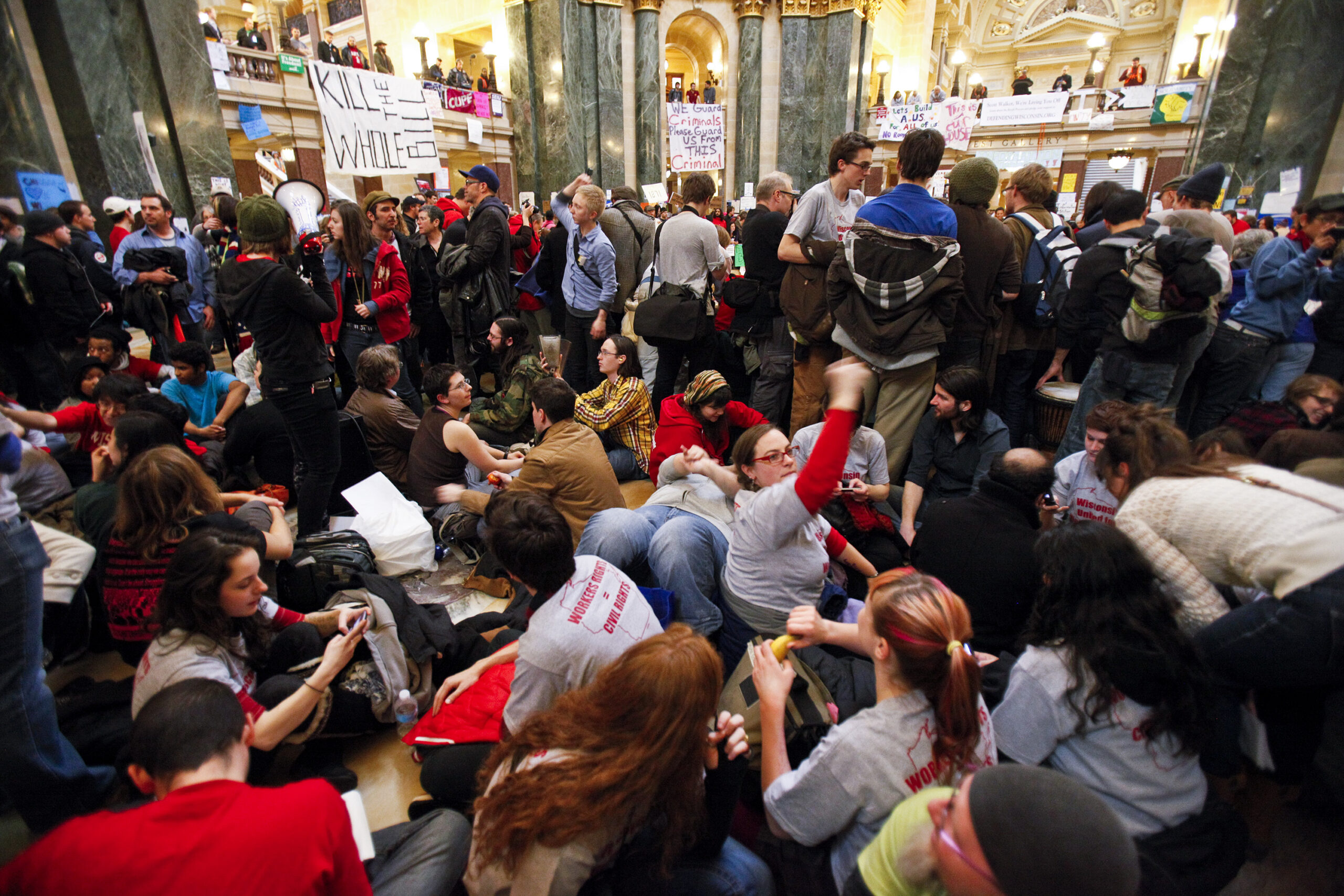
By Feb. 20, 70,000-plus protesters had occupied the state capitol, banging drums, singing and chanting; packed like sardines on the floors of the building, camping on mattresses that soon became filthy and were quickly awash in debris. The place “smelled like a Port-a-John,’ Walker wrote later; marijuana smoke wafted everywhere, and a “disgusting film” covered the floor. On March 3, a court order ended the occupation (and allowed cleaners to come in with blast hoses). But on March 10, when the state assembly passed the bill, 53 to 42, the protesters returned, banging on windows and ripping doors off their hinges. They forced the police to evacuate Republican legislators by forming a wall through which they could walk to safety on buses, after which the protestors pounded on the windows of the buses, rocked the vehicles, and tried to lie down in their path.
Meanwhile, Walker received numerous death threats, some of them aimed at his parents and children, including one, which, as he told to the forum in Iowa, threatened to ‘gut my wife like a deer.’ Small acts of nastiness also continued, showing the left wing’s concern for the interests of children and others: “gluing the doors shut on an elementary school I went to read at,” Walker wrote later. “People dressed up as zombies … coming up in front of a Special Olympics gathering where I was speaking … just … unbelievable things.”
While all this went on, it had at least the tacit support of the Democrats, who might cease to exist without public unions, and was largely ignored by the press outside of Wisconsin, which is so busy looking for S.S. or Ku Klux Klan conduct among Tea Party members it can’t seem to see it elsewhere.
This ought to change if Walker runs against Hillary Clinton. What would she say if he were to ask her about it? Inquiring minds should want to find out.
Noemie Emery, a Washington Examiner columnist, is a contributing editor to The Weekly Standard and author of “Great Expectations: The Troubled Lives of Political Families.”
