

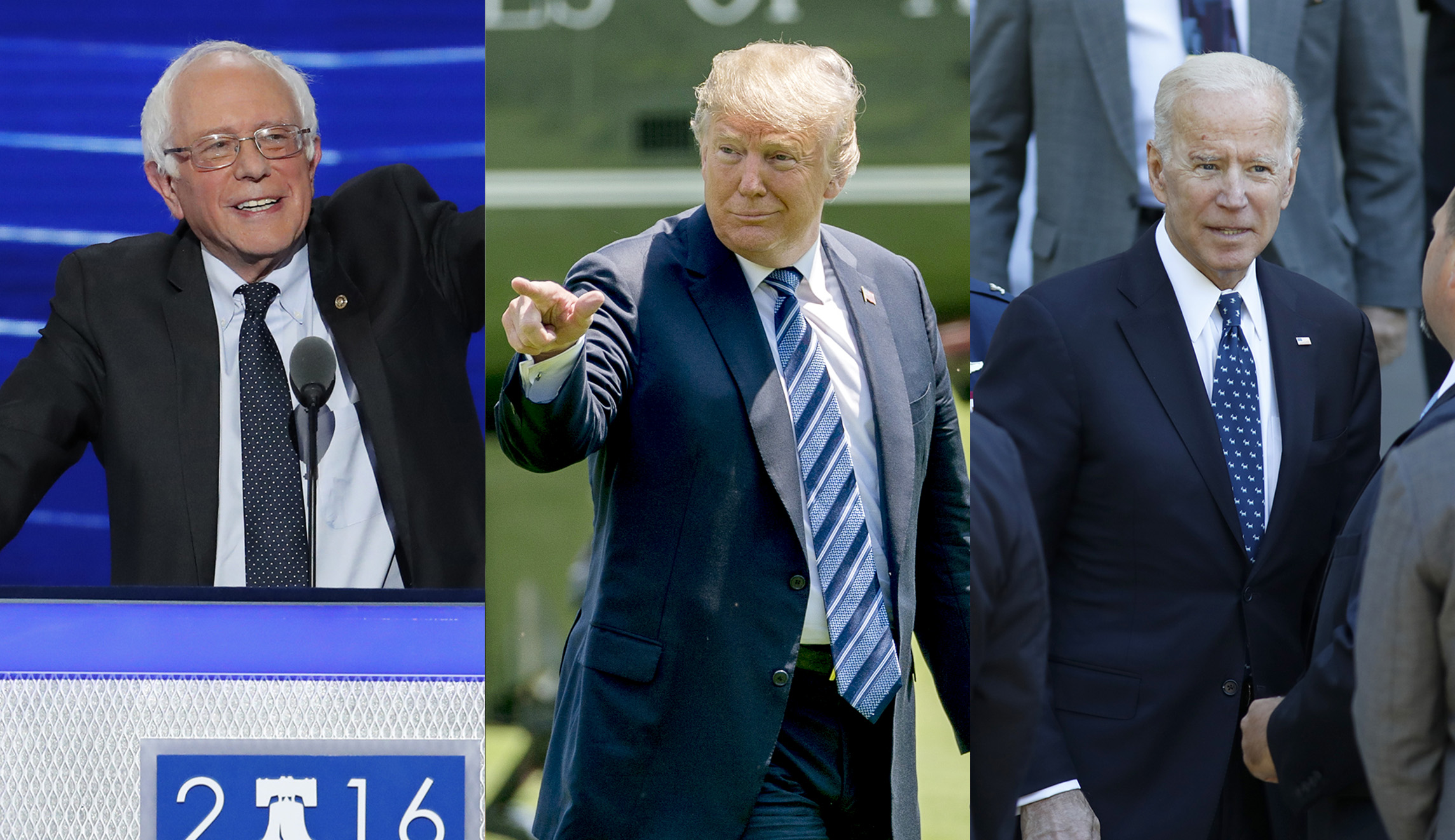
The crowded field of aging presidential candidates has raised questions about their prospects for good health and longevity. And while there’s no crystal ball, one study released Friday provides some insight into how long candidates might live and the risk of impairment as they age.
The white paper, from the American Federation for Aging Research, finds that on Inauguration Day 2021, Donald Trump would have a life expectancy of 11.4 years, putting him on track to survive well past a second term. Joe Biden and Bernie Sanders would have a life expectancy of 9.3 and 8.7 years, respectively, barely enough for a two-term presidency.
Recommended Stories


The study used data from the Social Security Administration to find that all 27 people who declared a run for president are likely to survive at least a single term as president, and even a second term. If inaugurated again in 2025, Biden at that point would have another 7.2 years and Sanders would have another 6.6 years. The odds are lowest for former Alaska senator Mike Gravel, 89, who doesn’t intend to become president. The data show his life expectancy would be 4.6 years past inauguration. If he outlived that, at that point, his lifespan would be another 3.4 years.
The findings, of course, are no guarantee. The candidates could always succumb to an infection, stroke, or accident, or become cognitively impaired. The study suggests none of the candidates would have some sort of disability for longer than 11 months toward the end of their lives, but there are many unknown variables.
“There is no guarantee one way or another that they will live long or not have health problems, but the evidence we see from the scientific literature says there is nothing in the chronological age that would lead us to think age is an issue for any one of them,” said S. Jay Olshansky, lead author of the paper and an aging expert at the University of Illinois at Chicago.
Olshansky’s past research has suggests that, contrary to popular belief, presidents don’t age faster than most people, and tend to have long lives. Part of the reason is that they have advantages that improve their odds, such as having higher incomes and access to top-notch healthcare.
His latest paper, he said, was motivated by a Washington Examiner article that quoted Dr. David Scheiner, Barack Obama’s longtime personal physician before he was president, saying that voters should not accept a candidate’s declaration of health at face value.
He made the comments in light of the fact that seven candidates would be over age 70 on Inauguration Day. Presidential candidates since Ronald Reagan have released some of their medical records to the public, but no law demands their release and no candidate has disclosed a full medical history.
Reached by phone Thursday, Scheiner said he was unsatisfied with the study’s findings.
“It’s not that I fear them dying in office, it’s that I fear them screwing up because they don’t have the cognitive capacity to do the job,” he said. “It’s too important to allow someone to get in there about whose health we know nothing.”
Scheiner raised concerns about Trump’s speech patterns, as well as his risk for cardiovascular problems given that he is overweight and has a sedentary lifestyle and diet.
Biden, he said, made him nervous with his performance in the first debates, appearing “frail.”
He said Elizabeth Warren, 70, had fresh ideas and creative thinking, but added: “Even on her I would still want a test to be done.” Warren’s life expectancy, the study shows, is 15.4 years if she were to be inaugurated in 2021.
Olshansky readily agreed that his study offered only a glimpse of what to expect. To better assess lifespan, each candidate would need to fill out a questionnaire and undergo a medical exam.
“That’s what the message is all about,” Olshansky said. “Technically we don’t care about how long people live and what their prospects are, it’s how healthy they are and whether they are healthy enough to do the job they have been hired for.”
Olshansky plans to update his analysis as candidates provide more details. Even so, he said it was entirely possible that some of the candidates might be “super-agers,” a subgroup of the population that has high mental capacity well past age 80.
Politicians have long been attuned to how age differences can tilt an election. When he was campaigning for the Senate at age 29, Biden drew attention to the age of his 63-year-old opponent, Cale Boggs. Now, he’s on the other side of such attacks.
Trump, 73, has said he sees himself as a “young, vibrant man” compared to Biden, 76, and Sanders, 77. The testimony of former special counsel Robert Mueller, he said, “made Biden look like a dynamo.”
Younger candidates are joining in. Cory Booker, 50, called Trump an “elderly, out-of-shape man.” Pete Buttigieg, 37, notes some of his opponents have “been in the public sphere for longer than I’ve been alive.” If elected, Buttigieg would set a record for youngest president, as would Tulsi Gabbard, 38, and Seth Moulton, 40.
It’s not clear, however, that voters favor younger politicians. Joe Trippi, a Democratic strategist, said that after having a newcomer like Trump become president, Democratic voters may gravitate toward a candidate with more experience, though he acknowledged the party was split.
“There are definitely two fights going on in the party right now: The usual ideological fight, and then there is a generational fight,” Trippi said.
There are other downsides to running as a young candidate besides being cast as inexperienced and unprepared.
Rep. Eric Swalwell of California, 38, said the place where he was in his life was a factor that caused him to drop out of the presidential race. While he believes that young candidates can usher in fresh ideas, he said it proved too challenging for him to run for president, raise two young children with a wife who works full time, and also still be paying off his student loans.
“I don’t think age is relevant,” he said. “I think it’s mindset. I just think we need a candidate who lives in the present and thinks about the future. I think there is a risk of having people who have been around for so long as these problems have persisted, and the problems still persist.”
