Trump throws the word ‘treason’ around far too carelessly

Donald Trump’s dangerous demagoguery, repeatedly using variations of the word “treasonous” to describe his critics and opponents and a supposed “deep state” conspiracy, must stop.

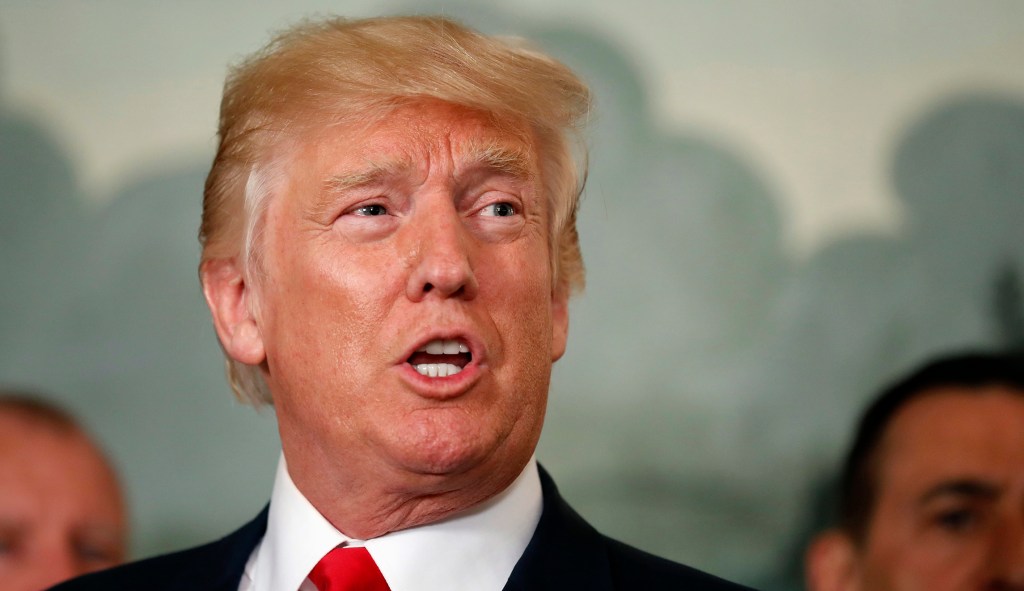
Trump did it again on Monday when, in response to a question about the end of the Mueller investigation, he said: “There are a lot of people out there that have done some very, very evil things, some bad things, I would say some treasonous things against our country. And hopefully people that have done such harm to our country — we’ve gone through a period of really bad things happening — those people will certainly be looked at. I’ve been looking at them for a long time.”

The accusation appears here to refer to supposed deep state conspirators. But Trump has said the same of his critics far too often. That they are treasonous is a smear he has repeated again and again. As the chief executive of the United States and the ultimate head of American law enforcement, his words to such effect carry a weight far beyond that of some ordinary Joe blowing off steam.

Treason has a specific legal meaning. It involves making war against the United States, which clearly isn’t involved here, or giving aid and comfort to a declared enemy of the United States. Treason is a crime punishable by death, and if the head of U.S. law enforcement says somebody has acted in a treasonous manner, his words convey a real threat.

This is especially so if he follows up such use of the word with a not-so-veiled hint of retaliation. “These people will certainly be looked at,” he said. “I’ve been looking at them for a long time.”

It is equally wrong, although not as legally weighty, for Trump’s critics to use the word carelessly when describing his actions, as they certainly have done at times.

So here’s a little civics lesson for the threatener in chief, and for the rest of us.

While none of the items in the following list actually is “treasonous,” some come at least a bit closer than others. For example, it is not treasonous, but it is still closer to treason, for a president to suggest he is above criticism and above the law than it is for a citizen to criticize the president. Indeed, the criticism itself can be an act of patriotism.

It is not treason for a president to reveal classified information to the Russian foreign minister and ambassador, but it is even further from treason for the media to question him about doing so. It is closer to treason for a president to tell Russians, in the Oval Office, that firing an FBI director eased “pressure because of Russia” than it is for people to say the remark is inappropriate. It is closer to treason, even if it is not treason, to let a Russian photographer, but not U.S. press, into an Oval Office meeting, or to take a meeting alone (except for an interpreter) with Russian President Vladimir Putin, than it is to worry about such behavior.

And it certainly is closer to treason, although again not treason, for a president to side with Putin over this nation’s own intelligence agencies than it is for American political opponents of his to shout from the rooftops that their president appears emotionally compromised.

It is now indisputable, by the way, that Russia tried to help Trump get elected. Trump has chosen to believe the denials of the murderous Russian dictator over all of the proof to the contrary.

To cite an old but insightful saying, dissent really can be, and often is, the highest form of patriotism. Trying to quash dissent, on the other hand, or suggesting that the president himself is above criticism, investigation, or opposition, runs afoul of the entire American tradition.

Indeed, if one were to use the word as carelessly as Trump uses it, one could say that suggesting such presidential immunity from dissent is … well, treasonous.

Related Content