

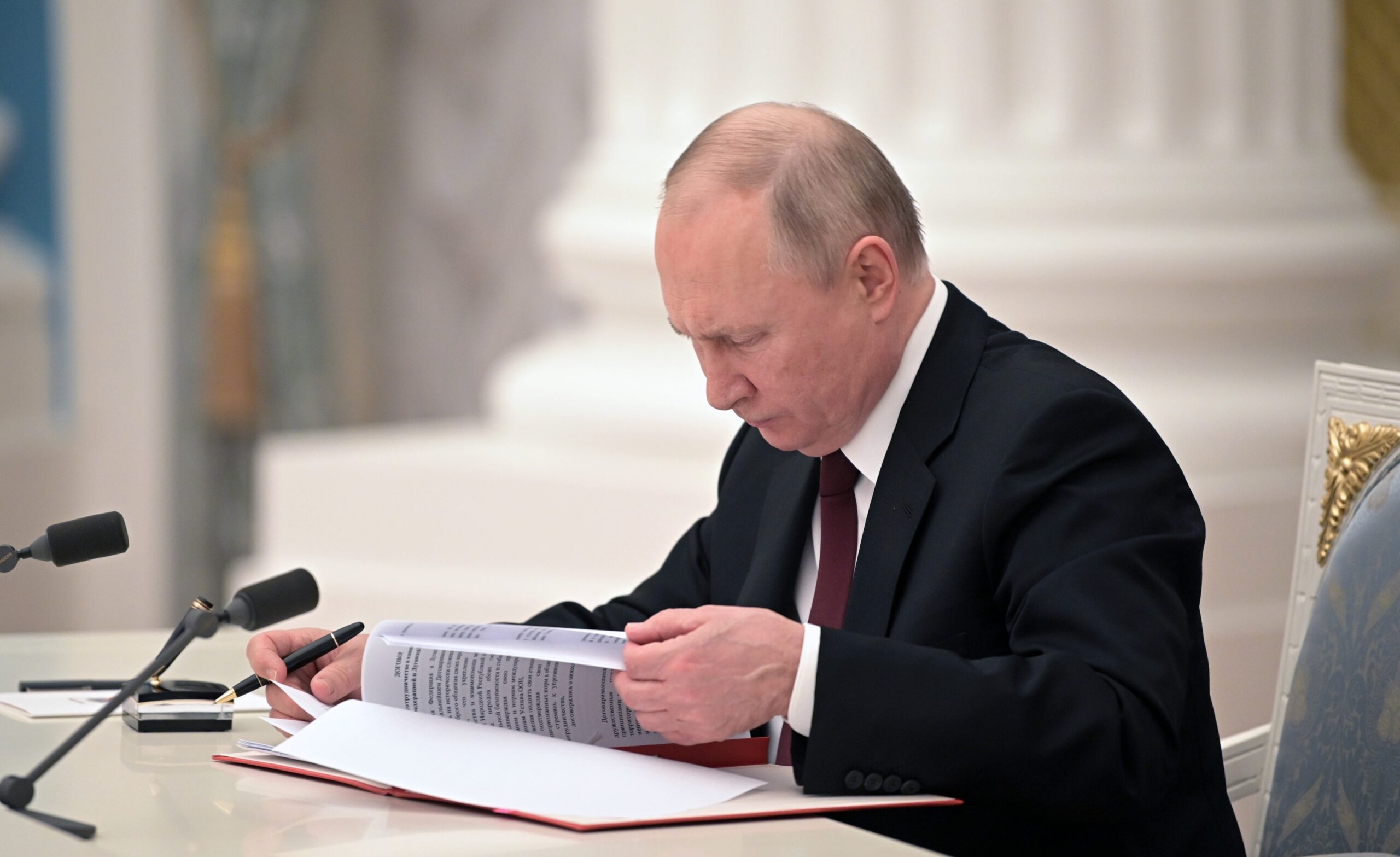
On Monday, Russian President Vladimir Putin crossed a diplomatic red line.
“I deem it necessary to make a decision that should have been made a long time ago to immediately recognize the independence and sovereignty of the Donetsk People’s Republic and the Luhansk People’s Republic,” he declared. Putin then ordered Russian “peacekeepers” into the two breakaway regions of Ukraine that the Kremlin has supported since initially precipitating the conflict in 2014. Putin’s threats to Ukraine went further, however. He openly questioned Ukraine’s right to exist as an independent state.
Recommended Stories


While Secretary of State Antony Blinken rightly condemned the move, subsequent White House backtracking only emboldens Russia further.
Make no mistake: Russia is the aggressor and acts illegally. Still, many European diplomats and U.S. politicians who condemn Putin forget that they supported the precedent for Putin’s actions. The Russian strategy of unilaterally recognizing a state and then using its supposed independence to bludgeon and delegitimize a democratic state is the core of the diplomatic strategy pursued by many European states, American liberals, and international organizations in the Middle East.
Palestinians engender sympathy in the Arab world as much as Ukraine’s ethnic Russians win Russian nationalist support. But sympathy does not supersede fact in international law. Donetsk and Luhansk are like Palestine: The creation of each was political and driven by hatred of the “other.” None has precedent of independence. Prior to World War I, Palestine was part of the Ottoman Empire, and before, it belonged to a number of other empires and entities, including the Roman Empire in which it was a province from which its name derives.
During the late Ottoman period and in the years immediately after, Arabs considered Palestine an extension of Syria. When the United Nations partitioned Palestine and ended the British mandate, Jews accepted an independent state even though it fell short of what they sought; Arabs did the opposite and rejected the mandate. Jordan subsequently seized the West Bank, and Egypt occupied the Gaza Strip. Few countries — Arab or otherwise — recognized either move. Ultimately, both renounced their claims to sovereignty. Both the West Bank and the Gaza Strip were terra nullius, land belonging to no governing state. Palestine may ultimately emerge as an independent state, but first, it must negotiate its extent; this has always been the core of the 1993 Oslo Accords. While some may say that anything outside Israel’s 1949 borders is Palestine, technically, the entire West Bank remains disputed territory rather than occupied territory.
By retroactively recognizing Palestinian statehood and embracing the entirety of Palestinian claims over the West Bank (Israel ceded claims to Gaza in 1995), critics of Israel claimed that it had occupied another state’s territory. It has been a useful bludgeon for everyone from the European Union to Ben & Jerry’s Ice Cream, for example, which seeks to stigmatize Israel as occupying Palestinian territory. It is fiction, however. The irony is that these organizations and companies ignore actual occupations, such as Turkey’s 47-year occupation of northern Cyprus.
The sad reality is that while liberals say human rights motivate them, by twisting Middle East reality to fit their agendas, liberals created a precedent for action that illiberal dictators such as Putin embrace. Israel will be fine. It is strong enough to defend itself. Ukrainians, however, now pay the price for liberals’ belief that they can twist international law selectively to fulfill their political worldview without regard to the precedents they establish.
Michael Rubin (@mrubin1971) is a contributor to the Washington Examiner’s Beltway Confidential. He is a senior fellow at the American Enterprise Institute.
