

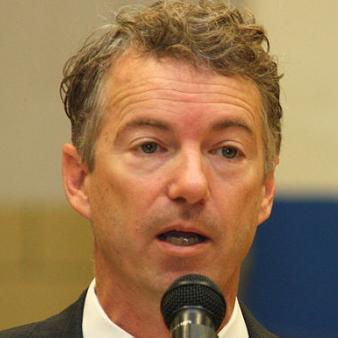
Rand Paul announced his candidacy for president this week, and the libertarian Republican was immediately greeted by a chorus of doomsayers. NBC News went with the headline, “Why Rand Paul Probably Can’t Win Republican Nomination.” Dick Morris says, “Rand Paul can’t win.” The New York Times’s Nate Cohn says, “Perhaps in a decade or two, a representative of the libertarian wing of the party will have an easy time winning the nomination. It’s just unlikely to happen in 2016.” And Times columnist Nick Kristof fired off this tweet shortly before Paul announced:
BREAKING! He won’t be elected! Let’s cover more policy, less horse race RT @AFP: #BREAKING Senator Rand Paul announces run for President
— Nicholas Kristof (@NickKristof) April 7, 2015
That tweet is perfect in its own way, because it unintentionally makes an important point. Condemning someone’s campaign from the very outset is, in fact, the very worst sort of the horse race journalism. For one, the election of our current president shows that this kind of premature dismissal is pure folly. Eighteen months out from the 2008 election, to the extent that Barack Obama had a base of support, it was from the fringe of his party. His past policy positions suggested he was too liberal on key issues to get elected. He didn’t seem likely to get the financial backing necessary to secure the Democratic nomination, and generally speaking, he didn’t have a clear electoral path easily divined by political analysts. But none of this mattered in the end. Obama completely rescrambled the traditional Democratic electoral coalition by increasing turnout among the poor and minorities in ways that compensated for a lack of support among working class white voters that had been key to recent Democratic victories.
If you watched Paul’s announcement, he made it perfectly clear that he is planning a strategy that involves something similar. He doesn’t plan on winning just by grabbing expected GOP voters — he wants to expand the GOP coaliton by winning young voters and going after minorities that the GOP has struggled to attract. Whether or not he’ll be successful at that, it’s far too early to tell.
Now Kristof says he doesn’t want to focus on horse race politics because he wants more coverage of policy. But how does policy coverage happen in the context of a presidential race? Well, policy debates are often forced by candidates going out on a limb and staking out new positions that force confrontations within and outside their party. It’s hard to imagine Rand Paul’s presence in a GOP primary won’t be good for policy debates. Especially in contrast to the Democratic party, where they’ve all but cleared the field for Hillary Clinton. The fact that Clinton has but one minor challenger in Martin O’Malley means that the policy coverage on the left will likely be scant.
Further, the particular ways that Paul deviates from the GOP mainstream that supposedly make him “unelectable” are instructive. He’s been on the vanguard of issues such as legal marijuana and criminal justice reform that do seem likely to appeal to younger voters, and there’s little evidence that these issues would cause a rift with the GOP base the way they would have 20 or more years ago when whether Bill Clinton had inhaled was considered scandalous.
Foreign policy is a more legitimate bone of contention. Personally, I find Paul to be too non-interventionist and insufficiently supportive of providing the resources necessary for a robust national defense. Certainly others at this magazine have made (and will likely continue) to make this point. However, Paul has been modulating his rhetoric on foreign policy as of late in recognition of threats such as ISIS, and he signed Senator Cotton’s letter opposing the Obama administration’s Iran deal. It might behoove everyone to see what Paul’s actual policy positions are and to find out whether they match up with this tougher rhetoric before its decided that he’s too non-interventionist to win the nomination. And this is also an opportunity for those who might disagree with Paul on foreign policy to start looking for points of agreement so that they can help persuade him to be more realistic about the threats the country faces.
The bottom line is that Paul’s presence in the GOP race is likely to provide more policy debates, not fewer. His attempts to expand the tent shouldn’t be dismissed, and if he’s at all successful in these efforts it could redound to the benefit of the whole party even if he doesn’t win the nomination. And those that disagree with him on foreign policy and other issues should welcome the opportunities to debate him both as teachable moments for voters and as a chance to persuade Senator Paul.
And finally, dismissing Paul’s candidacy is an affront to voters. They decide whether Paul’s candidacy is viable, not media elites. Maybe the odds are stacked against Paul, but his campaign deserves a chance to begin before it’s declared over.
