

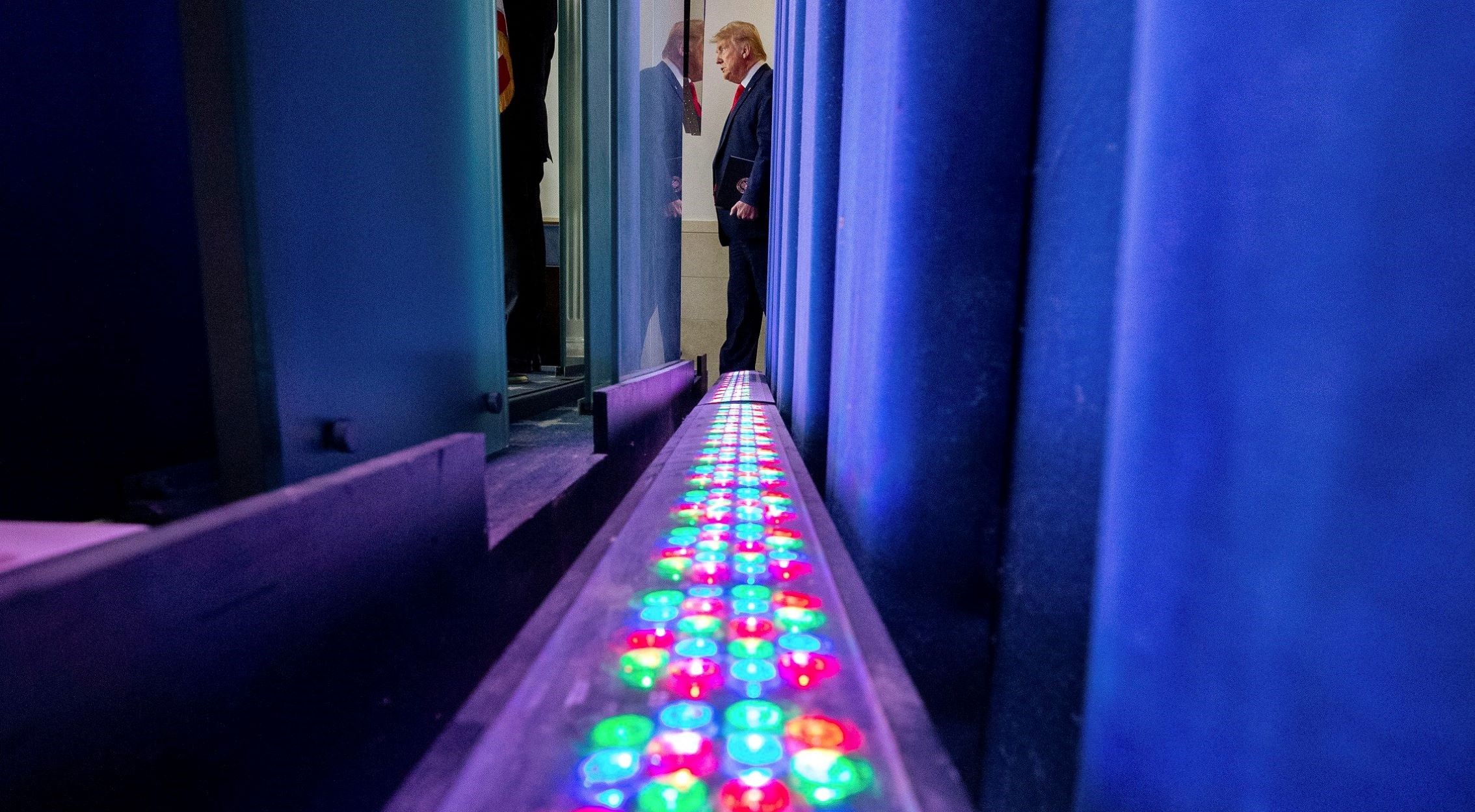
One moment, President Trump was announcing recommendations that the public should use face coverings to prevent asymptomatic carriers from spreading the novel coronavirus. The next, he was announcing that he would not be wearing one as he was “feeling good.”
“This is voluntary,” he said. “I don’t think I’m going to be doing it.”
Recommended Stories


The White House coronavirus briefing attracts millions of viewers and is one of the country’s most important platforms for delivering important advice and updates for an anxious public.
But the message on improvised masks is the latest example of how an unpredictable president can sometimes undermine the work of the scientists and advisers beside him.
“I’m feeling good,” he said. “I just don’t want to be doing it. Somehow sitting in the Oval Office behind that beautiful Resolute Desk, the great Resolute Desk, I think, wearing a face mask as I greet presidents, prime ministers, dictators, kings, queens … I don’t know. Somehow, I don’t see it for myself.”
This time it could also make for an awkward weekend in the White House residence.
While the president was speaking, the first lady offered her advice on Twitter: “As the weekend approaches I ask that everyone take social distancing & wearing a mask/face covering seriously. #COVID19 is a virus that can spread to anyone – we can stop this together.”
The issue of face masks divided scientists and public health experts as the coronavirus death toll mounted. The Centers for Disease Control and Prevention had long concluded there were insufficient benefits to recommend that the public don masks and that the practice risks diverting vital protective gear from front-line medical workers.
As the weekend approaches I ask that everyone take social distancing & wearing a mask/face covering seriously. #COVID19 is a virus that can spread to anyone – we can stop this together.
— Melania Trump (@FLOTUS) April 3, 2020
However, that changed this week with growing evidence that sneezing or coughing were not the only ways to spread the virus. Simply breathing might be enough.
CDC Director Robert Redfield said it was increasingly clear that asymptomatic carriers were spreading the disease.
“We now know that there may be individuals in areas of significant community transmission that may be asymptomatically infected, and we know that a face barrier can actually interrupt the number of virus particles that can go from one person to another,” he said. “So, as was said by the president, the purpose of this face covering is to be another … mitigation strategy to protect someone from spreading the virus from themselves to someone else.”
It is not the first time that the president has talked at crossed purposes to his experts, who have sometimes fact-checked him on the spot.
At the start of last month, during a meeting with his senior health officials, Trump talked about a vaccine being ready in months and then within a year. He was corrected first by his health secretary and then by Anthony Fauci, one of the country’s leading infectious disease specialists and who has worked for six presidents.
“A year to a year and a half,” he said.
It was Fauci who stepped in again more recently after Trump said the malaria drug chloroquine might be a “game changer” and had been approved to treat COVID-19 patients.
“The information that you’re referring to specifically is anecdotal,” Fauci told a reporter during a briefing. “It was not done in a controlled clinical trial. So, you really can’t make any definitive statement about it.”
