
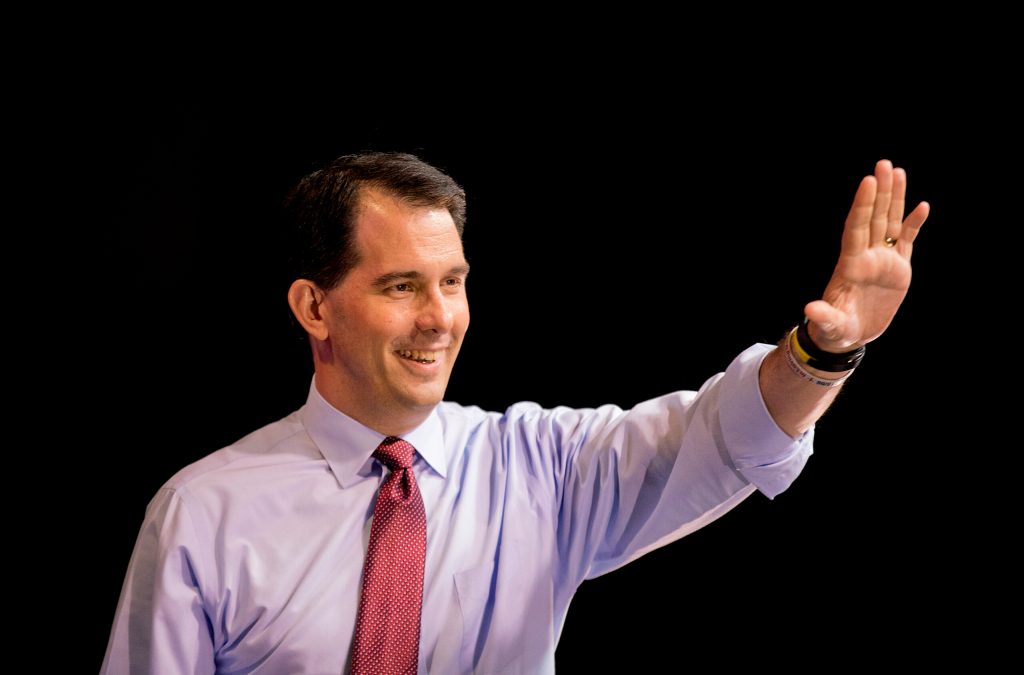
Walker won’t buck special interests

Washington, D.C., is an actual swamp riddled with proverbial diseases, which are spread by consultants, lobbyists, and other parasites on the body politic. An effective statesman — especially a president — must enter the swamp with an immunity to these viruses, or he will fall victim to them.

Scott Walker’s actions suggests he lacks the required immunity to special-interest pleading. The $80 million state subsidy he approved this week for the Milwaukee Bucks is the latest evidence.

Walker embraces the label “aggressively normal.” His normality isn’t merely personally charming, it’s also politically appealing to conservatives. Walker doesn’t come into the race as your typical wheeler-dealer trapped in the Washington way of seeing things. He instead brings common-sense problem solving.

But if his distance from Washington frees him from Beltway ways of thinking, it also leaves him without some of the habits of action and mind needed to fend off special interests.

On some level, Walker’s fondness for the Bucks is endearing, in that regular-guy way. You could see Walker setting aside the politics and the economics of the matter (both of which are bad) and approaching it as the God-fearing, America-loving Midwestern dad he is: These are our Bucks. Let’s keep them here.

Who doesn’t want to enjoy a cold Miller Lite and root for the home team, either at the new arena, or at Matty’s Bar & Grille, or just at home on the couch? Losing the Bucks would mean losing an entire major sport.

It would be reassuring if that were Walker’s defense of the arena subsidy. But instead, he deploys overly simple economics, arguing that the taxpayer money spent on the arena will more than recoup itself through income taxes on NBA players.

Walker, to his credit, doesn’t rely on airy promises of economic stimulus. He tells me he relies on “raw, hard dollars.”

“My state gets $6.5 million a year … every year the NBA plays basketball in the State of Wisconsin,” Walker said at the GOP donor gathering organized by Charles Koch in early August, pointing out that the state will recoup its money well within the 20-year window of the agreement. “If they leave, I lose that. For a fraction of that, I get to keep that team in the state.”

Walker talks as if he’s a small-government guy who is willing to buck laissez-faire dogma when the math is clear cut. But here’s the thing – the Bucks and the NBA aren’t the only special interests who will argue that a subsidy to them is in the public interest.

The corporate lobbyists never (or rarely) show up and simply say, “hey, here’s a campaign contribution, now slip us some taxpayer loot.” They always argue that the eminent domain taking, the state mandate, the tax credit, the bailout, the import quota, the export subsidy, or the government-granted monopoly they seek, will make everyone better off.

A good conservative or a libertarian will have developed resistance to these special pleadings. He will recall the admonitions of Frédéric Bastiat and Henry Hazlitt, that for every visible benefit of government intervention there is a hidden cost. With that knowledge, his immediate reaction to special pleading will be skepticism, if not dismissal. What’s needed is not ideology so much as good habit.

Instead, Walker swallows the superficial economic arguments of the special interests. His calculus assumes that the Bucks wouldn’t stay in town without a state subsidy–which is not a given. It also assumes that whatever would replace the Bucks, and whatever else could be done with that tax dollars, would have zero economic value–which is clearly false.

Few opinions in domestic economic policy have as wide consensus as the conclusion that sports subsidies do not provide economic benefits. If Walker will swallow the NBA’s arguments, which special interests won’t pull the wool over his eyes?

That’s why conservatives should worry about Walker as President following this stadium deal. At the same time, Republicans should worry about Walker as a nominee.

If Hillary Clinton is the nominee, the strongest, most obvious, and truest attack on her is as a crony politician who sells public favors for private money.

Can Scott Walker, who just approved a quarter-billion in tax dollars to the hedge-fund billionaires who own the Bucks, credibly make this charge? It’s especially tough, considering the $150,000 donation Walker received the day before he announced his support for the deal—the gift came from a financial firm called HF Securities, registered to J. Patrick Hammes, the son of Jon Hammes, a co-owner of the Bucks. A few weeks later, Walker named the elder Hammes as a finance chairman for his Presidential campaign.*

Walker says there’s nothing crony about his deal. “We’re not doing this to help the Bucks. We’re doing this to protect our financial interests.”

Scott Walker’s intentions are good. But in Washington, well-intentioned guys often fall prey to the special interests.

* Correction: This column originally stated that the firm donating to Walker was the firm of Jon Hammes, the Bucks’ owner.

Timothy P. Carney, The Washington Examiner’s senior political columnist, can be contacted at [email protected]. His column appears Tuesday and Thursday nights on washingtonexaminer.com.

Related Content