

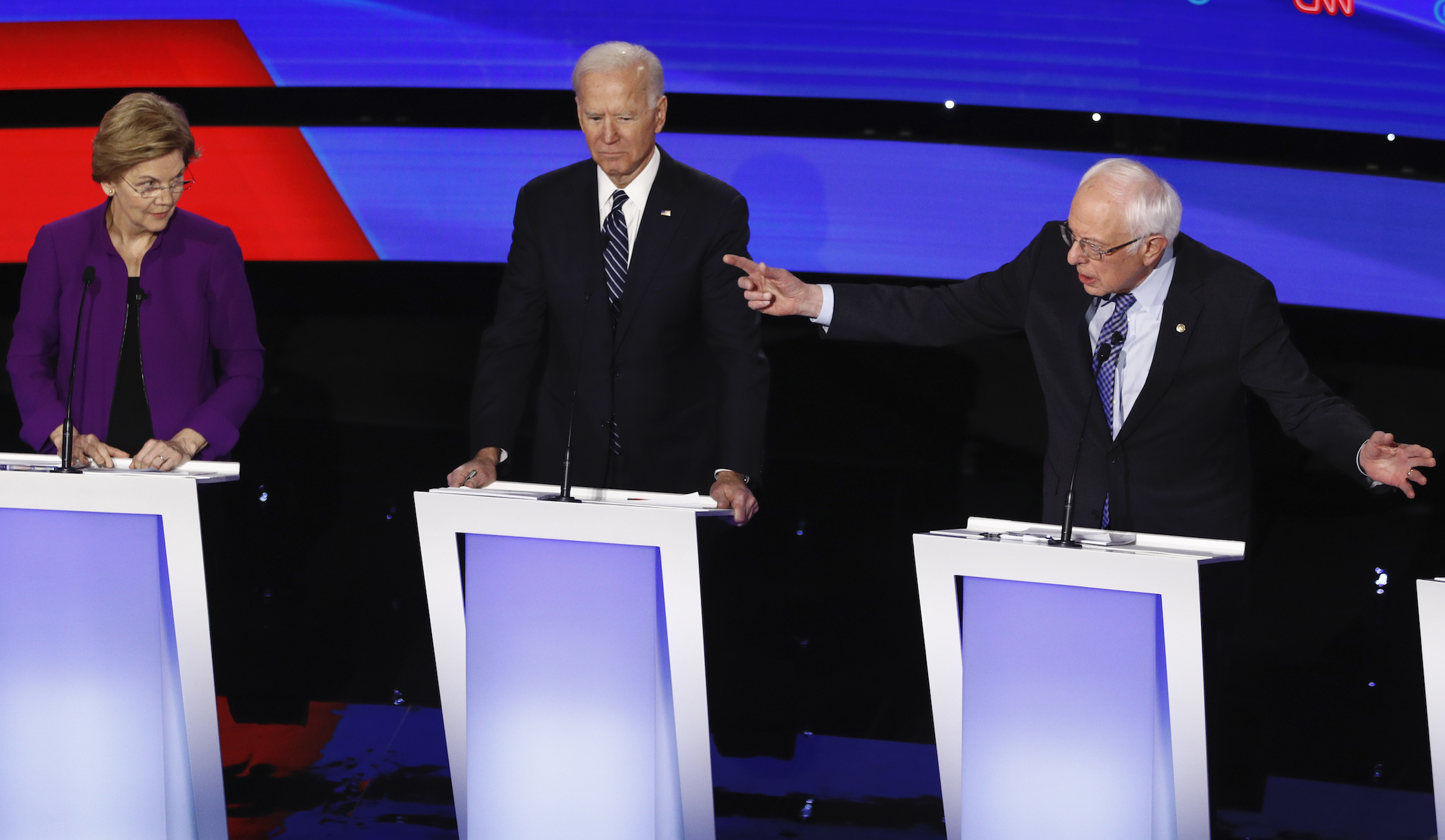
Democrats seeking to oust President Trump in 2020 largely skirted mentions of him in a low-key debate whose most impassioned moments included Bernie Sanders and Elizabeth Warren clashing over her claims that he said a woman can’t be elected president.
In a six-person debate in Des Moines, Iowa, less than three weeks before the state’s kickoff caucuses on Feb. 3, Warren insisted her senatorial colleague asserted in a 2018 meeting that a female candidate couldn’t claim the White House.
Recommended Stories


While Warren, 70, and Sanders, 78, didn’t get angry or show outward hostility, as many predicted, the tension was palpable.
“Well, as a matter of fact, I didn’t say it. Anybody who knows me knows that it’s incomprehensible that I do not believe a woman could not become president of the United States,” Sanders said. “This is what Donald Trump and some of the media want.”
The moderators ignored Sanders’s denial, prodding Warren to dish on how she responded to his statement during their private meeting.
“I disagreed,” she said. “Can a woman beat Donald Trump? Look at the men on stage. Collectively, they have lost 10 elections. The only people on this stage who have won every single election that they’ve been in are the women. Amy and me,” she added to applause, referring to Minnesota Sen. Amy Klobuchar, 59.
The pair’s dispute then spilled over into their different opinions of Trump’s signature trade deal with Canada and Mexico. Sanders won’t vote in favor of ratifying the agreement because it doesn’t address climate change, while Warren said she’d support it but will work for a better arrangement once she wins the White House.
Ironically, Warren and Sanders then effectively tag-teamed to counterpunch their center-left opponents on foreign policy and healthcare, particularly former Vice President Joe Biden’s 2002 vote, as a Delaware senator, to authorize the Iraq War.
Biden acknowledged his decision “was a mistake” but quickly pivoted to how former President Barack Obama, who slammed Hillary Clinton over the issue in 2008, still picked him as his running mate and “asked me to end that war.”
Biden, 77, accused Trump of “flat-out” lying about the threat posed to U.S. embassies overseas to justify the killing of Iranian Revolutionary Guard Quds Force leader Gen. Qassem Soleimani this month, escalating tensions in the Middle East. Yet, in what was a low-energy debate appearance, he said he would keep troops in the region to patrol the Gulf and assist in the fight against the Islamic State.
Klobuchar, who also had a shaky outing, declined to reprise her attacks against Pete Buttigieg, 37, over his lack of experience, instead touting his short tour of Afghanistan. But she said her record in the Senate proved she could deal with “these life and death issues” before emphasizing how Trump was taking the country “pell mell toward another war.”
For Buttigieg, the U.S. could remain engaged in the Middle East without having “an endless commitment to ground troops,” but the former South Bend, Indiana, mayor ripped Congress for not passing a new military authorization measure, proposing a three-year sunset clause in any future legislation.
Steyer, a billionaire environmentalist who was under pressure to prove he deserved to be in the debate, swiped at Buttigieg for not better representing his generation by advocating more forcefully for climate change action.
Trump was largely overlooked until the final minutes of the debate when the candidates were asked about the president’s looming Senate impeachment trial.
The top-tier contenders vying for their party’s nomination to challenge Trump in the fall — Biden, Buttigieg, Sanders, and Warren — are in a fluid race ahead of Iowa’s opening contest.
The latest gold-standard poll coming out of Iowa revealed last week 45% of likely caucusgoers could change their mind before next month. Tuesday’s debate, the first all-white event of the primary, was billed as one of their last chances to make their closing arguments to a wide audience.
