

“Do you have a statement for the Palestinians?” “What about your gaffes?” “Do you feel that your gaffes have overshadowed your foreign trip?”
No, that wasn’t the press corps last week greeting Hillary Clinton on her journey into foreign lands (middle America). That was the press corps screaming at the top of its lungs at Mitt Romney, the Republican presidential candidate, at a sacred Polish site, the summer before the 2012 election. More to the point: That was when the press had a candidate it wanted to manhandle.
Stay informed.Stay ahead.
Join Washington Examiner for unlimited access to the news, analysis, and commentary that matter most.
Already a member? Log in
In Clinton’s first week in this presidential race, meanwhile, the press treated her more like Kim Kardashian than the possible next commander in chief. Her personal tastes (in food, drink, transportation, and even clothes) spawned countless reports. And any sort of policy platform? Not so much.
It’s been an exceedingly bizarre affair. Consider this: Never before in American politics has a presidential candidate announced her candidacy and then disappeared for 48 hours. Until last week, that is, when Clinton did just that.
First, her team released a video—mostly featuring Americans representing myriad ethnicities and sexual orientations and even (briefly) the candidate herself.
“I’m getting ready to do something,” Clinton said, looking pale as a ghost straight into the camera. “I’m running for president. Americans have fought their way back from tough economic times, but the deck is still stacked in favor of those at the top,” said Clinton, who’s made probably around $20 million since leaving the State Department two years ago.
“Everyday Americans need a champion, and I want to be that champion. So you can do more than just get by, you can get ahead. And stay ahead! Because when families are strong, America is strong. So I’m hitting the road to earn your vote. Because it’s your time, and I hope you’ll join me on this journey.”
Clinton didn’t really want anyone to join her. No rally, no campaign events, and no interviews followed. The normal burst of attention a candidate would seek to harness was eschewed. Instead, Clinton wanted to be closeted with her closest campaign aides and play elusive.
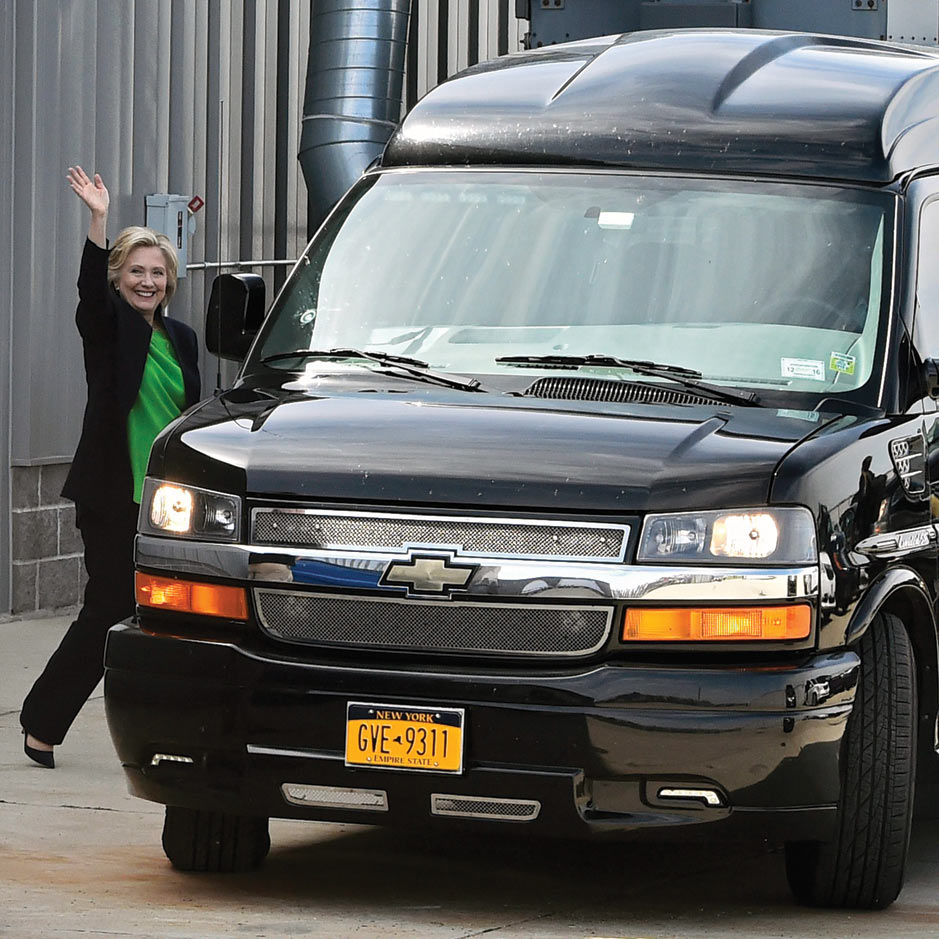
Then she got into her Secret Service-owned-and-driven luxury van (outfitted with a bed, a 29-inch TV, and lots of leather), and spent two days on the road incognito. When the celebrity candidate did emerge for a bite at a Chipotle in Maumee, Ohio, she wore dark sunglasses to pick up her food and dine—without, apparently, introducing herself to a single voter in that important swing state. (The manager of the eatery pulled the security camera footage of Hillary’s pit stop, which soon got disseminated to every corner of the Internet.)
Still, the Clinton high command did not want the campaign to elect Hillary Clinton to be perceived as being just about Hillary Clinton. That, they believed, would look to naïve American voters too much like her failed 2008 presidential bid. Instead they’d let the video announcement stand alone and allow the campaign to be about, well, nothing in particular. Her first night on the road, Sunday, April 12, Hillary for America (the campaign’s official title) sent out an email quoting journalists praising the video—and praising its emphasis on voters, not Clinton. Also in the email? The first of many references (most of which came directly from the campaign itself) to Hillary’s humility.
All the bragging about Clinton’s humility was a prelude to a listening tour, a rehash of sorts of her 2000 Senate run, when she successfully carpetbagged into the state of New York to run for Senate. That race was her first foray into elective politics. Her only other success was her easy reelection there six years later.
The beauty of a listening tour is simple: When you’re listening, you’re not expected to be talking. The conceit allowed Clinton to spend a few days in Iowa without actually saying anything of substance or answering questions.
She staged photo-ops for the press horde and, more important, for her own camera crew, which appeared to be in tow to film future campaign videos. The most illustrative moment came when a video captured reporters sprinting across a grassy community college field to catch a glimpse of the luxury van transferring Clinton from one building to the next. No one caught up to her.
The toughest criticism came from expressly liberal pundits who, despite their pretenses of independence, will surely climb aboard eventually. MSNBC host Rachel Maddow pointed out that the only issues Clinton talked about “sound[ed] like generic political slogans” that could have been adopted by any of her Republican opponents. Then Maddow mocked Hillary for talking about removing big money from politics. “This is going to be a $2.5 billion presidential campaign, maybe. There is about a, hmm, 98 percent chance that Hillary Clinton is going to be one of the two candidates in the general election in this $2.5 billion campaign. As such, I’m not sure anybody expected that an anti-Citizens United, anti-unlimited-money-in-politics plank, even potentially a constitutional amendment anti-money-in-politics plank would be one of the first things that she would put in her platform, but she has,” the liberal pundit snarked.
“The most baffling trend of all was what seemed like this State Farm commercial gone viral,” liberal TV pundit Jon Stewart said, referring to the launch video. “This is boring as s—,” Stewart sanctimoniously (yet correctly) declared.
In truth, of all the Democrats on the national scene, the Clintons historically have not been the ones to get a free pass from the media. The reporting up until Hillary’s announcement had asked important questions about the private email server she set up while secretary of state, which allowed Clinton to defy the Freedom of Information Act and other government archiving regulations.
But something drastic happened when Clinton announced. The schizophrenic liberal press, with a few exceptions, turned fawning. History was on the line—the first woman to be elected president. There was no rallying cry for Clinton to sit down for an interview and explain all the scandals that had plagued her in the months leading up to her announcement. (By contrast, Marco Rubio, who announced a day after Clinton, gave at least seven interviews.)
Perhaps it was a good thing Hillary Clinton drove to Iowa last week in a Secret Service caravan. There’s no way she would have been able to fit all her baggage in the overhead bin. And, hiding in her van, unlike failed presidential candidate Mitt Romney, she didn’t have to answer for all her gaffes.
Daniel Halper, author of the bestselling Clinton, Inc.: The Audacious Rebuilding of a Political Machine (Broadside Books), is online editor of The Weekly Standard.
