Imagine cresting the steps of the Lincoln Memorial and instead of seeing the imposing-yet-human white stone sculpture of the president who presided over the Civil War, coming face to face with a sculpture of the log cabin he grew up in.
The design was one iteration of the memorial that for generations has inspired its visitors and symbolized unity and freedom, said Diana Schaub, a Loyola University Maryland political science professor speaking at a panel discussion on memorial architecture. But often, those first versions end up on the drafting room floor.
The World War II Memorial originally included a 70,000-square-foot underground museum; today’s Franklin Delano Roosevelt Memorial is the third version of a design that was massively overhauled and took nearly three decades to iron out, said Eric Wind, secretary and chairman emeritus of the National Civic Art Society.
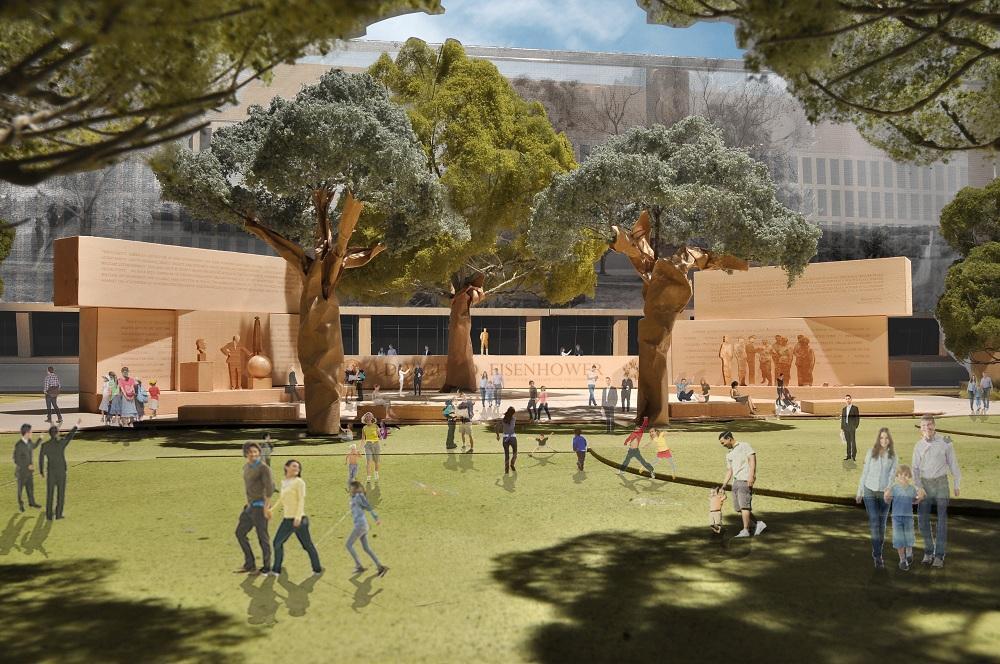
But the proposed Dwight D. Eisenhower Memorial, slated to be the next memorial in Washington’s monument core, has largely stayed the same, despite protests from the art community and the Eisenhower family.
“They’re tweaks,” said Bruce Cole, a senior fellow at the Hudson Institute, speaking after a discussion on the role of memorials in civic life hosted by the American Enterprise Institute last week.
Cole added that “adjustments” made during prior memorial approval processes have “included going back to the drawing board.”
In the scrapped version of the Lincoln Memorial, designers felt that Honest Abe, also known for his humility, wouldn’t like a grandiose statue of himself, said Schaub. Famed architect Frank Gehry, the designer of the controversial Eisenhower Memorial, has used similar reasoning for the centerpiece of his design: a life-size statue of Eisenhower as a young cadet looking out at sculpted scenes of his later accomplishments as World War II supreme commander and two-term president.
Some aspects of Gehry’s design have changed. The standing cadet was originally a sitting young boy, and the sculpted scenes used to be etched into stone blocks. But his changes unveiled last week on Capitol Hill didn’t touch the most controversial feature: towering stainless steel tapestries that border the four-acre site at Independence and Maryland avenues and depict the prairielike landscape of Eisenhower’s boyhood home of Abilene, Kan.
The many elements of Gehry’s design, and the Dwight D. Eisenhower Memorial Commission’s seeming support of it, “represents what’s wrong with memorial trends today,” said Michael Lewis, a Williams College art and architecture professor.
“The instant it tries to say too many things, it is no longer a monument but a Russian novel,” he said.
The memorial design has yet to be approved by the commission, which is also consulting with the Eisenhower family.