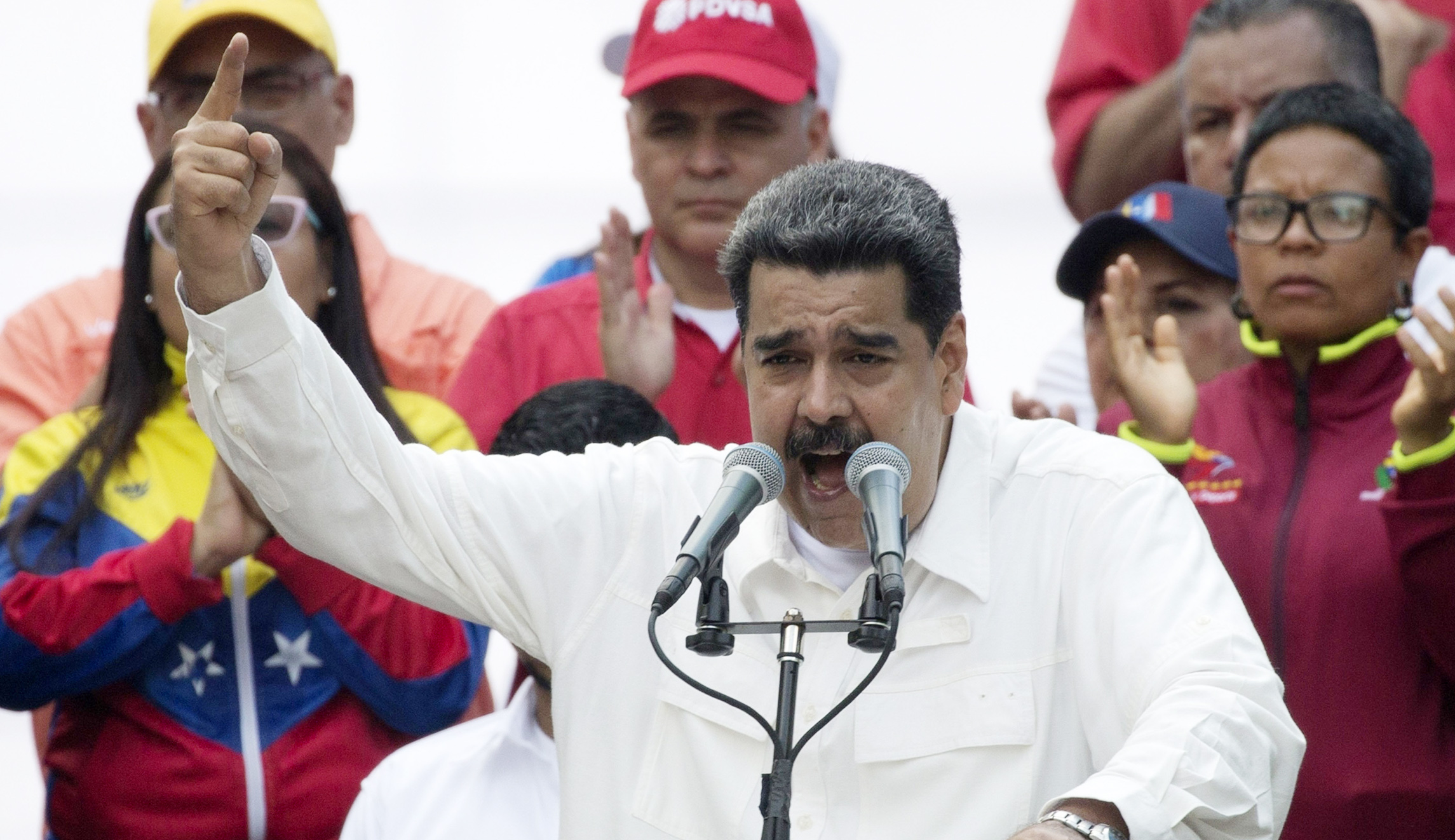
Leading European allies are undermining negotiations to oust Venezuelan strongman Nicolás Maduro because of their hesitance to impose sanctions on the regime, according to a top U.S. official.
“Many of the Europeans are making a real mistake here, because many of them take the position, while these negotiations are ongoing, we shouldn’t do sanctions,” Elliott Abrams, the State Department’s special representative for the Venezuela crisis, said Wednesday. “And this is exactly wrong, because while they are ongoing, if you want them to succeed, you need to increase the pressure on the regime to compromise.”
Maduro’s envoys have been meeting in Barbados with representatives of top opposition lawmaker Juan Guaidó, whom President Trump and other western powers recognized as the legitimate interim president in January. The U.S. is not a direct party to the talks, which have been mediated by Norway, but the administration has been trying to rally international pressure against the regime while offering amnesty if Maduro steps aside peacefully.
“The United States is not in this for some kind of vengeance,” Abrams said during a discussion at the Foundation for Defense of Democracies, a Washington-based think tank with close ties to the administration. “We are attempting to help Venezuelans recover their democracy.”
Guaidó’s team is using the Barbados talks to push for Maduro to step aside and permit free elections to form a new government, the lawmaker’s envoy in Washington confirmed, while endorsing Abrams’ criticism of the European allies.
“We need to increase that pressure from the European countries,” Ambassador Carlos Vecchio said at the forum. “In a certain way, they have been bypassing the sanctions from the U.S. using Europe and we need to close that door.”
Most European Union countries recognize Guaidó, but a handful of nations have thwarted a consensus to crack down on Maduro. The opposition leader’s position has strengthened in recent weeks, however. Greece cut ties with Maduro earlier this month, after a center-right coalition defeated the left-wing leadership that had refused to recognize Guaidó. Maduro was also weakened by a report from the United Nations’ top human rights watchdog, Michelle Bachelet, who confirmed that regime “registered 5,287 killings, purportedly for ‘resistance to authority’” in 2018.
That report “had a real impact on Western Europe,” according to Abrams, who thinks his efforts to convince holdouts such as Italy to back new sanctions might soon bear fruit.
“I hope they do a robust list of individuals involved in human rights violations,” he said. “We’d also like to see them [impose] travel restrictions, because a lot of the ill-gotten stolen funds of the Venezuelan people are being spent living the high life in Europe, and they should stop that.”
Abrams emphasized that these sanctions should be perceived as part of an effort to convince Maduro to step aside peacefully in exchange for the amnesty offer, even if that deal seems unsatisfying in light of the regime’s apparent crimes.
“If you look at every Latin American transition to democracy that I can think of in the last 30-40 years, there is a negotiation, and there is a kind of transitional justice that isn’t really justice,” he said. “There is always some kind of compromise in which there is no perfect justice because country after country chooses peace, democracy, development over justice, frankly. It’s a compromise. And I think that that will happen in Venezuela.”
