

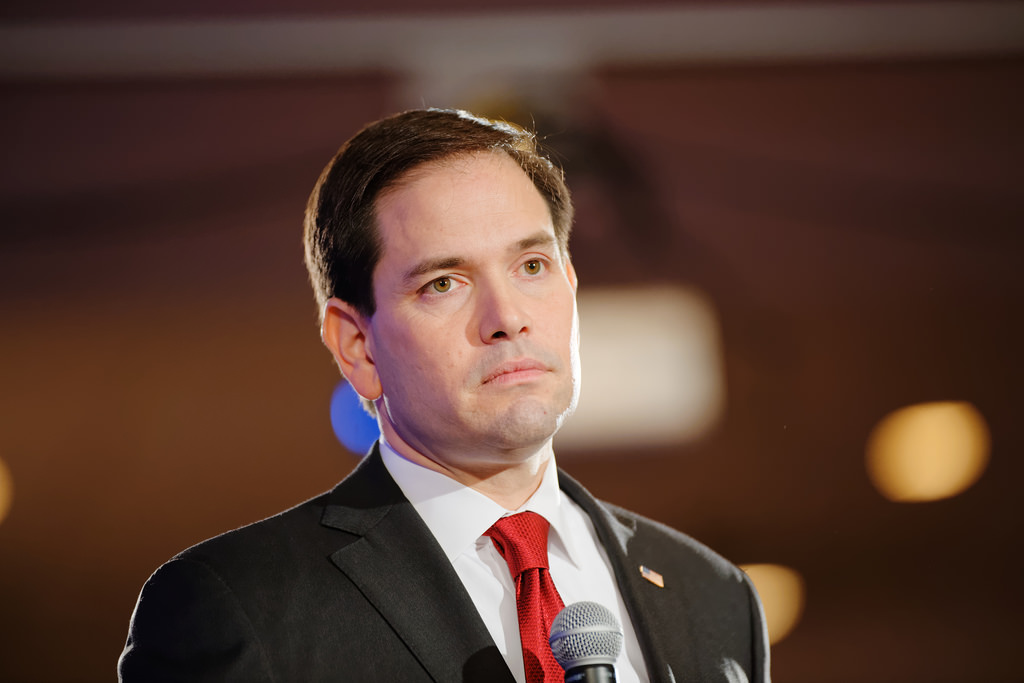
With Marco Rubio dropping out tonight, you’re going to hear a lot of theorizing about why he lost. It was the Gang of Eight. It was Trump. It was the anger. It was the out-of-touch elites. None of this is correct.
For a long time Marco Rubio was the odds-on favorite to be the Republican nominee. Why? He didn’t raise the most money. He was never higher than third in the RealClear poll average. He did not have any obvious base of electoral support or geographic safe house. Even his home base of Florida was going to be a dog fight with Jeb Bush. The only thing Rubio had going for him was his innate political skill.
Yet Rubio was such a tremendously gifted candidate that despite his situational liabilities, his personal assets were enough to make him the smart-money favorite. And not just the smart-money: You can tell who campaigns fear by watching who they spend their money attacking, and the rest of the Republican field spent its dollars through the fall and winter going after Rubio, despite the fact that he was always in the second tier of the polls.
So what happened? Rubio’s participation in the Gang of Eight was always his Achilles Heel, yet he seems to have finessed the issue to the point that it became only a minor liability. Exit polls consistently showed that immigration was a lower-level concern. For instance: in Florida, where Trump thrashed Rubio, 12 percent of voters said immigration was their top concern, compared with 22 percent who said terrorism, 26 percent who said government spending, and 35 percent who said the economy/jobs.
It’s not clear that Trump’s rise hurt Rubio, either. Or at least, that Trump hurt Rubio any more than he hurt other Republicans. Rubio was never a threat to win either Iowa or New Hampshire, so it wasn’t Trump who blocked his rise in the early states. Neither is there any evidence that voters were simply “too angry.” Rubio, Cruz, and Kasich—none of whom are especially angry pols—have consistently taken about 65 percent of the vote. And he wasn’t a tool of the Republican elites. The Republican establishment rallied to Rubio three weeks ago, only as a last resort, and with something less than its full support.
What killed Rubio, then? It was the fundamental dynamics of the race which were obvious and foreseeable from the start. In a field of 17 candidates, with Jeb Bush sucking up all of the early institutional support and money and with no natural early state, Rubio’s path was always incredibly narrow. To navigate it, he had to winnow the field early and consolidate establishment support quickly (in order to survive the opening burst from a strong southern candidate) which would then allow him to build out as the consensus candidate beginning in March. Practically speaking, that meant achieving two immediate objectives.
First, Rubio had to show well in Iowa. He didn’t have to win, but he had to place high enough to give him some momentum going into New Hampshire. Second, he had to beat the three-headed monster of Chris Christie, Jeb Bush, and John Kasich in New Hampshire. By beating the four of them, he would cut down their campaigns ten days into the race and immediately begin absorbing their supports, both electoral and logistical.
Not beating all three of these candidates in New Hampshire wouldn’t kill Rubio’s campaign immediately, but it would be fatal just the same. Rubio could still compete and would probably still emerge from that pack. But it would be too late: The Southern candidate would roll up big victories through the SEC primary and by the time Rubio consolidated, the nomination would be slipping away.
Which is what happened to Rubio, almost to the letter. He didn’t get the job done in New Hampshire. By allowing Bush and Kasich to soldier on, Rubio’s campaign became the walking dead.
There were lots of tactical contributions to Rubio’s fall along the way. Having Jeb Bush and his affiliates drop tens of millions of dollars in negative advertising on his head even when Bush had no pathway to the nomination didn’t help. (And this can’t be emphasized enough: At no point since October was Bush viable even for a second.) Having the media gift Donald Trump with $1.9 billion—that’s with a “b”—in free airtime didn’t help either.
But the core of Rubio’s failure was much simpler: Too many candidates, the resource-warping effect of Jeb Bush, and bad early-state geography left him with only one route to the nomination. And in New Hampshire he didn’t close out on the guys needed to beat.
In a cycle of weirdness and chaos, Rubio’s demise is one of the few things that unfolded about how you might have expected.
