

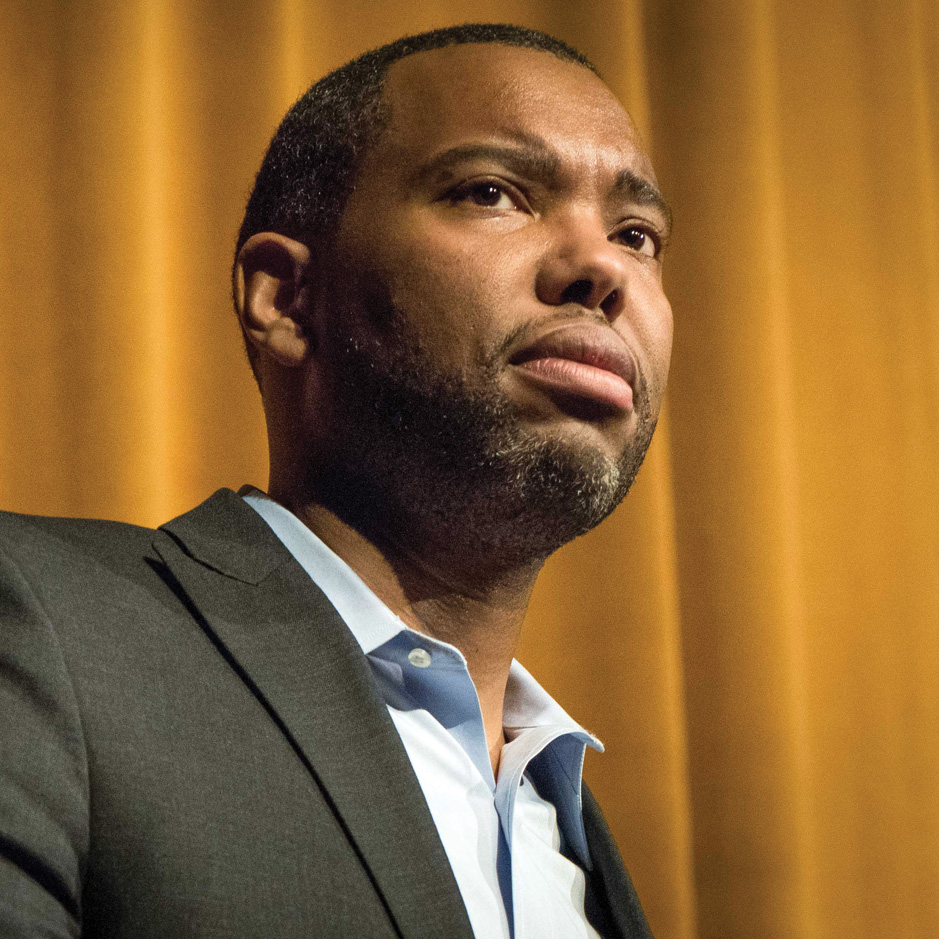
Maybe “Culture Belongs to Everyone,” as they say at New York City’s Shakespeare in the Park shows, but the works of Atlantic essayist and blogger Ta-Nehisi Coates appear to exist in another realm altogether. In the weeks since the publication of Between the World and Me, Coates’s letter to his teenage son about the perils and promise of being black and male in America, critics have struggled to find adjectives to match his achievements. Carlos Lozada of the Washington Post summed up recent discussions of who counted as America’s foremost “public intellectual” by concluding: “Coates has won that title for himself, and it isn’t even close.” New York Times film reviewer A.O. Scott tweeted: “ ‘Must read’ doesn’t even come close. This from @tanehisicoates is essential, like water or air.”
The book’s devotees ask not just whether we can “come close” to fathoming its genius but whether we, and especially the whites among us, have the moral standing even to aspire to. The novelist Michael Chabon begs pardon:
Recommended Stories


The Times columnist David Brooks was clearly troubled by a passage in which Coates recalls watching the World Trade Center towers burn on September 11, 2001, and remembers having seen “no difference” between a policeman who had shot one of his college classmates and those police and firemen then being incinerated in the buildings. (“They were not human to me.”) But Brooks managed to catch himself before he committed an act of lèse-majesté: “I suppose the first obligation is to sit with it,” he wrote, “to make sure the testimony is respected and sinks in. But I have to ask, Am I displaying my privilege if I disagree? Is my job just to respect your experience and accept your conclusions? Does a white person have standing to respond?”
Other white public intellectuals were ready to offer guidance. Wrote Toronto National Post columnist Emily Keeler: “It’s despicable for Brooks to position the destruction of people’s lives as some kind of learning opportunity for white people. . . . Coates isn’t writing to or for us, fellow white people.” But Keeler could not help taking a little peek at the book herself, and now, she writes, she “wouldn’t give up the chance to bear witness to that bracing act of love, and perhaps, to feel changed by it, for the world.”
Plunder and reparation
For decades, several books every publishing season have promised an “authentic” account of the experience of being black in America. But the 39-year-old Coates, a Baltimore native, has struck it very big. We learn from New York magazine that he even shows up late for meetings with the president. Coates claims as his model a classic of the black autobiographical genre, James Baldwin’s The Fire Next Time (1963). It is not immediately clear, though, what distinguishes Coates’s effort from the heap of less distinguished books written in Baldwin’s wake. To figure this out one must look at “The Case for Reparations,” a 16,000-word essay Coates wrote for the Atlantic last year, which won him a wide Internet following. The article makes no explicit “case” that someone should pay today’s blacks for the mistreatment of yesterday’s. The case gets made by implication, through a thumbnail history of American slavery, the racial prejudice that underlay it, and the inequality and injustice that survived it.
Coates asks us to accept that reparations, far from being unthinkable, have always made intuitive sense to reasonable Americans. This requires a slippery kind of redefinition, in which a Chicago homeowners’ association suing slumlords, or an eighteenth-century slave claiming part of her fled Loyalist owner’s estates, is “seeking reparations.” It also requires racializing certain race-neutral phenomena. Until the introduction of federal housing guarantees in the 1930s, whites, it goes without saying, were the biggest victims of housing financed “on contract”—i.e., through a system in which the buyer acquires no equity until the house is fully paid for. In the 1950s Chicago that Coates describes, it was black newcomers who suffered most. Coates notes, rightly, that federal housing aid made suburbanization possible. He adds that federal housing authorities actively reinforced segregation by accepting restrictive covenants and other instruments of exclusion and by “redlining” (classifying certain neighborhoods as bad credit risks). A hallmark of Coates’s style is the lurid metaphor that blurs the past and the present, the imaginary and the real, and incites ideological combat. “In America,” he writes, “there is a strange and powerful belief that if you stab a black person 10 times, the bleeding stops and the healing begins the moment the assailant drops the knife.”
From this point, Coates orates, rather than reasons, his way to a reinterpretation of American history. The key concept is “plunder.” White Americans did not, as the heroic narrative of civil rights would have it, move from enslaving blacks to excluding them, and then, starting in the 1950s, steadily break down the exclusion until we reached the more equal world of today. No—Coates’s argument is one of “structural racism.” To this day, society is structured so that whites can continue to rip off blacks. Indeed, they cannot do without blacks, whose exploitation is their main source of prosperity. America’s entire democratic Constitution was built on goods robbed under color of law and still rests on that robbery. “By erecting a slave society,” Coates writes, “America created the economic foundation for its great experiment in democracy.” Reparations are owed because today’s system is the same system in essence, and all whites participate in it. “White supremacy,” he writes, “is not merely the work of hotheaded demagogues, or a matter of false consciousness, but a force so fundamental to America that it is difficult to imagine the country without it.”
Coates does not address such questions as whether the Constitution, unsubsidized by plunder, is something the country can still afford, or whether democratic verdicts passed under conditions of plunder—including the decision to wage war against the slaveholding South in 1861 and the passage of civil rights laws in the 1960s—are to be thought legitimate or illegitimate. But he does come up with a basis for a “bottom line”: the difference between black and white per capita income, multiplied by the population of blacks, to be paid each year for “a decade or two.” It is a figure that would today come to between $4 and $9 trillion (between a quarter and half the U.S. GDP), to be supplemented perhaps by “a program of job training and public works that takes racial justice as its mission but includes the poor of all races.”
One more element in this view of reparations should detain us, and it is the key element: The reparations under discussion will not discharge the debt whites owe to blacks. “We may find,” Coates writes, “that the country can never fully repay African Americans.” What he is proposing is ultimately less a regime of reparations for blacks (since nothing can be fully “repaired”) than a program of infinite penance for whites. To judge from the reaction to Coates’s book, white intellectuals are ready to endorse this idea almost unanimously.
X marks the spot
Between the World and Me uses this plunder-based model of the American race problem as a way to understand the recent wave of highly publicized incidents involving police violence against young black men. It repeats many themes from the reparations article. But it is written in a very different idiom—as a rambling, reminiscent, repetitive, hortatory, easily distracted letter of advice to Coates’s teenage son. The evidence mustered in the reparations article was tendentious, but there was a good deal of it. Coates cites historians Thomas Sugrue and Kenneth Jackson and the late Tony Judt’s discussion of Israeli controversies over German reparations. This new book doesn’t use evidence at all. It is a performance, an oration, an affirmation: a cri de coeur for those who are well-disposed to it, a harangue for those who are not.
Violent confrontations between youth and law enforcement are invoked, not explained. When Coates alludes, for instance, to his son’s shock at finding out on television one night last autumn that “the killers of Michael Brown would go free,” he presents the episode as a self-evident miscarriage of justice. That night, which ended in riots in St. Louis, was certainly a tense one, and a politically engaged person can be forgiven for getting angry or downcast in front of a TV set. But months have passed, and the best evidence we now have is that the policeman who shot Brown should indeed have walked free. Not even former attorney general Eric Holder thought there was enough evidence for an indictment. And Holder is a man whose attentiveness to the very questions of police prejudice that preoccupy Coates led the historian and activist Michael Eric Dyson to call him a “straight-up-and-down race man.”
Someone who has not read Between the World and Me may have the sense that reviewers are dodging the nitty-gritty of Coates’s argument about police violence. They are not. There is no argument. It is no part of Coates’s project to weigh the evidence in the varied cases of, say, Trayvon Martin, Michael Brown, Eric Garner, Walter Scott, and Freddie Gray; to consider whether high crime rates in black neighborhoods may provoke, and even justify, more aggressive policing there; or to ask whether the vividness and efficiency of our new information technology might not be causing us to overreact to a handful of incidents among the millions of encounters between police and suspects each year. (That is, we might assume we’re seeing the tip of the iceberg when what we’re seeing is the iceberg.) Coates assumes police guilt in each instance. It is part of the “structure.”
The book, in fact, develops no arguments of any kind. In this sense it is true to the literary device Coates uses to frame it. Father-to-son letters tend to be written in a somewhat private language, and are rarely given over to logical demonstrations of truth or falsity. In place of arguments, Coates has a field of favorite subjects, or themes, which he crisscrosses haphazardly, as if running a lawnmower, for the duration of the book, sometimes going back over territory he has covered before, and leaving certain important patches unmowed. One can lay out the half-dozen most important of these themes:
Plunder. The white plunder of blacks, he writes, “has matured into habit and addiction; the people who could author the mechanized death of our ghettos, the mass rape of private prisons, then engineer their own forgetting must inevitably plunder much more.” The plunder model is more suited to alleging bankers’ exploitation than policemen’s violence. In fact it creates a logical problem—one cannot exploit something and destroy it at the same time—that Coates seeks to resolve by introducing a mystical-sounding concept of bodies.
Bodies. The “black body” is invoked in a variety of ways, sometimes Strangelovean (“This need to be always on guard was an unmeasured expenditure of energy, the slow siphoning of the essence. It contributed to the fast breakdown of our bodies”), sometimes minatory (“The police departments of your country have been endowed with the authority to destroy your body”), sometimes erotic (“We are all our beautiful bodies and so must never be prostrate before barbarians, must never submit our original self, our one of one, to defiling and plunder”).
Nostalgia. Coates loves the literature of the days when the struggle between blacks and whites was more obviously Manichean than in our own era of mass immigration, the EEOC, and shopping malls. A curious element of this book is its vocabulary. The word “African-American,” imposed on American usage with partial success since the 1980s, appears only twice; “black,” which appears 208 times, is Coates’s preferred term. “Affirmative action” does not appear in the book in any form. Nor does “Obama,” although Coates tells his son at one point, “I don’t know what it means to grow up with a black president, social networks, omnipresent media, and black women everywhere in their natural hair.”
Howard University. A main repository of this nostalgia is historically black Howard University, in Washington, D.C., which Coates attended, and which he describes variously as “the vastness of black people across space-time” and “my only Mecca.” He is grateful to the faculty for having encouraged him to take with a grain of salt the “weaponized” history he confesses a taste for, and alludes to a contemporary at school named Prince Jones who was killed in a confrontation with police in Virginia in 2000.
Atheism. Coates insists vehemently on his atheism. Since he does not bother to demonstrate, Christopher Hitchens-style, any grounds for nonbelief, his primary purpose seems not theological but political. Coates wishes to disaffiliate himself from the mostly Christian-derived theories of nonviolence, associated with Martin Luther King Jr. and drummed into the heads of schoolchildren each Black History Month, through which all Americans under 50 have come to understand the civil rights movement. (Coates is quite right that this is an oversimplification of what was a highly varied uprising, but he does not dwell on the subject.) Such theories, as Coates sees them, mean “exulting non-violence for the weak and the biggest guns for the strong.”
Malcolm X and black nationalism. Coates claims descent instead from the alternative tradition of Malcolm X, who professed indifference to whether black emancipation came through the ballot or the bullet. Coates’s father, the subject of his first memoir, had been a “local captain” in the Black Panther party in the 1960s. Coates reveres him, and the Black Panther movement generally. “I was attracted to their guns,” he writes of his youth, “because the guns seemed honest. The guns seemed to address this country, which invented the streets that secured them with despotic police, in its primary language—violence.”
Real blacks, fake whites
If that were the whole of the book, there would be little to excite any reader—and, in terms of subject matter, that is the whole of the book. But underpinning these discussions is a mythologized, even metaphysical idea of race, and this is what has imparted to certain readers an exhilarating promise of liberation. Coates’s world is, in the literal sense, unprincipled. It is arbitrary. Sauce for the goose is never sauce for the gander. When whites are at issue, he urges us to “forget about intentions”—protestations that one is not a racist don’t keep blacks from being left to suffer in the streets. When it comes to blacks, intentions matter profoundly—we must understand that the menacing boys of Coates’s childhood Baltimore were more afraid than threatening; most likely they were “girding themselves against the ghosts of the bad old days when the Mississippi mob gathered round their grandfathers so that the branches of the black body might be torched, then cut away.”
Blackness is real in this world, but whiteness is fake. Coates uses theories of “racecraft” that have lately come out of academic cultural studies departments, which hold race to be a pure social construction, but he is unwilling to apply them with the same rigor to his own blackness. “We will always be black, you and I,” he tells his son, “even if it means different things in different places.” When Coates talks in ghetto slang with a stranger at an airport, they are communicating as “two particular strangers of this tribe that we call black. . . . In that single exchange with that young man, I was speaking the personal language of my people. It was the briefest intimacy, but it captured much of the beauty of my black world.”
Whiteness, by contrast, is presented as a figment of the imagination, a kind of delirium. Strictly speaking, there are no whites, there are only “these new people who have been brought up hopelessly, tragically, deceitfully, to believe that they are white.” Sometimes Coates calls this belief “the Dream,” a concept he conflates with the American Dream. The Dream is not just a “deceitful” but an utterly malevolent force. It is what justifies the plunder of blacks:
This theme—that whiteness, in all its falsity, is parasitical on blackness, in all its authenticity—is one he returns to again and again:
Whiteness, defined this way, becomes a kind of bloodsucking subhumanity. “Part of me thinks that your very vulnerability brings you closer to the meaning of life,” Coates tells his son, “just as for others, the quest to believe oneself white divides them from it.” Black Is Beautiful is a beautiful message, but there are two senses in which one can say it. You can say “Black [Too] Is Beautiful” or you can say “[Only] Black Is Beautiful.” This book leans towards the latter view.
Focusing his rage on “people who believe themselves to be white,” as opposed to whites, is a punctilio that lets Coates write to two contradictory ends. First, it shields him, on a technicality, from imputations of hatred and scapegoating. But second, by blurring lines of racial identity, it allows him to scapegoat whites more broadly, even for misdeeds they did not commit. The street gangs of Baltimore who terrified Coates when he was young were black—but to speak of “black-on-black crime” is, in his view, to indulge in “jargon, violence to language, which vanishes the men who engineered the covenants, who fixed the loans, who planned the projects, who built the streets and sold red ink by the barrel.” The Maryland police officer who shot Coates’s classmate Prince Jones in September 2000 was black, as were many of the politicians responsible for hiring him—but they do not bear the ultimate blame for Jones’s death. Who does? “The Dream of acting white, of talking white, of being white, murdered Prince Jones as sure as it murders black people in Chicago with frightening regularity.”
There is one passage in the book that has been taken up with such zeal by street protesters and the Black Lives Matter movement that it can stand as the book’s condensation and synopsis:
Here is what I would like for you to know: In America, it is traditional to destroy the black body—it is heritage.
If the country really is as Coates describes it here, with such traditions, such a heritage, what is the proper response to it? In the passage where he describes to his son his indifference to the attacks of September 11, 2001—the passage that made David Brooks so mad that he nearly interrupted his thank-you letter to Coates—Coates notes that there was once a slave market in lower Manhattan. He implies to his son that forgiveness is his to confer, and urges him to withhold that forgiveness:
The charge that Coates is leveling at the present-day United States is genocide. The project, the “struggle” that Coates is recommending to his son, is retribution for genocide. You would need to be a “public intellectual” not to see where this is tending.
Dazed and confused
If certain readers have not been able to see it, that is partly because nowhere in this book is Coates’s meaning as clear as it ought to be. One is constantly running across sentences that appear to have been mistypeset: “Remember the rumbling we all felt under the beauty of Paris, as though the city had been built in abeyance of Pompeii.” Even critics who extol Coates’s prose admit that there are moments when they haven’t the foggiest idea what he is talking about. Michiko Kakutani of the New York Times praised his “lyric and gritty prose” but grants she found his leitmotif of “the Dream” “somewhat confusing.” David Brooks calls Coates’s definition of whiteness “confusing,” too, and says of his 9/11 thoughts: “You obviously do not mean that literally today (sometimes in your phrasing you seem determined to be misunderstood).” The book, apparently, is eloquent in the sense of “hard to understand.”
Opacity serves Coates. His narrative often does exactly what he excoriates the white American narrative of race for doing: It obscures agency. It leaves unclear who is doing what. Deeds and misdeeds for which someone ought to be assigned responsibility happen like weather. Coates’s descriptions of his childhood neighborhood are hazy—in his account of a gang member showing a gun in the local 7-Eleven parking lot, it is never clear whether the boy is threatening Coates or someone else. Coates’s late classmate Prince Jones, killed by a policeman in Virginia, is waved at the reader as a totem of Coates’s own proximity to real violence and injustice. It is only after recurring professions of his anguish at Jones’s death that Coates notes, 10 pages before the book’s close: “The fact is that I had not known Prince all that well.”
Where Coates is most precise is when he is recasting, to tendentious and incendiary effect, what others have said. This is a trope that will be familiar to readers of his reparations article (“In 1949, a group of Englewood Catholics formed block associations intended to ‘keep up the neighborhood.’ Translation: keep black people out.”). Here, he describes a strange encounter on the West Side of Manhattan, in which, he says, a white woman, coming off an escalator, pushed his 4-year-old son and said, “Come on!” and Coates threatened her:
This book is short, simple, monomaniacal, and punchy. That can be a plus. “Visceral” and “direct” are two perfectly appropriate adjectives that have been much conferred. And yet, critics have felt the need to praise the book for the very virtues in which it is most obviously deficient. Jack Hamilton, an assistant professor at the University of Virginia, writes in Slate: “Coates is more teacher than preacher, a polymath whose breadth of knowledge on matters ranging from literature to pop culture to French philosophy to the Civil War bleeds through every page of his book, distilled into profound moments of discovery, immensely erudite but never showy.” Not a word of this is true. Coates may well possess this knowledge privately, and there are signs of it in his reparations article, but it is wholly absent from his book. What Civil War? The two pages describing battlefields he toured with his son after page 99? What French philosophy? Coates mentions Sartre and Camus once, on page 122, but only to say he’s never read them. Coates himself, while he professes a love of books and learning, makes no claim to erudition, “immense” or otherwise.
In general, black writers have been more balanced in their assessment of the book. The linguist John McWhorter, for instance, who is one of the rare American commentators of any race who actually can lay claim to a broad erudition, was taken aback by the “almost tearfully ardent praise” for Coates’s reparations piece. McWhorter dismissed one of Coates’s more exuberant fans as having written “the kind of thing one formerly said of the Greatest Story Ever Told,” and described Coates as fulfilling the role of a priest in some new religion of antiracism.
Majoritarian pigs
Coates has written a provocative book about one of the pivotal issues of our time: the confrontation between black youth and forces of order. With an Internet and grassroots campaign having arisen to delegitimize the latter, it would be surprising if the issue did not gather intensity in coming months. Coates’s contribution to the discussion is not well written or well reasoned or trustworthy. But it is politically engaged, and exhilarating in the way that political engagement is exhilarating. If the book itself tells us little about the issue, the reaction to the book among intellectuals tells us a lot. It is evidence that something is changing at the core of our literary culture. Either critics have lost sight that there is such a thing as an unworthy book on a worthy subject; or they are too terrified of being tarred as racists even to give an accurate description of a book about race.
Coates’s book sets a mood rather than conducts an argument. Feeling demonized himself, he offers a counter-demonization that will convey forcefully to whites (or at least those who read it) that blacks (or at least one black author confident he speaks in their name) think white culture worthless and predatory. It will convey, too, that he considers the measures put in place to secure racial equality since the civil rights legislation in the 1960s laughably inadequate.
Both races believe race relations have deteriorated in recent years, a New York Times poll has found, with two-thirds describing them as “generally bad.” There was a moment of solidarity over the murder of nine black Christians in South Carolina, culminating in a successful biracial movement to remove the Confederate battle flag from the state’s capitol. In fact, a poll taken in mid-July by the Pew Research Center found a slim majority of whites (53 percent) saying, for the first time ever, that “the country needs to continue making changes to achieve racial equality.” But each side is perpetually in danger of missing, or minimizing, the sacrifices the other has had to make over the last half-century. Heightening the tension are the almost constant admonitions to whites that the country’s demography is changing and they will someday be outnumbered. The implicit message is that concessions will be imposed on them, whether they like it or not.
So the lavish praise—and even gratitude—that Between the World and Me has elicited from white elites is surprising. Truculent, aggrieved, allergic to compromise, Coates has nonetheless seen his book blown to the top of the bestseller lists on a powerful tailwind of antiracism. The cynical way of explaining its success is to note that the interests of privileged minorities (royal families, oligarchies, coteries of literary critics) are often the same as those of underprivileged minorities. Both of them distrust and seek protection against electoral majorities. In this light some of the most impassioned passages in the book are revealing. “The problem with the police is not that they are fascist pigs,” Coates writes at one point, “but that our country is ruled by majoritarian pigs.” Coates returns to this rare word in his closing pages. “We are captured, brother, surrounded by the majoritarian bandits of America.” A median voter might find such statements appalling. A New York literary critic, with his own misgivings about majoritarian views on gay rights and guns and school prayer, might find them consoling.
A less cynical explanation is to say that McWhorter is right about antiracism’s having become a substitute religion. In demanding from whites a program of infinite penance, Coates is offering them a metaphysical purpose. Many seem to welcome it, as did the Germans who flocked to the lectures of Daniel Jonah Goldhagen when he published Hitler’s Willing Executioners in 1996. Coates’s book runs whites down—but at least it gives them a role. In our day, the peer pressure to join the procession of penitents gains momentum online, from what students of Internet memes call “virtue signaling.”
“My experience in this world,” Coates writes, “has been that the people who believe themselves to be white are obsessed with the politics of personal exoneration.” He needn’t have made that explicit. It is plain from the style of his prose. As Bertrand Russell once wrote: “A skillful orator, when he wishes to stimulate warlike feeling, produces in his audience two layers of belief: a superficial layer, in which the power of the enemy is magnified so as to make great courage seem necessary, and a deeper layer, in which there is a firm conviction of victory.” But to rely on whites’ desire for exoneration may be to miscalculate, in just the way various villains in Coates’s narrative once did, from the builders of the Southern cotton economy to the planners of the all-white towns who succeeded them. They, too, looked at black-white relations as they existed in one era, in one place, in one social class, and mistook them for laws of nature, forgetting that race relations can always get a lot better, and just as easily get a lot worse.
Christopher Caldwell is a senior editor at The Weekly Standard.
