

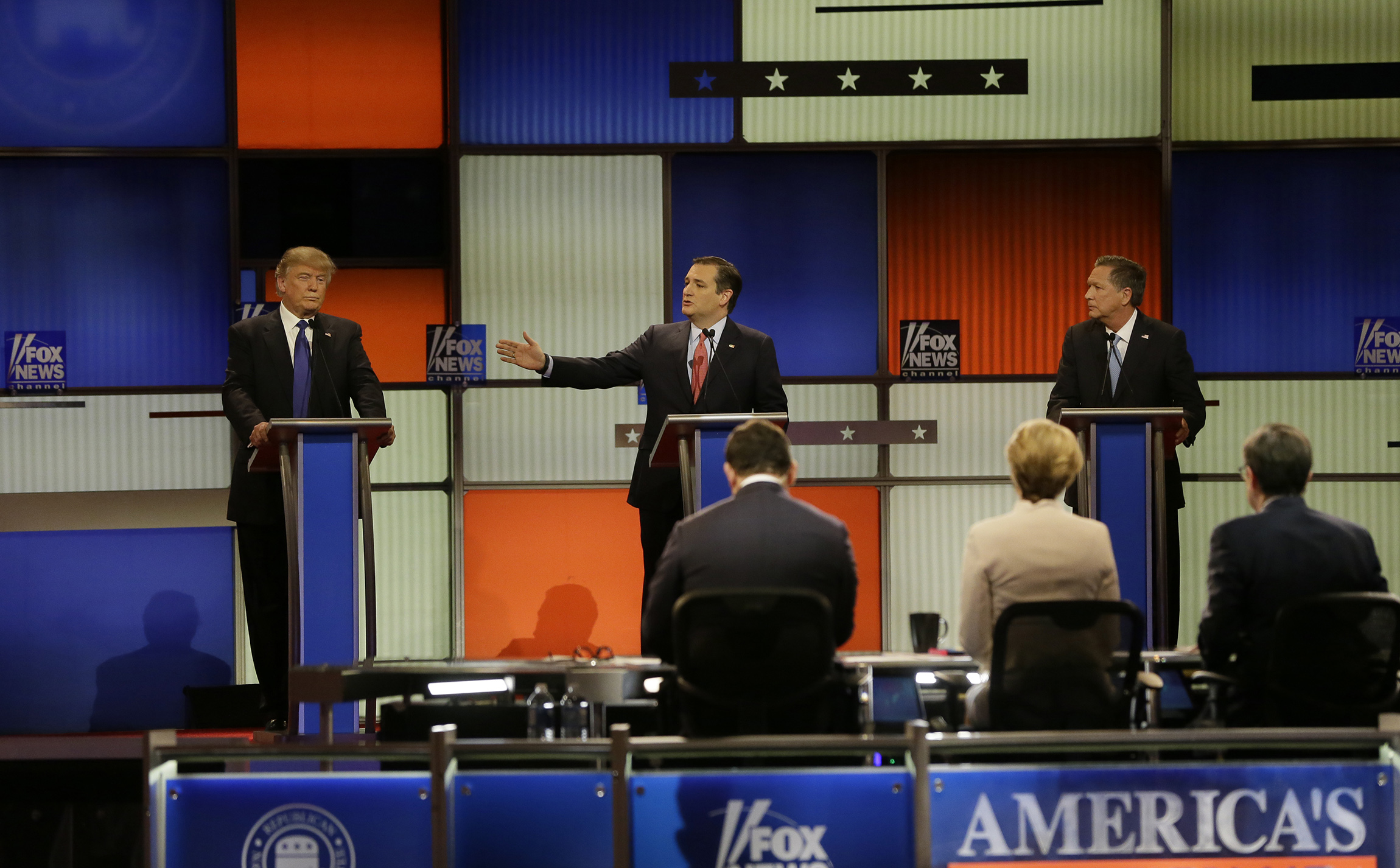
At last! The two remaining candidates opposing Donald Trump for the Republican presidential nomination have joined forces in agreeing which of them will concentrate on beating Donald Trump in at least some of the states remaining to vote in the Republican contest.
The Cruz-Kasich deal. It has been obvious for months now that there are two blocs in the race for the Republican nomination: those supporting Donald Trump and those opposing him. The anti-Trump bloc has been larger in every contest up to and until Trump’s home-state victory in New York last week. Trump has received 38 percent of the votes cast in Republican primaries and caucuses and other candidates have received 62 percent. If the bulk of the anti-Trump vote coalesces behind one candidate, Trump loses almost everywhere.
Recommended Stories



Delegate selection rules, particularly the winner-take-all rules applied statewide or in congressional districts, mean that Trump’s 38 percent has given him 47 percent of delegates selected so far — something that should be kept in mind when he makes his highly selective complaints about delegate selection rules.
Now, finally, the managers of the remaining anti-Trump campaigns have reached an agreement allowing the candidate — Ted Cruz or John Kasich — weaker in each of several contests to step aside, in effect, and let the other rally the anti-Trump majority. Only three states have been mentioned in the account. Kasich will step aside for Cruz in Indiana May 3, Cruz will step aside for Kasich in Oregon on May 17 and in New Mexico on June 7.
This could prove decisive in Indiana, where April polling shows Trump leading Cruz 39 to 33 percent, with 19 percent for Kasich. The Kasich vote is presumably concentrated in affluent areas like Hamilton County just north of Indianapolis; if the bulk of those votes go to Cruz (as in the affluent suburbs of Milwaukee) he could easily win statewide and deny Trump much in the way of delegates. Indiana awards 30 delegates winner-take-all to the statewide winner and 3 delegates each winner-take-all in each of its nine congressional districts. Combining the anti-Trump forces is thus of paramount importance there.
It’s of less importance in Oregon and New Mexico, the states the Cruz campaign conceded to the Kasich campaign. Initial analysis, based on Oregon’s geographic situation and a February poll in New Mexico, might see Cruz as having an advantage over Kasich in these states, but even if so that advantage would be minimal in term of delegates.
Oregon chooses its 28 delegates statewide by proportional representation; conceding affluent Portland suburbs to Kasich might cost Cruz 1 or 2 delegates, but wouldn’t have much effect on Trump’s delegate haul. Similarly in New Mexico. Cruz’s strength in earlier contests even in more crowded field in areas adjacent to Texas — Oklahoma, northwest Louisiana — might suggest he could carry New Mexico’s Little Texas. But New Mexico allocates its 24 delegates proportionately, with a 15 percent threshold.
My judgment is that Cruz conceded Oregon and New Mexico wisely, in return for getting Kasich to concede the much more valuable — in timing and delegates — Indiana. As for the states left unmentioned, most clearly favor one or the other Trump opponent, leaving not much need for an explicit deal. On May 10, Nebraska, with high German ethnicity and social connectedness, is clearly favorable to Cruz, while West Virginia geographically, with very low social connectedness, is highly favorable to Trump. If either opponent can detach some votes from him it’s Kasich, governor of next-door Ohio and native of McKees Rocks, Pa., in the coal-and-steel country around nearly Pittsburgh. But the real race is for individual delegates.
The allocation of several June 7 states is just as clear. Montana and South Dakota, both winner-take-all, are places where Cruz should be competitive with Trump, while it’s likely that Kasich can win more votes against Trump than Cruz in winner-take-all New Jersey, as he did in next-door New York.
That leaves Washington on May 24 and California on June 7. Washington is a kind of testing ground for its West Coast neighbor. Washington’s 14 statewide delegates are allocated proportionately, so there’s no need for an anti-Trump pact on them as there might be for California’s 13 delegates which are awarded winner-take-all. But in both states the bulk of delegates, 30 in Washington and 159 in California are selected winner-take-all in each of those states’ 10 and 53 congressional districts. The problem facing all campaigns and analysts is that no one has much idea of the proclivities of the very few Republican voters in heavily Democratic districts. There are two districts in Washington, covering Seattle and its close-in suburbs, which voted 65 percent or more for Barack Obama in 2012; there are 24 such districts in California, 10 in the San Francisco Bay area and 14 in Southern California. I would describe the dominant voting bloc in the two Washington districts and in 11 of these California districts as gentry liberal; of the other California districts, I would describe the dominant group as Hispanic in 10, black in 2 (although each has more Hispanic than black residents) and Asian in 1. But that’s not to say that most of the few renowned of psephologists has thrown up his hands at predicting the outcome among these tiny electorates.
Naturally the Trump campaign is bellowing its disapproval of the Cruz-Kasich deal. But there’s nothing unfair about enabling the anti-Trump majority, if it exists, from stopping the nomination of a candidate it believes would be disastrous for the party and dangerous for the nation.
