

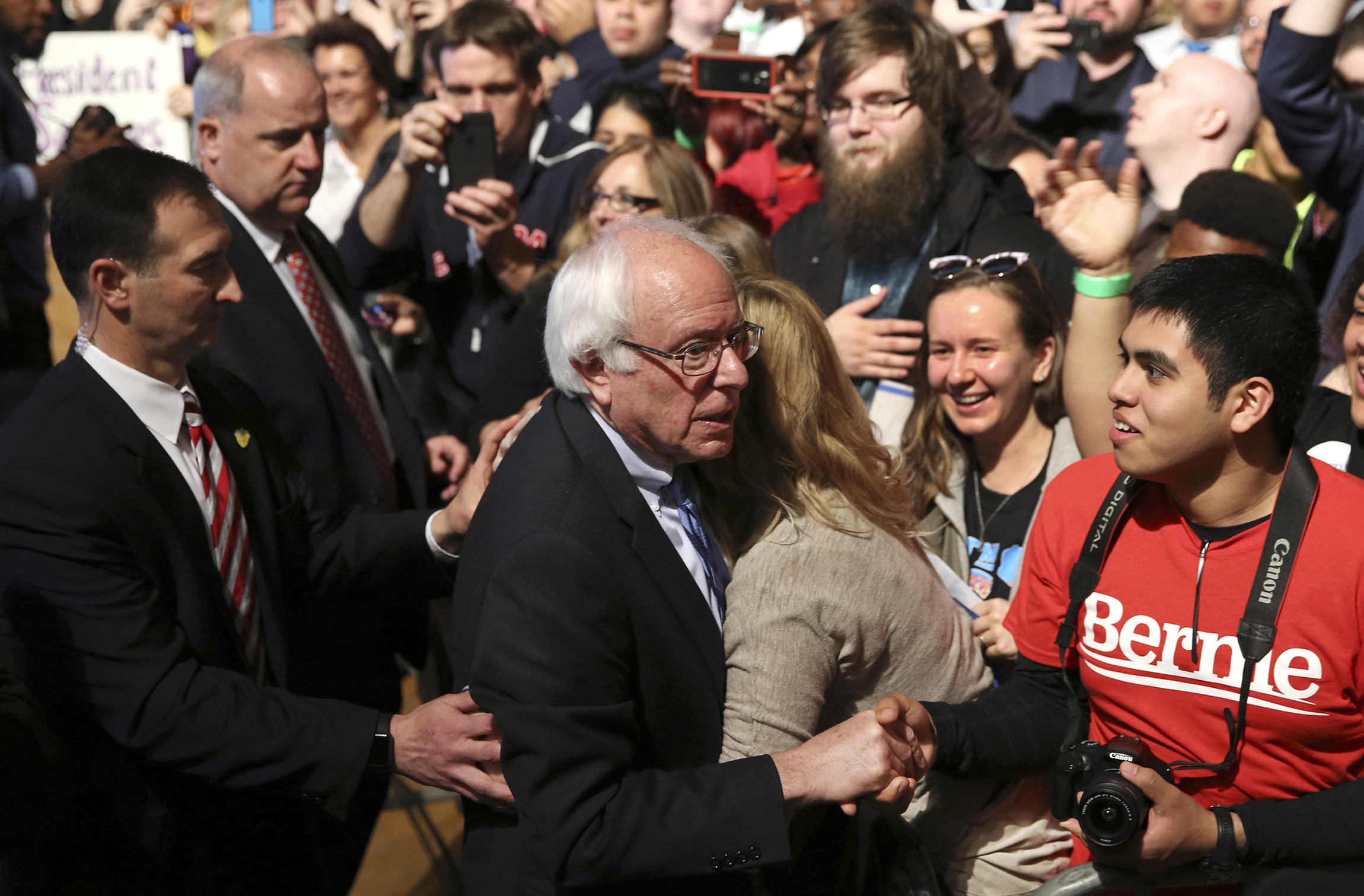
Although Sen. Bernie Sanders has little chance of securing the Democratic nomination, he is unlikely to exit the primary as quietly as his Republican counterparts.
Sanders’ legions of devotees are reluctant to support his rival, Hillary Clinton, despite the near-certainty of their candidate’s defeat. The Vermont senator has used his dimming chances to argue the system is “rigged” against his campaign, a narrative that is only reinforced each time Sanders suffers a loss.
Stay informed.Stay ahead.
Join Washington Examiner for unlimited access to the news, analysis, and commentary that matter most.
Already a member? Log in
That anti-establishment sentiment is preventing Clinton from calling the race in her favor, said David Hopkins, professor of political science at Boston College.
“I think that the Clinton campaign is sensitive to any perception that they’re trying to elbow Sanders out of the race prematurely,” Hopkins said. “They don’t want to alienate his supporters, so they’re trying to be very careful about how they handle the end game here.”
Clinton leads the Vermont senator by a thin margin when it comes to pledged delegates, having thus far won 22 states to Sanders’ 17. But her advantage among superdelegates — convention delegates who acquire their position due to their status as party leaders rather than through the primary process and who are not bound to any presidential candidate — is likely insurmountable for Sanders. She leads him with 523 superdelegates to his 39, and more are expected to emerge in favor of the former secretary of state before the party heads to Philadelphia for their convention in July.
“I’m sure they’d love it if he dropped out tomorrow, but publicly, they can’t look like they’re shoving him out the door,” Hopkins said of the Clinton campaign. “They want his supporters to feel like the process has been respected and everybody’s gotten their chance to vote.”
One Democratic strategist who declined to be named said Sanders is unlikely to drop out as long as he is winning states, raising money and riding on his core support — all factors that continue to buoy his campaign.
“He’s a competitor and when you’re a competitor it’s very hard to call it quits,” the strategist said.
“It’s just a hard thing when you put so much time and effort into something.”
But Sanders’ refusal to leave a race he can’t win is putting Clinton in an increasingly uncomfortable position.
Now that Donald Trump’s last two opponents have conceded the Republican nomination to him, Clinton is left to fend off both a general election opponent and a primary rival simultaneously.
And while Clinton is the all-but-certain victor, she is set to weather additional primary defeats in the weeks before she can claim the nomination.
Sanders leads Clinton by an average of 6 points in West Virginia, according to RealClearPolitics. The Mountain State will vote on Tuesday. Clinton has attempted to walk back her claim earlier in the campaign that she aims to “put a lot of coal miners and coal companies out of business,” but the damage will likely cost her coal-rich West Virginia, a state she won handily in 2008.
The following week, Sanders faces another favorable day of voting with contests in Oregon and Kentucky. Oregon’s population is 88 percent white, providing Sanders an even friendlier demographic tableau than nearby Washington state, where he beat Clinton by a 45-point margin in March.
A primary poll conducted in Kentucky last summer showed Clinton leading Sanders by 44 points. But the race has shifted dramatically since then and the Vermont senator is expected to win Kentucky on May 17.
Hot on the heels of an upset victory in Indiana last week, the spate of likely victories could sustain Sanders to the end of the primary despite the odds against his nomination.
Brad Bannon, a Democratic strategist, predicted Clinton would hold off on touting her superdelegate lead until almost every primary vote has been cast.
“[Clinton] will systematically trot out her superdelegate supporters with public announcements after the California and New Jersey primaries on June 7,” Bannon said.
Although Clinton will have amassed enough pledged and unpledged delegates by then to lay any questions about her crown to rest, Sanders could remain in the race until the convention. He has indicated he plans to do so, proclaiming last week in Indiana that his campaign intends to head to Philadelphia “with as many delegates as possible to fight for a progressive party platform.”
Bannon said Sanders’ recent rhetoric suggests he is no longer running for the nomination, but for a greater say in what the party will stand for in the general election.
“Sanders’ price for hugging HIllary on the last night of the convention will be planks in the party platform,” he said. “Sanders will want planks that call for tougher restrictions on Wall Street, restoration of the Glass-Steagall Act, opposition to the Trans-Pacific Partnership and a $15 federal minimum wage.”
Hopkins said Sanders could use his endorsement as a bargaining chip to win policy concessions from the Clinton campaign so he has a tangible success to show supporters who could be bitter about his defeat.
That doesn’t mean Sanders isn’t facing pressure to bring his party together sooner by exiting or, at the very least, turning down the heat on his opponent. Trump’s ascension has placed fresh urgency on the need for the Democratic primary to produce a definitive nominee before Republicans can gain an advantage.
“The one X-factor here is that Sanders himself is not a member of the Democratic Party — he doesn’t have the same loyalty to the party that most presidential candidates have,” Hopkins noted. “And so the only sort of wild card in the way that this might go is that he may not have the same amount of incentive to pursue party unity that, say, Hillary Clinton had eight years ago.”
Democratic leaders have already begun to warn Sanders’ supporters against upending the convention when their candidate is forced to concede the ticket to Clinton in July.
While some experts have speculated Clinton may select a running mate who appeases those bruised Sanders fans, others predict she will turn her attention to the general election when it comes to choosing a vice president.
“She is likely to go with a running mate that has potential to win over disaffected Republicans. Consistently the exit polls have shown there [are] twice as many Republicans who might defect from Trump than there are Democrats who might drop [Clinton],” Bannon said. “A Dem VP nominee who appeals to disaffected Republicans is more valuable to [Clinton] than a running mate that will pacify Sanders supporters.”
