

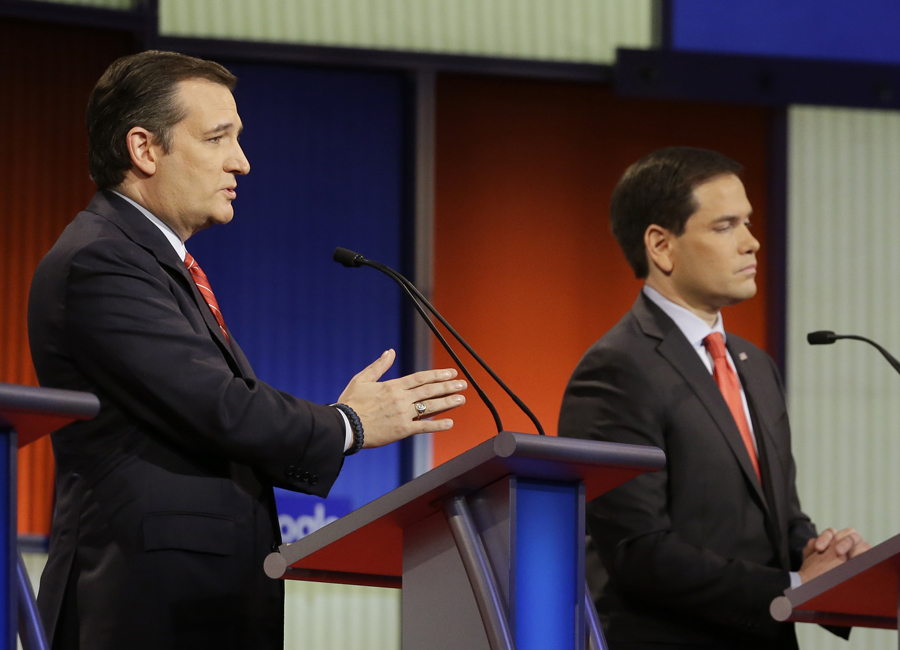
NORTH LAS VEGAS, Nev. — Ted Cruz and Marco Rubio have this much in common: They’re both trying to convince Republican voters that Donald Trump isn’t running away with their party’s presidential nomination.
The two senators are engaged in an increasingly bitter rivalry for the right to become the New York celebrity businessman’s main foil on the march to Cleveland. But Cruz, of Texas, and Rubio, of Florida, both spent Sunday delivering process arguments that the GOP nomination battle is far from over, and that each has a better path to the top, beginning with Tuesday’s Nevada caucuses and ending some time in March or April.
Recommended Stories


“There are so many individuals in the race right now,” Nevada Lt. Gov. Mark Hutchison, Rubio’s campaign chairman in the state, told the Washington Examiner during an interview at a campaign rally for the senator in North Las Vegas.
“Once this race gets pared down to two or three individuals,” Hutchison added, “I think you’re going to see — as Sen. Rubio noted Saturday night, that this is a three person race and he’s going to compete very well. You’re going to see him continue to be very competitive. I don’t know that Donald Trump is going to continue to be able to win with 30 or 35 percent of the vote.”
Earlier Sunday, Nevada Attorney General Adam Laxalt, who is leading Cruz’s effort in the Silver State, offered a similar message — that Trump might have started out dominant, but there are opportunities for Cruz to move up. “I think that [Trump] is tapping the deeply-felt dissatisfaction for Washington, and his microphone is such that it’s getting to voters that aren’t necessarily in the day to day weeds of where people are on policy.”
“The good news is,” Laxalt added, “he’s tapping this huge chunk of people that have said: ‘Enough.’ And, hopefully Cruz is able to convince enough of those people that that’s why he came to Washington, that’s what he’s consistently done, is fight to change the culture of Washington.”
Trump is favored to win Nevada, despite the lack of the kind of sophisticated voter turnout operation being fielded by the Cruz and Rubio campaigns. Trump won New Hampshire and South Carolina, and since 1980, no Republican who has won the second and third voting states on the presidential primary calendar has failed to secure the nomination. But Trump is an unusual frontrunner, and Cruz and Rubio both believe that affords them an opportunity to make (recent) history.
Rubio was particularly energized Sunday, after rebounding from a campaign near death experience in New Hampshire where he finished fifth, to place second in South Carolina. The senator began the day with a rally in Tennessee that attracted more than 4,000 people — his biggest crowd of the campaign so far — and followed that with a gathering of about 2,000 in Arkansas, before speaking to more than 1,000 potential caucus goers in Nevada.
Rubio has yet to win anywhere; that has to change. But the exit from the race of former Florida Gov. Jeb Bush was expected to cause of a flood of endorsements and donations to flow into his campaign. Rubio supporters are optimistic that a slightly winnowed field — Ohio Gov. John Kasich and retired pediatric neurosurgeon Ben Carson are still running — and the senator’s slight victory over Cruz in South Carolina are setting him up to overtake Trump.
“If Cruz and Trump keep battering each other they’ll cancel each other at,” said Margaret Taormina, 74, of Henderson, who attended Rubio’s Sunday evening campaign rally in North Las Vegas. “Jeb Bush, I like the man, but he didn’t have a chance to win. That’s the other thing with Marco Rubio, he has a chance to win.”
Cruz won the Iowa caucuses and finished a strong third in New Hampshire.
But South Carolina was a disappointment. Cruz finished less than 1 percentage point behind Rubio — not exactly a distant third. Still, in the first contest in a southern state, Cruz’s placement set off alarm bells because he is supposed to be strong with the sort of conservative voters who live below the Mason-Dixon Line and populate the bloc of southern states that will vote in the March 1, super Tuesday “SEC” primary.
The senator remains undaunted, however. His home state, Texas, is up for grabs on March 1, and he has spent considerable time and money — going back to early last year — building grassroots organization that can help him to succeed in those states. The South Carolina results didn’t dampen the enthusiasm of Cruz’s supporters. A few hundred showed up to see him Sunday afternoon in Pahrump, a tiny desert community about 75 miles north of Las Vegas.
“The man stands for the Constitution and conservatism, more than any other candidate,” said Navy veteran Gene Griffith, 69, of Pahrump. “I’m not surprised that Trump has been as good as he’s been in these early battles because of all the free publicity he gets and the free airtime.”
With the key early primary states behind them, Cruz and Rubio are taking divergent roads into March.
Cruz’s schedule has him in Nevada through Tuesday evening, with several campaign stops up and down the state over the final 48 hours leading up the caucuses. Cruz will spend Tuesday evening here as well. Rubio will campaign in Nevada on Monday and Tuesday morning, but then heads to the Midwest, with an afternoon campaign stop in Minneapolis and an evening appearance Grand Rapids, Mich.
