
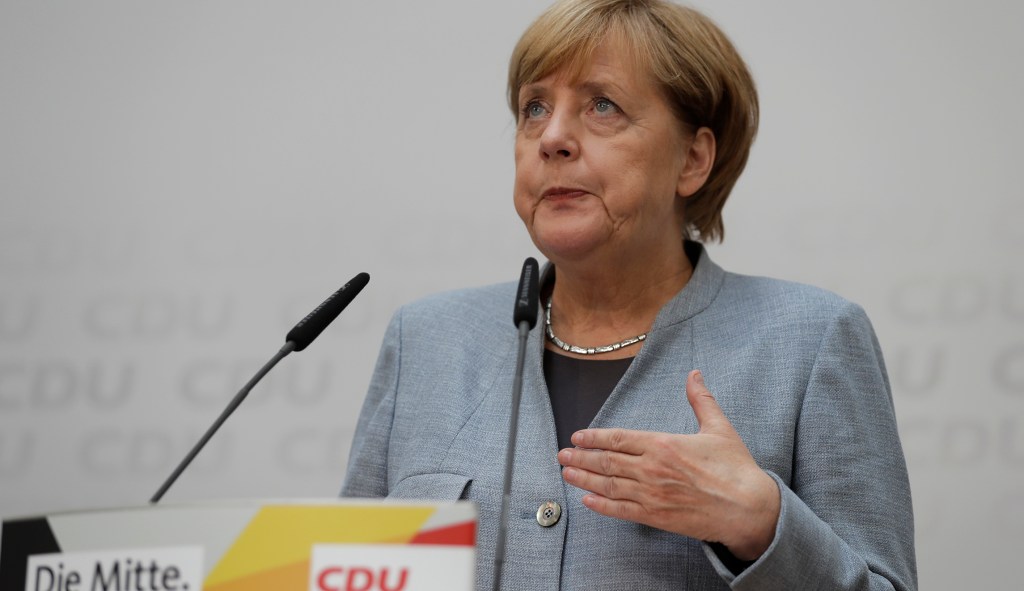
Merkel has two problems following Germany election rebuke

German Chancellor Angela Merkel had a bad night, Sunday, when her Christian Democratic Union/Christian Social Union alliance received its worse election result since 1949.

The result poses two challenges to Merkel in the form of her ability to govern and her long-term credibility as a leader.

Merkel’s first problem is one of math. While her CDU/CSU alliance will receive the most seats in the Bundestag, it won’t have enough to form a majority government. But with Merkel’s former coalition partner, the center-left Social Democratic Party, or SPD, pledging that their cooperation “is coming to an end,” Merkel needs the support of both the left-wing Green party and the pro-business Free Democratic Party.

That prospect is greatly complicated by the fact that the CDU/CSU and FDP share basic economic principles, but the Greens are avowedly left-wing. It will be hard for Merkel to meet enough Green demands that they will join her government. Even if Merkel were to support the Greens’ climate change policy, that would require major new government spending alongside new regulations on German industry.

In turn, that CDU/CSU-FDP-Green deal also affects U.S. interests. After all, considering Merkel’s staunchly cautious fiscal policy, the chancellor would seek to offset spending on Greens’ priorities with cuts elsewhere. I worry that Merkel may reduce defense spending below its already pathetic level or slow efforts towards spending 2 percent of gross domestic product on defense.

Merkel’s second problem is what the election says about her credibility as a leader.

Running on a platform that explicitly rejected Merkel’s policy of admitting hundreds of thousands of refugees, the far-right Alternative for Germany, or AfD, party picked up the third highest vote share of any party, and around 90 seats in the Bundestag. Indeed, in the former East Germany, the AfD was the most popular party with men and the second most popular party overall.

That so many Germans would vote for a far-right party speaks to the public anger over Merkel’s refugee policy. The chancellor’s recent efforts to scale back her refugee quotas were clearly not enough to assuage the discontent. Correspondingly, if Merkel continues on her present course, the AfD is likely to continue growing in popularity. Presenting camera-friendly candidates, the AfD has insulated its supporters against criticisms they are Neo-Nazis.

So yes, while Merkel remains Germany’s leader, this election is the lowest point in her 12-year tenure as chancellor. She now faces a great political challenge, and if Merkel cannot build a coalition, new elections must follow.

Related Content