First lady reaches out to blue-collar voters

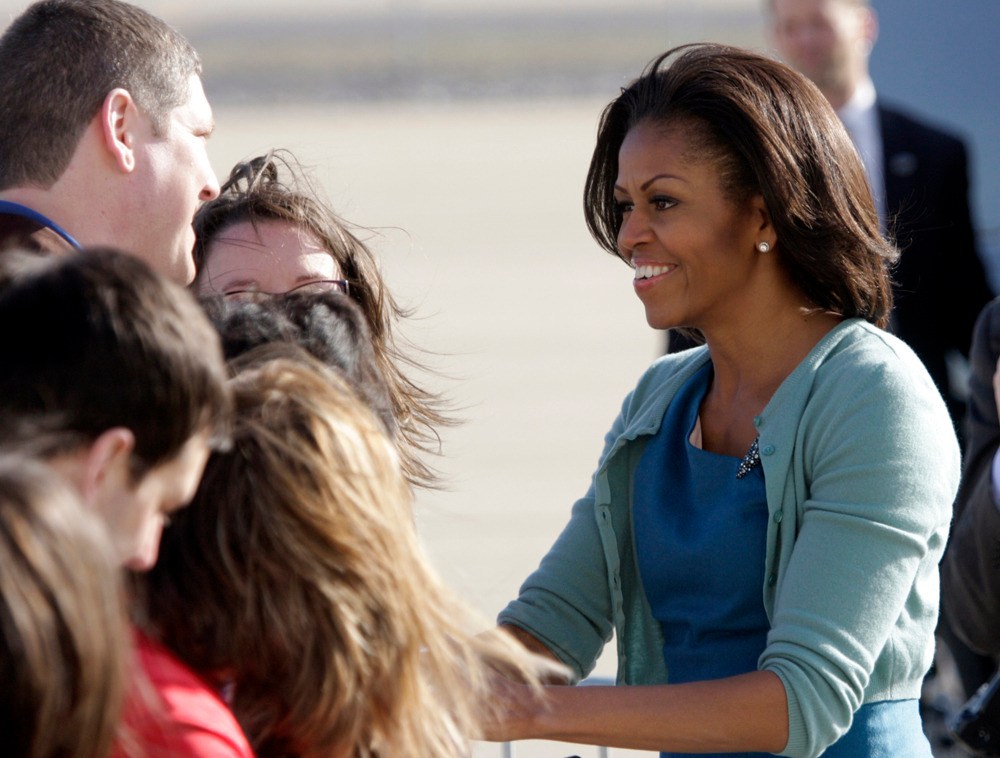
First lady Michelle Obama is stepping up her role in the president’s re-election campaign, attracting high-dollar donors to star-studded fundraisers, courting women at house parties across the country, and relating her husband’s life experiences to the everyday struggles of the blue-collar voters so reluctant to embrace him.

Traveling to battleground states like Ohio, Florida and Virginia, Obama has raised millions this year for her husband’s re-election campaign at nearly two dozen fundraisers, roughly half the number her husband has attended.

To help blue-collar voters reconnect with the president, the first lady regularly describes him as a passionate man and loving husband who understands the economic hardships facing American families today.

“Barack knows what it means when a family struggles,” Obama said at a recent fundraiser. “We are so lucky to have that kind of man as president.”

Political experts say it’s critical for Obama to help voters relate on a personal level to the president.

“Candidates’ spouses in general can be most effective when they humanize the candidate, when they show a side of candidate that may not be communicated through a debate in Congress or a policy issue,” said Leonard Steinhorn, a political communications professor at American University. “We really want to see someone who can exemplify who we are as people, who can identify with the lives of the people that they lead.”

On the campaign trail, the first lady does that by talking about “those quiet moments at home late at night” where Obama “pores over” thousands of letters from people still struggling to get by.

From onetime Obama supporters who have grown disillusioned with the president’s slow delivery on his promises of “change,” the first lady asks patience. Her husband is still the visionary advertised in his 2008 campaign, she tells them.

“Even in the hardest of times, Barack never loses sight of the endgame, never,” Obama said. “He never gets distracted by all the chatter and the noise. He just keeps moving forward. … See, because your president has a vision — a vision for this country that we all share.”

The first lady has come a long way since the historic 2008 campaign, when she appeared reluctant to join her husband on the trail and was roundly criticized after claiming at the time that “for the first time in my adult life I’m really proud of my country.”

With an approval rating of 66 percent — much higher than the president’s — the first lady is expected to spend three days a week campaigning.

“I think she has been hitting her stride and finally finding her voice,” Steinhorn said.

Obama recently started “Women for Obama” to rally Democratic women to serve as campaign surrogates at dozens of house parties and phone banks across the nation.

On the campaign trail, she talks about her husband’s upbringing by his single mother and grandmother and touts the fact that he appointed two women to the Supreme Court and signed the Lilly Ledbetter Act, which called for equal pay for women.

“He [signed] it because he knows that when nearly two-thirds of women are breadwinners or co-breadwinners, he knows that women’s success in this economy is the key to family success in this economy,” Obama said at a recent fundraiser.

[email protected]

Related Content