

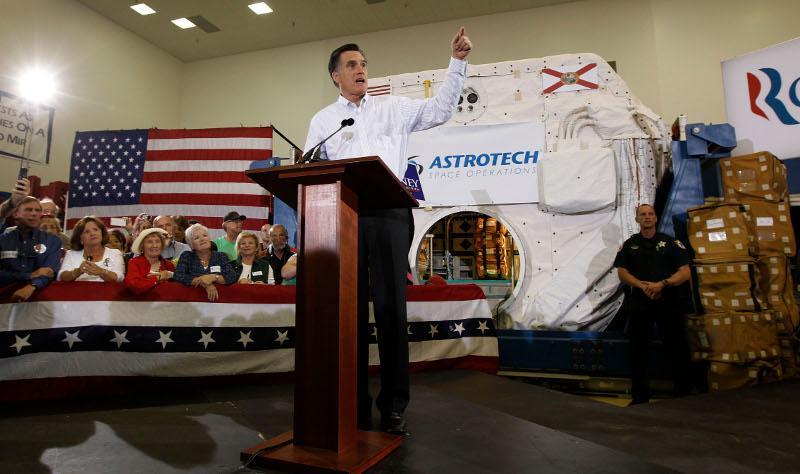
CAPE CANAVERAL, Fla. — One of the unique things about the Florida primary is that since the state is home to Cape Canaveral and the Kennedy Space Center, presidential candidates are required to make at least one substantial statement about American space policy. Newt Gingrich made his statement in a speech in Cocoa Beach on Wednesday, and Mitt Romney answered in an appearance at Cape Canaveral Friday evening. Together, the two speeches present perhaps the most striking contrast of the entire campaign between two strikingly different men. (You can watch Gingrich’s speech here; Romney’s is not available online.)
Both Gingrich and Romney spoke amid the ruins of the once-great American space program. The country that 43 years ago sent men to the moon now has no capacity to put a man even into orbit. A new moon program has been cancelled, there is no successor to the space shuttle, and there are no great projects on the horizon. In a 2009 restatement of goals for the nation’s space agency, NASA administrator Charles Bolden said President Obama ordered him to pursue three new objectives: to “re-inspire children” to study science and math, to “expand our international relationships,” and to “reach out to the Muslim world.” As for actual vehicles that fly into space, industry engineers have little to show for the last many years “except a bunch of Power Points,” said one space veteran recently.
That was the backdrop for the Romney and Gingrich speeches. Gingrich’s message to the space industry was that, under a President Gingrich, Americans would return to the moon, build a permanent base there, and reach out toward manned flight to Mars. Romney’s message was that, as president, he would consult experts to come up with an affordable mission for the space program.
Gingrich’s speech, delivered at a hotel a few miles down the coast from Cape Canaveral, has been widely ridiculed by Romney supporters and many in the press; a quick survey of Twitter will find plenty of jokes about moon colonies and statehood for the moon. But Gingrich’s speech was a well-received call to re-invigorate a program whose decline has led to a sense of malaise, as well as the loss of thousands of jobs, on the Space Coast. It was also a personal history of Gingrich’s fascination with space exploration. “I have a deep passion about this because I’m old enough that I used to read Missiles and Rockets magazine…before it merged with Aviation Week,” Gingrich said, recalling days he spent in the 1950s as a boy dreaming about space.
Gingrich pointed out that leaders in the past had called for Americans to exceed their technological limits to make new breakthroughs. Not just John F. Kennedy in 1961 calling for Americans to go to the moon; Gingrich cited Abraham Lincoln in 1859 calling for a transcontinental railroad at a time when the U.S. simply didn’t have the capacity to build one. (The railroad was completed in 1869.) Gingrich then laid out the space goals he would set if elected president:
We will have commercial near-Earth activities that include science, tourism, and manufacturing, and are designed to create a robust industry precisely on the model that was developed by the airlines in the 1930s, because it is in our interest to acquire so much experience in space that we clearly have a capacity that the Chinese and the Russians will never come anywhere close to matching.
And by the end of 2020 we will have the first continuous propulsion system in space capable of getting to Mars in a remarkably short time, because I am sick of being told we have to be timid, and I’m sick of being told we have to be limited to technologies that are 50 years old.
Each of Gingrich’s proposals was met with enthusiastic applause by an audience that had a good deal of knowledge about space. Given that the United States had the technology to travel to the moon 43 years ago, it doesn’t seem unreasonable to suggest that a base might be established there in the next ten. Nor does the proliferation of commercial space ventures suggest that it is unreasonable to discuss widespread activities in earth orbit. As for Mars — who knows? Gingrich was certainly setting a big goal. “I come at space from the standpoint of the romantic belief that it really is part of our destiny,” Gingrich said.
Romney answered some of Gingrich’s points during the Republican debate Thursday night in Jacksonville, calling them too expensive in light of America’s other needs. Romney specifically addressed the issue of space on Friday evening, when he spoke at Astrotech Space Operations in Cape Canaveral. Standing in a large room normally used to prepare satellites for launch, Romney began by criticizing President Obama for “his failure to define a mission for the space program for this nation.” That failure, Romney said, has led to lost technology and lost jobs. “It’s time to have a mission for the space program for the United States of America,” Romney said, to enthusiastic applause.
Then Romney explained at some length why he would not set a mission for the space program. “In the politics of the past,” he said, “I would come here and promise hundreds of billions of dollars, or I would lay out what my mission is — here’s what we’re going to accomplish. I’m not going to do that. I know that’s something that is very attractive, very popular, but it’s simply the wrong thing to do. It’s not the way the best decisions are made.”
Romney said appointing a commission to find a mission would be a far superior way to approach the problem:
The space program has several different objectives, Romney explained: 1) learning about climate and possible natural threats from space; 2) developing technology that leads to new commercial products; 3) developing technology that leads to new health treatments; and 4) national defense. “We must have a space program that combines all four of those missions,” Romney said, “so I’m not going to come here today and tell you precisely what the mission will be. I’m going to tell you how I’m going to get there.” He would get there, Romney said:
It would be hard to find a more stark contrast between Newt Gingrich and Mitt Romney than each man’s speech on space. In Gingrich, the Florida space community saw a man who has read extensively about space with a romantic’s enthusiasm, a man who believes it is a president’s role to set large national goals, like Kennedy and Lincoln in the last two centuries. With Romney, the space community saw a cautious businessman looking for input on product development from the various constituencies whose support he would need to go forward. (Romney’s approach to space recalled nothing so much as fellow businessman Herman Cain’s approach to nearly every national problem: convene a committee of experts in the White House and come up with a plan.) A lot of people scoffed at Gingrich’s proposals, but each man’s approach to space is worth examining, because they offer a glimpse into each man’s approach to governing.
