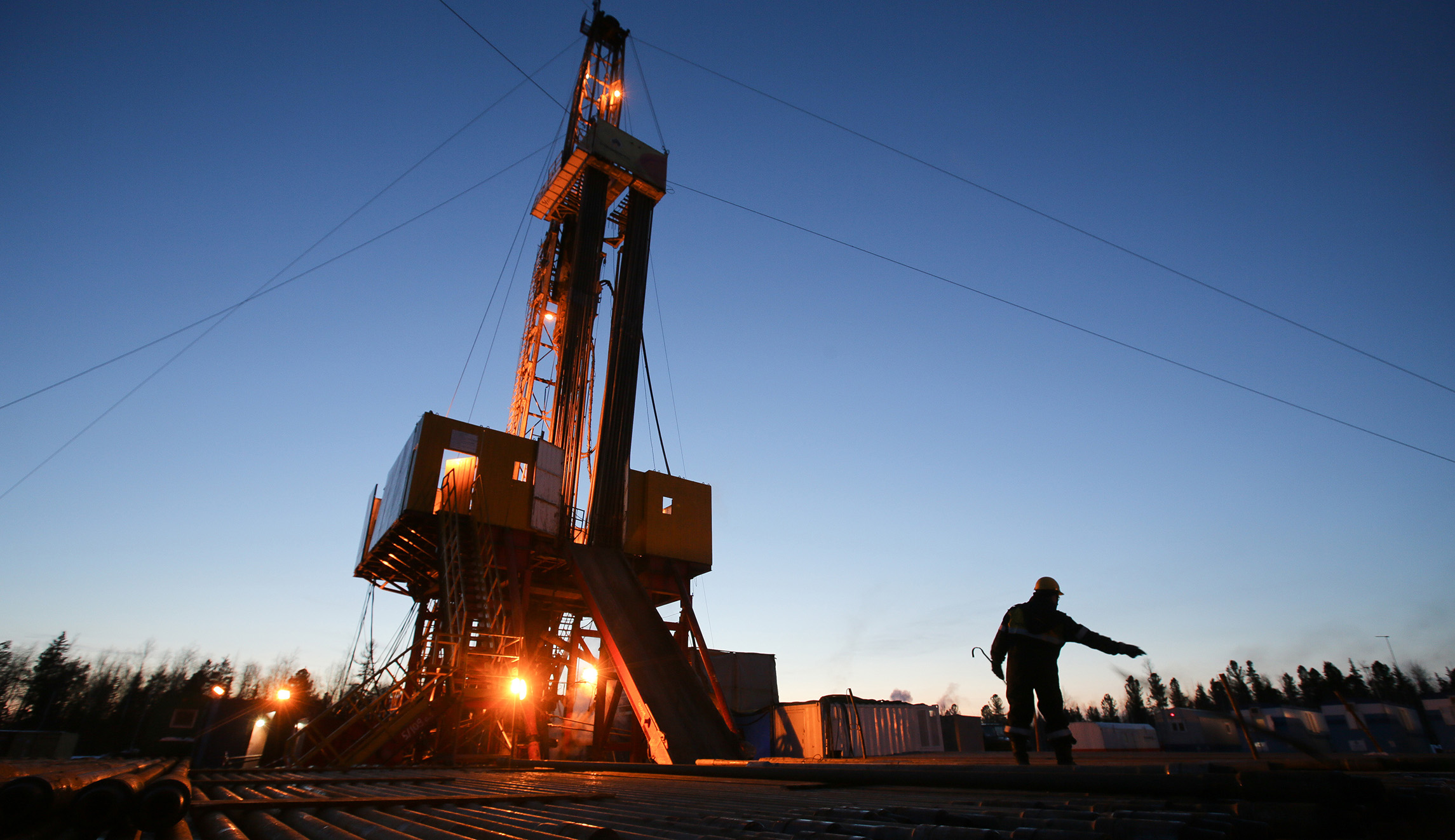
World oil supply grew in July, helped by strong production from Russia, the International Energy Agency reported Friday, helping to ease higher prices that have concerned President Trump.
The growth shows Russia is doing its part to fulfill a commitment among OPEC members and itself, agreed to in June, to collectively increase output by 1 million barrels per day in order to bring oil prices down.
The IEA, in its monthly oil market report, said Russia’s crude and condensate production rose by 150,000 barrels a day last month, to 11.21 million barrels a day.
That represents a “significantly sharper acceleration than expected,” IEA said.
Total global oil supply climbed 300,000 barrels per day last month, to 99.4 million barrels per day. That is 1.1 million barrels per day more than the world’s output this time last year.
However, production among OPEC members itself was stagnant in July, staying steady at 32.18 million barrels per day, due to an unexpected decline in output from Saudi Arabia, the oil cartel’s largest producer. Saudi production declined by 110,000 barrels a day, to 10.35 million barrels a day. Saudi Arabia, Russia, and the U.S. are the world’s largest oil producers.
OPEC and Russia agreed to boost production after the oil cartel and non-member countries for almost two years curtailed production by 1.8 million barrels a day to drive up the price of crude.
But Trump, and other countries, complained that prices became too high — raising gasoline prices — with Brent crude, the global benchmark, briefly reaching $80 per barrel this spring, from below $30 in 2016. It is now about $72 per barrel.
“This cooling down in prices is clearly welcome for consumers: the biggest single product market in the world is U.S. gasoline and the national average price increase seen during the spring seems to have stalled for the time being,” the IEA said.
U.S. gasoline prices, however, remain the same from a month ago, at about $2.86 per barrel on average as of Friday, compared to $2.36 a year ago.
Despite falling oil prices, the IEA warned that “with short-term supply tensions easing, currently lower prices and lower demand growth might not last.”
That’s mainly because of Trump’s intent to reapply sanctions on Iran’s by November, and punish countries who buy crude from Tehran.
“The market outlook could be far less calm at that point than it is today,” the IEA said.
Iran is OPEC’s third largest producer.
“Uncertainty remains regarding the degree to which the U.S. sanctions will take Iranian crude oil off the market,” the Energy Information Administration said Wednesday, even while predicting that the sanctions would limit Iran’s crude oil production and exports.
