

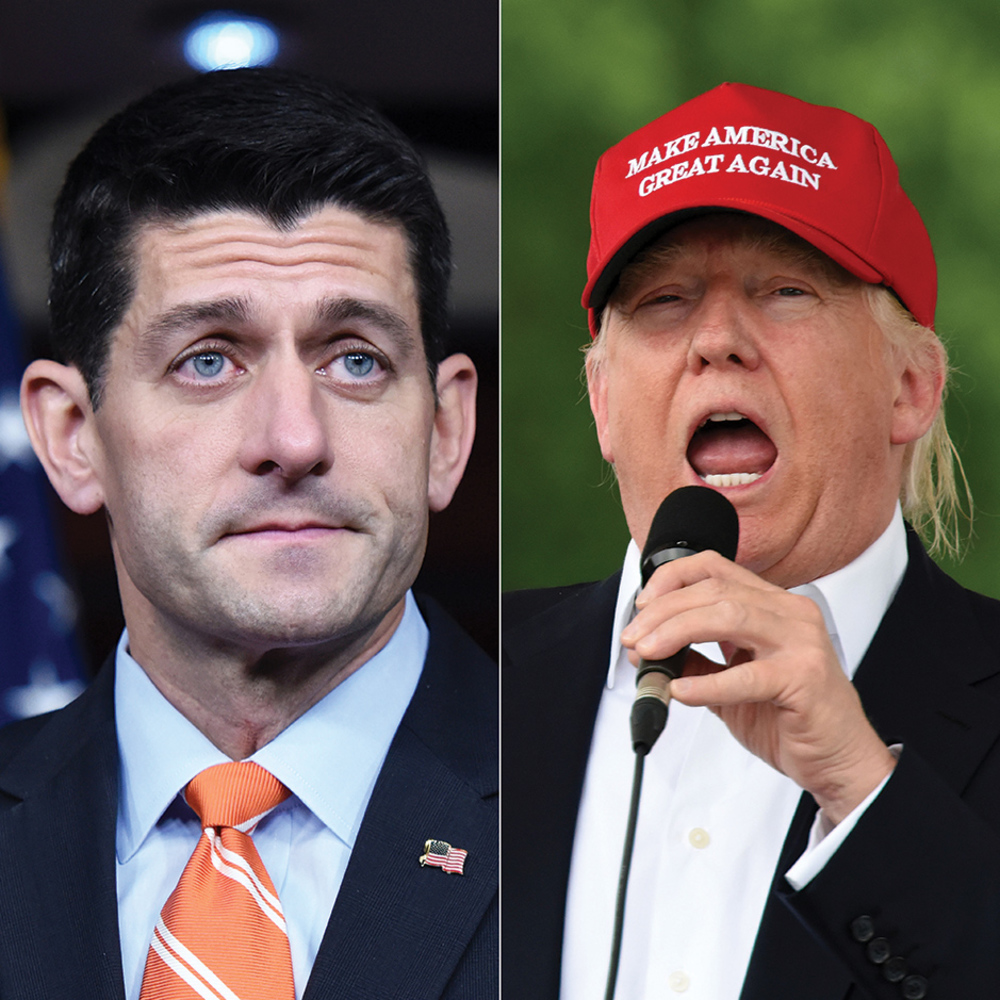
Donald Trump, like Ronald Reagan, becomes president as the head of the Republican party and leader of a political movement. For Reagan, joining the party with the conservative movement was painless. They fit nicely. For Trump, merging the party with his populist movement won’t be as easy. But it’s achievable.
There’s a practical reason and a political one for doing this. By emphasizing populist issues like immigration and trade, Trump achieved the impossible for a Republican presidential nominee: He won the Rust Belt states of Pennsylvania, Ohio, Wisconsin, and Michigan. Adding them to the GOP base delivered the presidency.
Stay informed.Stay ahead.
Join Washington Examiner for unlimited access to the news, analysis, and commentary that matter most.
Already a member? Log in
That’s the practical reason. Would any candidate besides Trump have won these states? That’s unknowable. But Mitt Romney didn’t win them in 2012. Nor did John McCain in 2008. This year, Hillary Clinton was confident they were hers.
With the industrial belt on board, the GOP has a coalition that includes more than traditional Republicans. It has millions more blue-collar voters and many more minorities. Exit polling showed Trump’s support was higher than Romney’s among black, Hispanic, and Asian American voters.
However, it’s a fragile coalition. To keep it alive, Republicans must embrace two agendas at once—the Republican reforms championed by House speaker Paul Ryan and the populist ideas favored by Trump.
Two days after the election, the Washington Post‘s James Hohmann insisted this can’t be done. Trump’s election is a “repudiation of Ryan’s brand of Republicanism, both substantively and stylistically.” That’s nonsense. Ryan doesn’t think so. Trump’s anger with him wasn’t about issues. It was prompted by Ryan’s slow walk to endorsement followed by his refusal to campaign for and defend Trump.
On most issues—even many foreign and defense issues—Trump ran as a conservative. Before the rupture over the Access Hollywood video, Ryan had outlined for Trump the six-part reform program of House Republicans. Trump objected to none of it. He and Ryan are close on entitlement reform. Their plans to slash taxes match. They both believe the rate of economic growth can be doubled to 4 percent. They want to gut the regulatory regime erected by President Obama.
There would be an insurmountable problem with Trump’s view on immigration and trade except for one thing: Trump has won the argument. Many, if not most, Republicans are willing to build a wall to secure the border with Mexico, especially if that’s the only way to get immigration reform. Indeed it is. And Trump has softened his stand on deportations to apply solely to illegal immigrants guilty of crimes.
Trade is more difficult. Ryan is a free trader, but he recognizes what’s wrong with the Trans-Pacific Partnership treaty and why it’s now dead. If Trump hasn’t ceased loose talk of tariffs on goods from China, he’ll have to. They’re likely to agree on getting rid of “chain” immigration and the annual lottery.
Ryan and Senate majority leader Mitch McConnell believe Trump needs them. They’re right. His campaign team was lean on policy advisers and his own ideas fall short of a real agenda. They need him, too. After Obama, Trump is a godsend. Trump is prickly, but Ryan and McConnell are adept at getting along when it’s necessary.
Trump was an early advocate of spiking the Republican message with a heavy dose of populism. But he wasn’t the first. That was former senator Rick Santorum of Pennsylvania. In 2014, Santorum spoke to the Republican National Committee about the party’s failure to appeal to a working class beset by the loss of jobs to immigrants and the closing of factories as companies moved operations overseas.
Santorum had raised these issues when he ran for president in 2012 (he finished second to Mitt Romney for the GOP nomination). Afterwards, he wrote a book on the subject, Blue-Collar Conservatives. Trump read it. Santorum wrote that Republicans should speak up for middle- and lower-income workers and their families. “That’s where Republicans need to go,” Trump told Santorum when they met.
And that’s where Trump went as a candidate. “He did it better than me,” Santorum says. “He proved the point.”
He proved it by leapfrogging 16 candidates for the Republican nomination and by winning the presidency last week. The key was his populism, his appeal to those in the bottom half of income earners. Without it, without stressing immigration and trade and vowing to “drain the swamp” in Washington, his chance of pulling off an enormous upset would have been small.
Patrick Caddell, the Democratic pollster, says a populist wind is blowing, dominated by three beliefs. First is that the country is in decline. Second, Americans no longer expect their children to inherit a better America than they did. Third, they believe there are “different rules for well-connected and people with money.”
“From the time I was a teenager and a self-starting pollster, I have had an acute interest in the phenomenon of political alienation,” Caddell wrote. “In our research, the current level of alienation that now grips the American electorate is staggering and unprecedented.”
In a poll, Caddell asked if “the power of ordinary people to control our country is getting weaker every day.” Eighty-seven percent said so. And 81 percent agreed with this statement: “The U.S. has a two-track economy where most Americans struggle every day, where good jobs are hard to find, where huge corporations get all the rewards.”
For Republicans, the lesson is powerful. If they’re allergic to working-class appeals, they’d better get over it. Voters are receptive. This year, the white working class responded. But the goal, says Santorum, is a multiracial coalition with “a strong, solid working class [of] small business, entrepreneurs, and wage earners.”
That’s long term. For now, Trump and Republicans must redeem the promise to rescue a working class in trouble. That comes first. If that slips, voters are bound to conclude that electing Trump and Republicans didn’t matter. Because nothing changed.
Fred Barnes is an executive editor at The Weekly Standard.
