
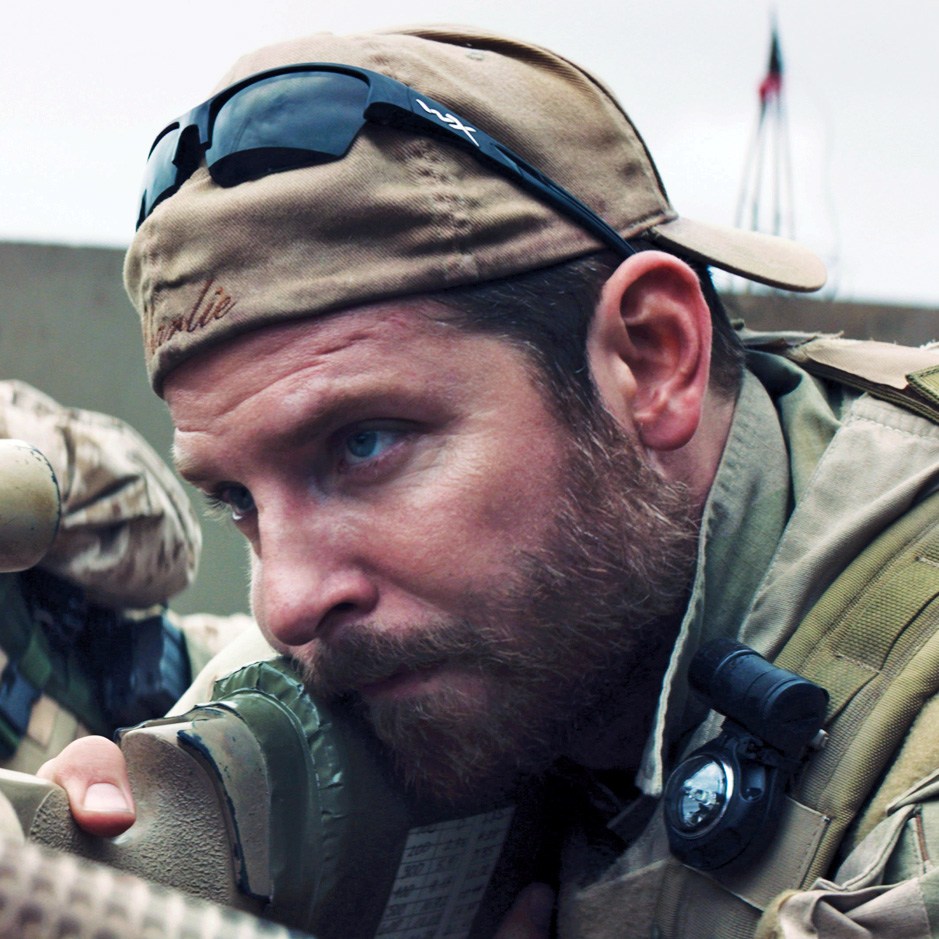
The overwhelming American Sniper is cast in shadow from start to finish by two real-world tragedies, one very broad and one very precise. The first is the irresolution of the Iraq war, the conflict to which the film’s titular character—Navy SEAL Christopher Kyle—was deployed four times. The second is the 2013 murder of Kyle at the hands of a disturbed veteran he was trying to help. As a result of these tragedies, the movie that tells their stories is haunted and grave.
American Sniper is about the toll of war—on Kyle, on his family, on the people with whom he served—and the way in which the sacrifices Kyle and others made to serve their country ennobled them and made them grand. These are immensely powerful themes, and the movie leaves you in a state of devastated awe. Strangely, though, they aren’t really the themes Chris Kyle himself stressed in the 2012 memoir on which the movie is based. Indeed, judging from that book, it’s not clear that the Chris Kyle we see in American Sniper is all that much like the real Chris Kyle.
Recommended Stories



There isn’t a lighthearted moment in American Sniper. It begins with Kyle on a rooftop in Fallujah; an Iraqi boy has been handed a rocket-propelled grenade and is walking toward an American convoy. Kyle is on “overwatch,” keeping an eye on the streets as American forces patrol them. The shot is his call.
Director Clint Eastwood and screenwriter Jason Hall then jump back in time to Kyle’s first time shooting a gun, while on a deer hunt with his father. Chris bags the deer and drops his rifle to admire his own handiwork, at which point his stern father upbraids him for mishandling the weapon. We then see a kid beating up Chris’s brother on a school playground and Chris interceding. After hearing about the incident, their father takes out his belt and is ready to mete out some justice until he is convinced Chris did the right thing.
The somber mood is not leavened by the budding love we witness between Kyle (Bradley Cooper) and his wife Taya (Sienna Miller). She is sharp and tough and fragile all at the same time; dating the wrong men has left her one of the emotionally walking wounded. Chris is quiet and interested but self-contained. She says her sister was engaged to a SEAL and so she knows they are self-centered. He responds that he would lay down his life for his country; how could that be self-centered? She has no answer. She trembles with fear as they become intimate.
When Chris deploys to Iraq, he finds his true calling. He is there to protect his country, and he does so by protecting its fighters—watching from above as they work the streets of Fallujah or Ramadi or Sadr City. He looks through a Leica viewfinder, spots an insurgent, and takes him out before the insurgent can injure an American.
He is not disturbed by the lives he takes. Rather, he is troubled by the lives he cannot save when he is not there. He is nerve-jangled at home by the very absence of the threats his extraordinarily watchful eye could pick up from 1,000 or 2,000 meters away. Taya feels his distance and is terrified and angered by it. He will not acknowledge that anything is wrong.
As he goes on his second tour, and his third, and his fourth, nothing much seems to be changing. From one town reduced to rubble, he moves to another, and then to Baghdad’s poorest and most dangerous neighborhood, where he and his fellows find themselves caught in an ambush just as a vicious sandstorm rolls in.
Chris Kyle must then reconstitute himself as a postwar warrior, haunted by what he has seen and the extremes of emotion and adrenaline to which his body has been subjected. It is a strain and a trial for him, and what we see is that he chooses to rebuild by returning to his first objective: devoting himself to helping others. And, in so doing, he loses his life.
That horrible, pointless death is key to the film, even though we never see it. The truth is that had Chris Kyle lived, American Sniper would likely be a very different film. The way Kyle saw himself was distinct from the character we see embodied here so unforgettably by Bradley Cooper, in a towering performance no one could have expected from him.
By his own account, Kyle was an aggressive and self-assured loudmouth who enjoyed mixing it up. He was not a reliable narrator of his own life. He told some tall tales at times, including one whopper about serving as a sniper at the Superdome during Katrina. Yet that aspect of his character—the self-mythmaking—is nowhere in evidence here. Nor is the fact that he reveled in the SEAL culture of hazing and the casual and almost jokey violence he and his comrades inflicted on one another. The book is full of bar fights and drunken revels and adolescent pranks that defined the SEAL experience for Kyle—behavior that, as he describes it, is consonant with the kind of physical toughness, stubbornness, and combativeness SEAL training celebrates, instills, and encourages.
Even more important, Kyle loved war. He says these words plainly and without qualification in his book. He loved the life-and-death nature of what he was doing in combat, and he felt himself reduced in stature and his life reduced in meaning when he was away from the battlefield. He wanted in on the fight, and when he left active duty, it took him a long time to feel as though he hadn’t surrendered an existence in which everything mattered, everything was heightened, everything was more vivid and more alive.
This is hardly a theme unique to Kyle. It was Robert E. Lee who famously told James Longstreet, “It is well that war is so terrible, otherwise we should grow too fond of it.” The warrior’s love of his trade and his craft is a condition the existence of which we are not supposed to note in 2015. We are to honor his or her service. We are to appreciate his or her sacrifice. We are to believe, and I think most of us do believe, in the nobility of his or her willingness to put everything on the line for love of country, love of home, and love of his or her fellow fighters. But that certain men today are the same as certain men have been throughout history is a truth we should all be able to acknowledge.
Chris Kyle was a warrior. That was what he chose to be, what he trained to be, what the United States wanted him to be and taught him how to be. Fighting for his country was both his job and his vocation, and it channeled something deep within him and ennobled it.
Some of this was due to conviction. Kyle believed what he had done in Iraq was more important than anything else he could have been doing—more important than being with his wife and small children. He says this, too, unqualifiedly. He acknowledges that this created deep tensions in his marriage and that he needed to find a new way of being when he left the service.
American Sniper bowls you over because it succeeds dramatically in making Chris Kyle’s story a parallel of the American experience in Iraq. The mission we see Chris embark upon is both practical and idealistic. The insurgents and their leaders are dreadful and monstrous and deserve their fates. The men on the front lines show resiliency and fortitude and immense seriousness of purpose. But the cause runs afoul of realities far above the pay grades of Kyle and his brethren. They did everything they were asked to do and more. Yet they would never taste victory.
This is the bitter truth about Iraq for all of us—whether you believe fighting the war was a mistake in the first place or you view the ultimate failure to have come about as a result of the political mishandling of the turnaround in the war’s fortunes after the 2007-08 surge. In this way, American Sniper is not only apolitical, but also antipolitical. It is the story of the effect of the war on the people who fought it and those they love—not on the country, not on Iraq, and not on America’s position in the world.
And that is one of the key reasons for the film’s astonishing and unprecedented success. Eastwood and Hall do not relitigate the causes of the war or the reasons why things went sour before and after the surge. They tell the story of the conflict through its impact on one man. And in so doing, in focusing so closely on this one remarkable American and his experience, American Sniper defines the national consensus on the war in Iraq as no other work yet has. It acknowledges both the greatness shown by the effort and the horror of the result of a war this country chose, at different times, with different leaders, and for different reasons, not to win.
John Podhoretz, editor of Commentary, is The Weekly Standard’s movie critic.