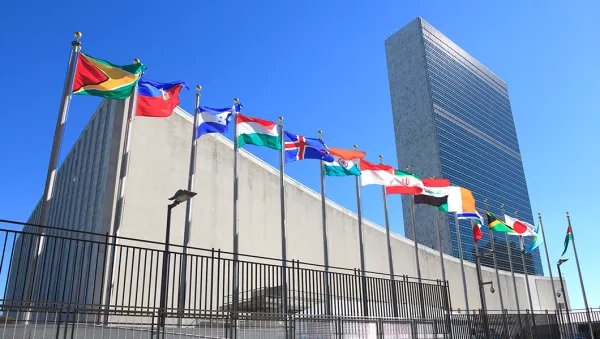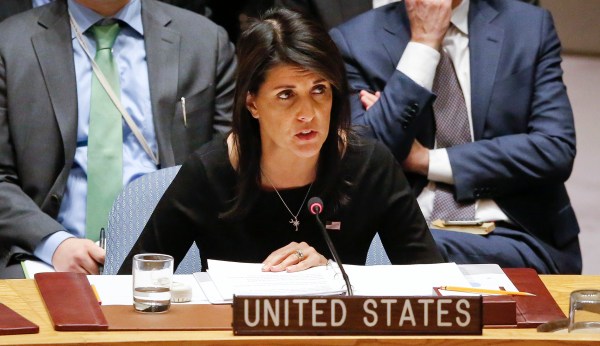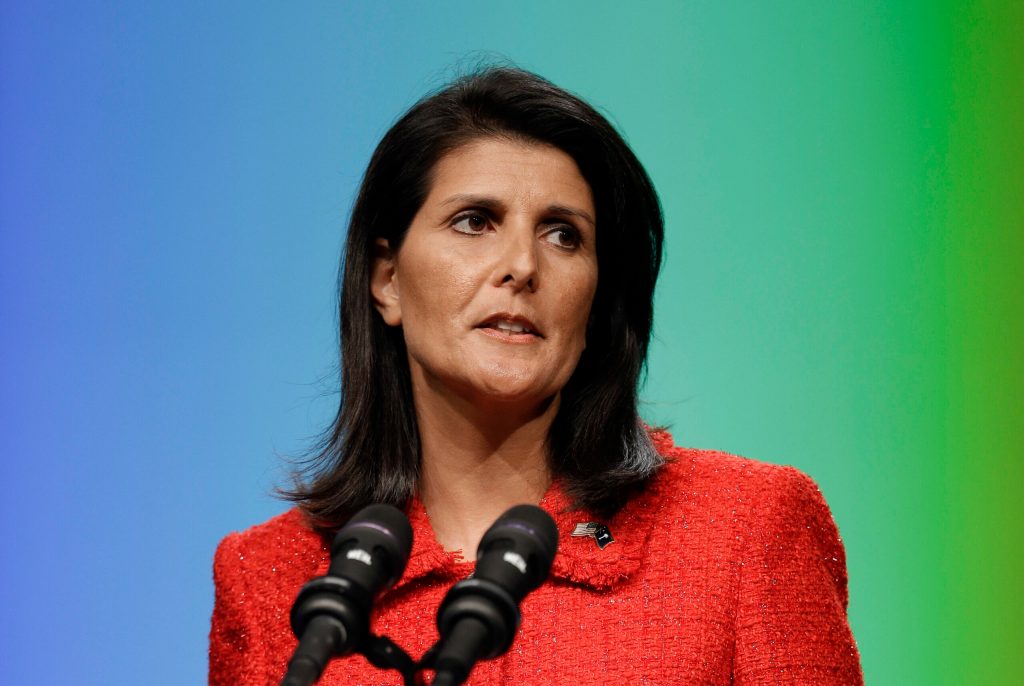
U.S. Ambassador to the United Nations Nikki Haley warned members of the United Nations Human Rights Council on Tuesday that they have no say in how the U.S. handles immigration.
“Neither the United Nations nor anyone else will dictate how the United States upholds its borders,” Haley said.
The U.N. Human Rights Council joined a chorus of Trump administration critics on Wednesday to denounce the practice of separating parents from their children at the border. Attorney General Jeff Sessions has defended the policy by saying the parents of those children have committed a crime by entering the country illegally and should not bring their children across the border, while federal law bars border officials from housing children in the same facilities as adults.
“The U.S. should immediately halt this practice of separating families and stop criminalizing what should at most be an administrative offense — that of irregular entry or stay in the U.S.,” the UNHRC spokesperson said. “We call on the U.S. authorities to adopt non-custodial alternatives that allow children to remain with their families and fulfill the best interests of the child, their right to liberty and their right to family life.”
That provoked a sharp rebuke from Haley. “Once again, the United Nations shows its hypocrisy by calling out the United States while it ignores the reprehensible human rights records of several members of its own Human Rights Council,” she said.
Sessions argued that the separations are brief, as a rule. “These are often within days … The adults are frequently getting bail, too, and be able to be with their children,” he told talk radio host Hugh Hewitt recently. “So it’s not, it’s certainly not our goal to separate children, but I do think it’s clear, it’s legitimate to warn people who come to the country unlawfully bringing children with them that they can’t expect that they’ll always be kept together.”
John Kelly, the White House chief of staff, also described the separations as a “a tough deterrence” to illegal immigration. “They’re not bad people,” he told NPR last month. “They’re coming here for a reason. And I sympathize with the reason. But the laws are the laws. But a big name of the game is deterrence.”
The UNHRC cited the reasons for immigration as an argument against the policy. “Children should never be detained for reasons related to their own or their parents’ migration status,” the spokesperson said. “The majority of people arriving at the U.S.’ southern border have fled Honduras, Guatemala and El Salvador — in many cases either because of rampant insecurity and violence, or because of violations of a range of other rights, such as health, education, and housing.”
Haley defended the administration’s human rights record.
“While the High Commissioner’s office ignorantly attacks the United States with words, the United States leads the world with its actions, like providing more humanitarian assistance to global conflicts than any other nation,” she said. “We will remain a generous country, but we are also a sovereign country, with laws that decide how best to control our borders and protect our people.”
Editor’s Note: This story has been updated to correct a reference to the UNHRC.