

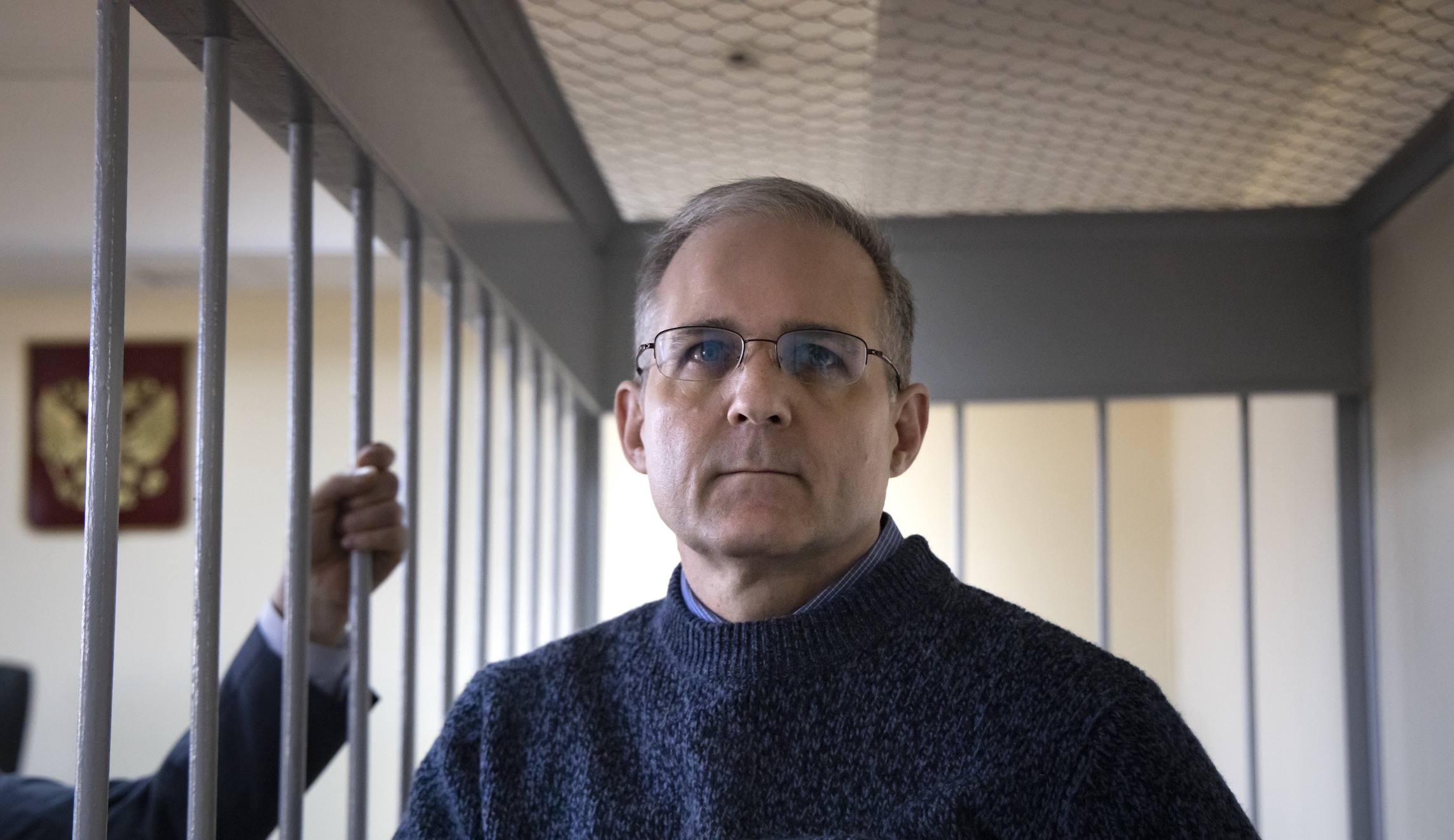
American Paul Whelan is Russia’s bargaining chip in an opaque game with the United States that could take months or years to resolve, the detained former Marine’s brother worries.
“We are going through this very long, slow wait for Paul to actually go through the justice system in Russia,” David Whelan, whose twin brother was arrested by Russian spy agencies in December, told the Washington Examiner.
Recommended Stories


Whelan, 49, was consigned to an additional two months in pretrial detention by a Moscow judge Thursday. That decision, made at the behest of the FSB, the successor to the Soviet-era KGB, came a day before the release of convicted Russian agent Maria Butina. Whelan’s detention was widely perceived as an act of retaliation for Butina’s arrest, spurring speculation of a potential swap, but Whelan’s family thinks Russia will demand a higher price for his release.
“The only things that Russians seem to want are really not compatible,” Whelan said. “So that really means that he would wait in Russia and be sentenced, convicted, and sent off to a labor camp or a prison until an equitable sort of swap will be made.”
The detainee’s Russia-appointed lawyer, Vladimir Zherebenkov, now expects Whelan’s trial to be delayed until May 2020, nearly 18 months after his original arrest. The ex-Marine was seized while traveling in Moscow for a wedding. Russian Foreign Minister Sergey Lavrov described him as “caught red-handed” with a flash drive containing classified information, but his Russia-appointed attorney said that evidence was planted by someone “connected to the military” whom Whelan regarded as a friend.
“Not a single witness said that Paul pushed them to take part in any criminal activity, to do espionage, that he was recruiting them, or in any other way acted like a spy,” Zherebenkov said Thursday. “Apart from the person who planted the flash drive.”
The detained American has had limited access to U.S. officials and his attorneys because the Russian officials monitor his communication. “300 days in Lefortovo [prison],” Rebecca Ross, a spokeswoman at the U.S. Embassy in Moscow, tweeted Thursday. “Without unrestricted legal assistance. Without unrestricted consular access. Without phone calls with family. Without evidence. This is not an open or fair process. Enough is enough – let [Paul Whelan] go home.”
His case attracted the attention of Canada, the United Kingdom, and Ireland, in addition to the U.S., because he holds passports with all four countries, but his family is confident that he has been falsely accused, in part because he was discharged from the Marines for misconduct.
“There’s no way that someone with his background and history would have been selected as a spy,” David Whelan said. “There’s no evidence to support it.”
The legal proceedings in his case are conducted entirely in Russian as the defendant looks on from a cage, so the ex-Marine has used the proceedings as an opportunity to address the media in the court. Whelan told reporters this week that a Russian guard threatened him with a gun.
“The important part today is human rights violation in the prison,” he told reporters. “I’m the victim of an assault by a prison agent, and that’s something that you need to cover. If the Moscow prosecutor is a coward and he refuses to talk to me, maybe he will talk to you.”
His family believes his arrest is part of the tit for tat that unfolded after Barack Obama imposed sanctions on Russia for interfering in the 2016 presidential election. Russian officials have highlighted the cases of Russian pilot Konstantin Yaroshenko, who was arrested in 2010 on drug smuggling charges, as well as arms dealer Viktor Bout, who was convicted in 2011 of selling weapons to a Colombian terrorist group. Whelan’s family gave the U.S. government a wide berth in deciding how to bargain for his release.
“We aren’t recommending or advocating for a swap, [though] we realize that is one of the options, perhaps even the best option,” David Whelan said. “You can’t swap a terrorist, or someone who provided material support for a terrorist, for a tourist . . . at least, I don’t think the American government would do it.
Butina might not have been the prize sought by the FSB because Russia “realized that she would be coming back so quickly” that they could target other concessions.
“The Russians are arresting American citizens in order to create trade opportunities,” the brother also said. “There’s really no plausible reason for him to be there, other than that the Russian government is trying to get some sort of payoff, essentially extortion or ransom for holding onto an American.”
