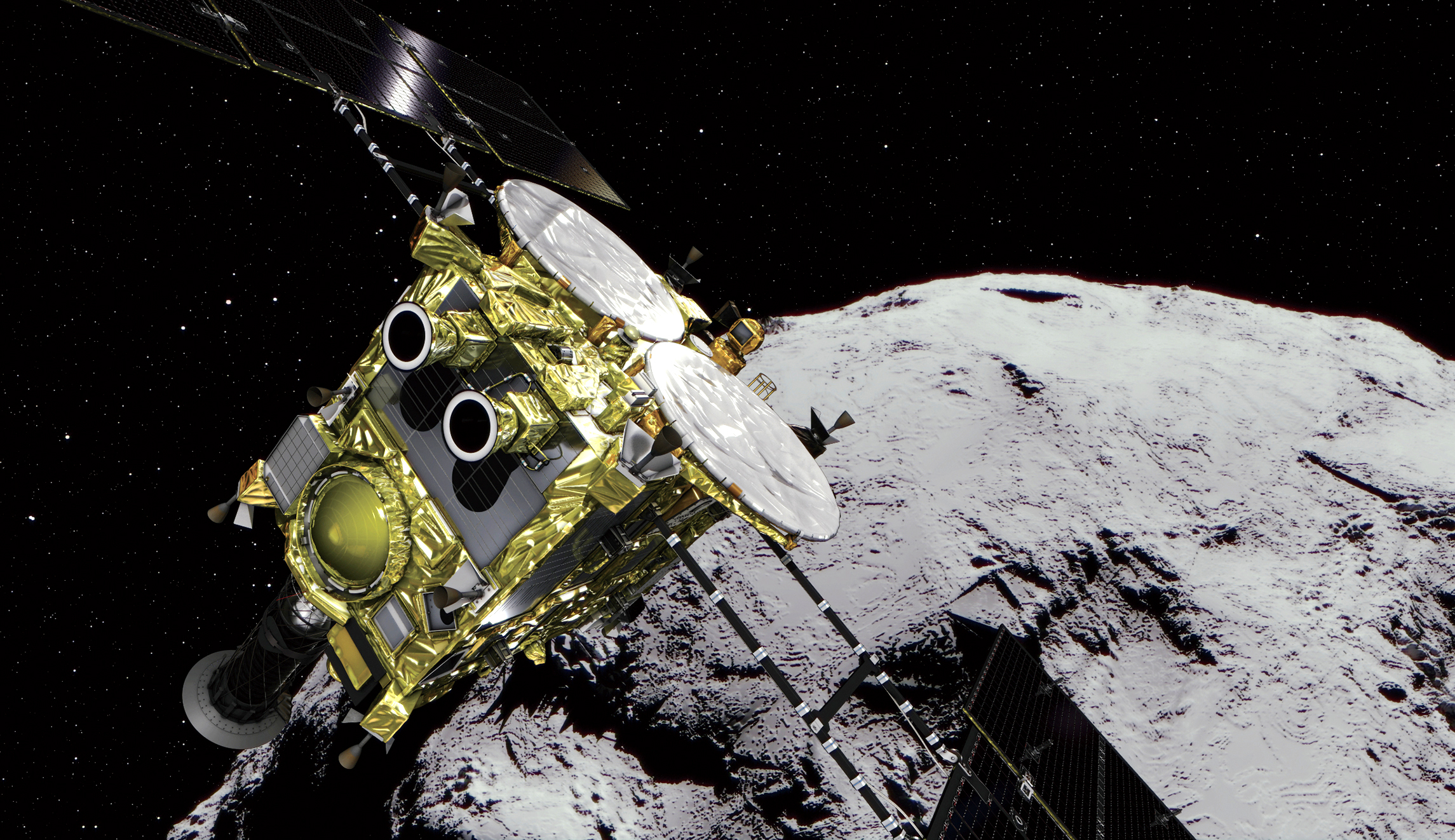
Japan has made history by landing “two rovers” on the surface of an asteroid, the Japanese space agency announced.
“They are in good condition and have transmitted photos & data,” the space agency tweeted. “We also confirmed they are moving on the surface.”
That mobility is historic. NASA landed a spacecraft on an asteroid in 2001, but the Japanese rovers can move around and take photographs. That makes them “the world’s first man-made object to explore movement on an asteroid surface,” according to JAXA, as the Japanese space agency is known. Asteroids interest scientists researching the history of the universe, and they’re rich with commercial potential, the nascent asteroid mining industry hopes.
“I cannot find words to express how happy I am that we were able to realize mobile exploration on the surface of an asteroid,” Yuichi Tsuda, a project manager at JAXA, said in a Saturday statement. “I am proud that Hayabusa2 was able to contribute to the creation of this technology for a new method of space exploration by surface movement on small bodies.”
The rovers are designed to “hop” around the asteroid; in such a low-gravity environment, anything “propelled by normal wheels or crawlers would float upwards” when it moves, JAXA stated. The rovers, armed with a combined seven cameras, remain aloft for as much as 15 minutes per hop.
Asteroids could have enormous economic potential. Goldman Sachs, heralding the “Second Space Age,” anticipates an array of rewards, from the potential to mine platinum from asteroids to the development of new technologies in space.
“Space was once the sole domain of governments, but that has steadily changed the last half-century,” a recent report from the bank said. “NASA and private industry are pushing the boundaries of what is known and unknown, ushering in the 22nd century economy.”
That will raise novel practical and legal questions about space operations and competition on earth. For one thing, a 1957 treaty doesn’t allow claims of sovereignty in space. Federal officials, private actors, and other diplomats eventually will need to agree to a means of governing human activity in space in light of new technologies.
“We believe, for example, that there are lots of minerals – especially valuable metals and rare earths – on asteroids,” Commerce Secretary Wilbur Ross said in August. “Well, how do you establish title to them? How do you establish mining rights? Is it first come, first serve? Is it the guy with the biggest spacecraft, the guy who puts the first weapons there? How do you establish who is really going to be doing it? . . . But to me, the more fundamental question is: legal structure doesn’t mean a lot if there isn’t some sort of enforceability to it. And that’s a huge open question.”
