

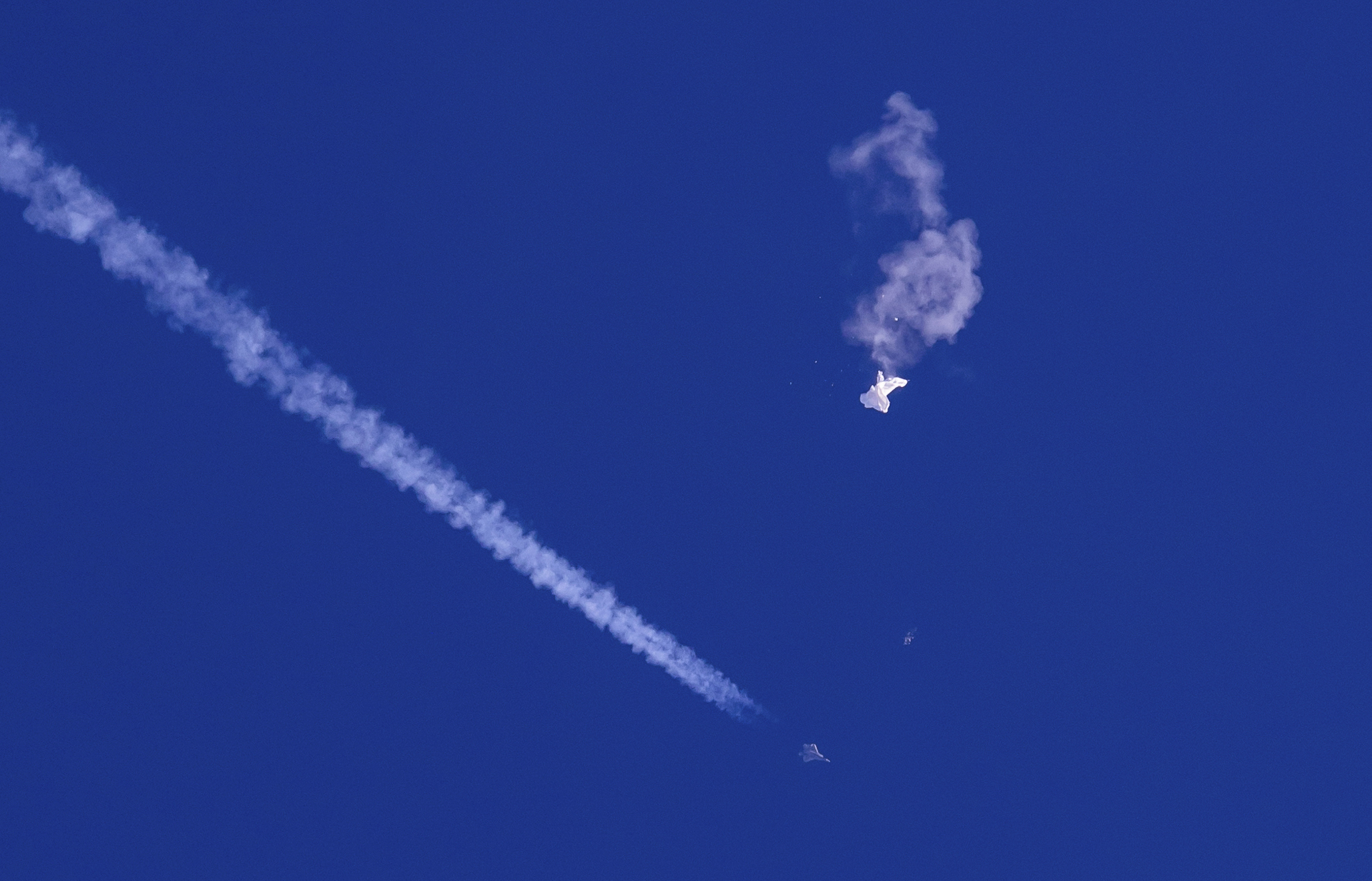
The military has had some success in recovering pieces of the Chinese spy balloon that it shot down on Saturday after it traversed the continental United States last week.
Recommended Stories


U.S. officials acknowledged that the recovery efforts are just getting started, though the Navy and Coast Guard, which are leading the recovery operation, have recovered some of it since a U.S. F-22 fighter jet fired a missile on Saturday afternoon, bringing down the Chinese spy balloon over the Atlantic Ocean near the coast of the Carolinas.
TRUMP’S LAST PENTAGON CHIEF PANS BIDEN ‘KEYSTONE KOPS’ CHINA BALLOON RESPONSE
The USS Carter Hall and USS Pathfinder are in the area. The former is focused on “collecting debris [and] categorizing the debris since arrival,” the commander of NORAD and USNORTHCOM, Gen. Glen VanHerck, told reporters on Monday, while the latter is focused on using unmanned underwater vehicles eventually to “produce us a map” of the suspected debris field.
There are other naval vessels in the area to ensure the safety and security of the mission, he added. Providing new insight on the size of the Chinese surveillance spy balloon, VanHerck said the assessment was that the actual balloon was “up to 200 feet tall,” while he described the payload “as a jet airliner type of size, maybe a regional jet” and said it probably weighed “in excess of a couple thousand pounds.”
U.S. forces prepared for the possibility that there were “explosives to detonate and destroy the balloon that could have been present,” he added, though he said the move was done out of an “abundance of safety” and not “any corroboration or confirmation of explosives.”
The balloon floated across the U.S. last week, first entering U.S. airspace over the Alaskan Aleutian Islands on Jan. 28 before it entered Canadian airspace and eventually made its way over northern Idaho.
“They have recovered some remnants off the surface of the sea,” National Security Council coordinator John Kirby told reporters on Monday. “And weather conditions did not permit much undersea surveillance of the debris field yesterday. They think the debris field is about 15 football fields by 15 football fields square. And so it’s sizable, but they’ve identified that, and they think that in perhaps even today, but certainly in the coming days, they’ll be able to get down there and take a better look at what’s on the bottom of the ocean.”
CLICK HERE TO READ MORE FROM THE WASHINGTON EXAMINER
Defense officials declined to shoot the balloon, which was at 60,000-65,000 feet in the sky, down due to the threat of falling debris, and they also believed the U.S. would gain more intelligence from being able to recover the remnants of the balloon than that China was able to gather from the balloon.
VanHerck also acknowledged that NORAD “did not detect” the previous four Chinese spy balloon incidents, three of which occurred under the previous administration.
