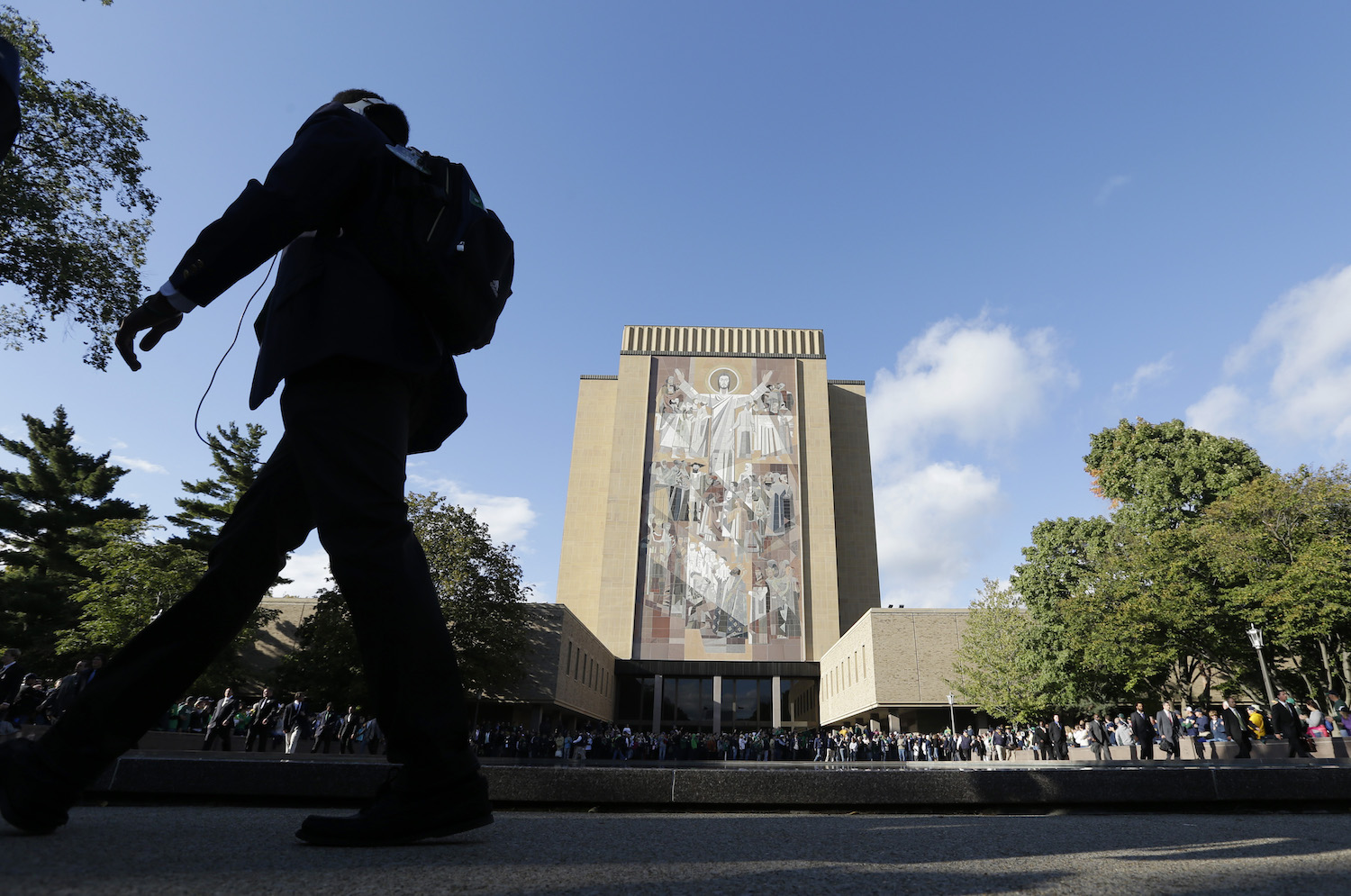
In 2009, there was a massive controversy at my alma mater over the invitation to President Obama to speak at commencement.
Obama, whose no-compromise version of pro-abortion politics clashed directly with Catholic teaching on the sanctity of all human life, was objectionable to many of Notre Dame’s graduating students that year, as well as alumni. Some of them attended his speech anyway. Some held an alternative commencement ceremony on South Quad with hundreds in attendance. The invitation also drew protests from outsiders, who set up across the street from the university’s main entrance, and in some cases let themselves be arrested for civil disobedience.
But Obama was also the fourth recent president to be invited to commencement at Notre Dame. Jimmy Carter, George W. Bush and Ronald Reagan had previously spoken at commencement in their first year in office. (Reagan’s speech was his first public appearance after he survived an attempted assassination.) George H.W. Bush and Dwight Eisenhower both spoke at Notre Dame’s commencement in their last year in office. Excepting the military academies, no other school has a better record in the last few decades times of luring presidents to speak.
And so immediately upon the election of Donald Trump, all the talk on campus turned to whether he would be invited as well.
A speech by the president might seem like a boon for any college, but it’s not a no-brainer when your university claims to have a moral mission. Trump’s personal life of admitted adultery; his so-called “locker-room banter” about sexually assaulting women; his maligning of a federal judge from nearby East Chicago, Ind., as “Mexican” and therefore incapable of adjudicating his fraud case fairly (not to mention the fraud itself); these things are pretty much the opposite of what Notre Dame is supposedly there to do.
From a policy perspective, although it’s much less clear-cut than the abortion issue, but a lot of Catholics would argue (with a reasonable basis) that the rhetorical tone he set in his campaign, as well as some of his policy aims, are either at odds with many Catholics’ understanding of Church teaching, or else (in the case of immigration) at least directly harmful to a large number of Catholics in the United States.
But of course, the counterargument here is that the university kind of threw away its moral criteria with the selection of Obama eight years earlier. Abortion is a truly non-negotiable question, a “Thou shalt not kill” issue. And Obama, true to his word, promoted abortion wherever possible, through law, regulatory coercion, and through protection of federal funding for both international and national organizations that perform and lobby for abortion.
It put Father John Jenkins, the university’s president, in a tough spot. He appears to have found a way out of it that isn’t quite Solomonic, but I think is going to work out fine. He invited Vice President Mike Pence, who has accepted.
Yes, Pence will be protested — every Republican is protested. George H.W. Bush was protested in 1992. And some of the protestors will go after Pence for the judgment he made to join Trump on the ticket.
But Pence, a former governor of the state where Notre Dame is located, will be protested mostly by the same people who hate him because he is strongly pro-life, which the loudest voices on campus (although not the majority) dislike. And the loudest protests will come because, as governor of Indiana, he signed a bill that upholds Catholics’ right to believe in and conduct business according to Catholic teaching on marriage and the family — precisely the teachings that are least popular today. Notre Dame as a whole should be happy if people are upset for those reasons. It’s a sign that the university has occasional conflicts with “the world, the flesh, and the devil.”
(I doubt there will be many angry letters over the fact that Pence was raised Catholic and left the faith, but I guarantee you will hear a few words about that at some point too.)
A Pence invitation makes it likely that the vitriol on campus will be much, much less intense than if either Trump had been invited, or if he had been explicitly disavowed as unacceptable after Obama had been welcomed with open arms. People will get angry, as they always do, but graduating students won’t have to suffer through the months of bitter cross-accusations of immorality and hypocrisy that would have filled the air.
That’s probably a welcome relief for students who, after 17 years of formal schooling, probably deserve to have their graduation day focused on themselves rather than political debates or (heaven forbid) riots.
