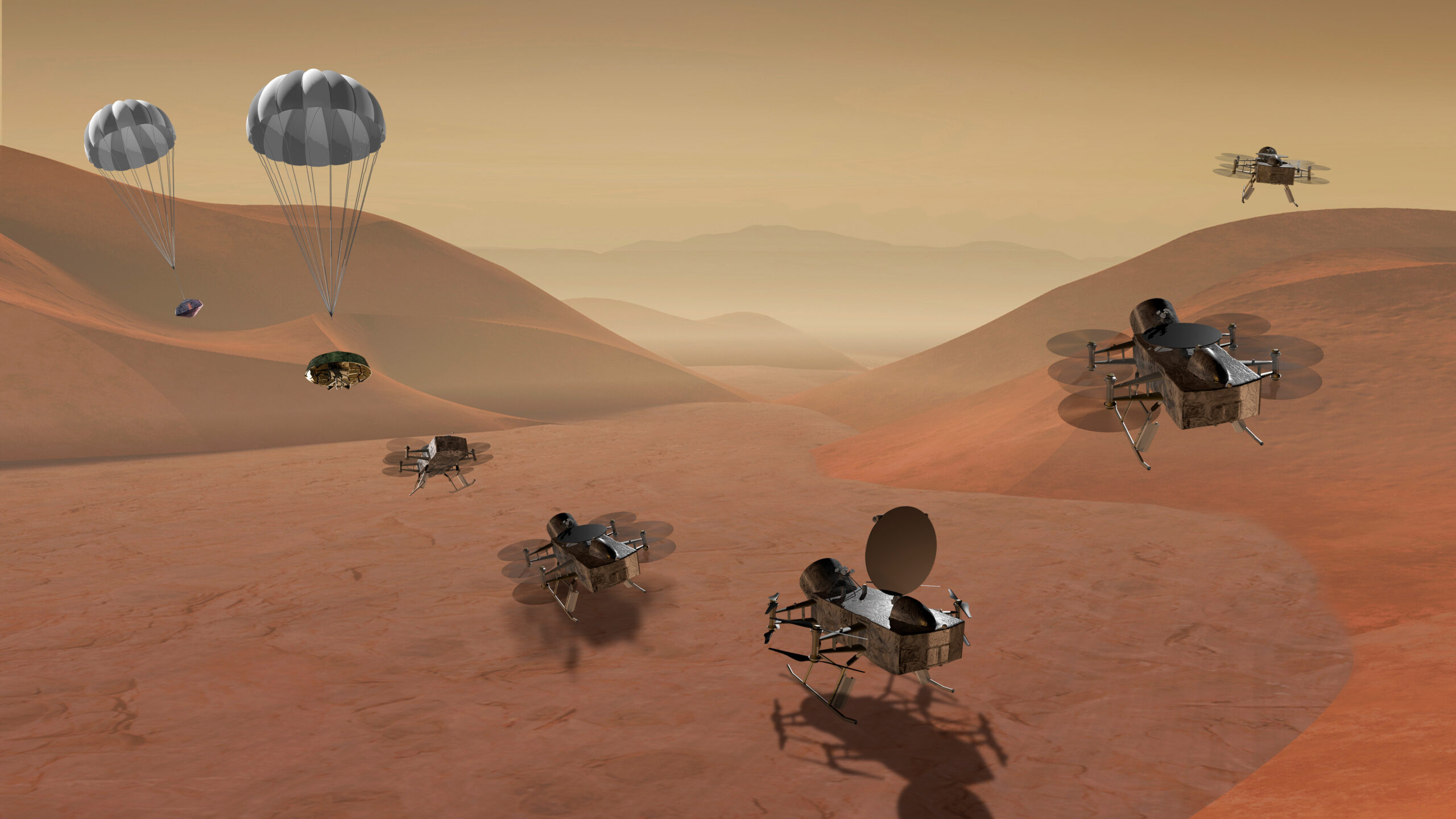
NASA announced its newest mission: to fly the drone-like “Dragonfly” to Saturn’s largest moon, Titan.
Titan’s atmosphere is closest to that of early Earth’s atmosphere and possesses the three key ingredients to potential life.
“It’s very similar chemically to Earth before life evolved. We can get a glimpse into what [Earth’s] conditions were like that led to life,” Curt Niebur, the lead program scientist, said during the Thursday announcement.
Titan has a methane cycle, which is not unlike Earth’s weather cycle, creating lakes, rivers, and canyons. In addition, chemical reactions occur that create organic molecules. The molecules drift into a light snow which is always forming organic synthesis.
“Even though it’s very cold on Titan, it has a lot of similarities to Earth in that respect,” said Niebur. “We would definitely recognize it.”
The temperature on Titan is about minus 300 degrees Fahrenheit. Dragonfly will land among the 100-200-meter sand dunes, taking photos and samples of materials on the surface.
Lori Glaze, director of NASA’s planetary science division, said that because Titan has the key ingredients of life and the energy required for life, this mission will allow scientists to observe processes on early Earth and look at biosignatures there today and signs of life now and in the future.
Dragonfly’s life span is expected to be around two and a half years, and the craft will travel approximately 180 kilometers around Titan’s surface. The name “Dragonfly” is a reflection of the craft itself, which flies with propellers because Titan’s atmosphere is four times denser than Earth’s.
“If you put on wings, you’d be able to fly on Titan,” said Elizabeth Turtle, a planetary scientist at the Johns Hopkins University Applied Physics Laboratory. Johns Hopkins is managing the mission.
“Titan is a perfect chemical laboratory to understand prebiotic chemistry,” said Turtle. “There’s energy in the form of sunlight and we know there’s been liquid water on the surface in the past.”
A 2026 launch and 2034 landing is planned for the new spacecraft.
