

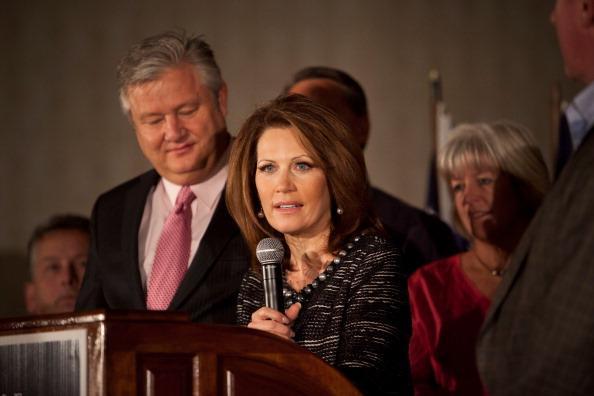
WEST DES MOINES — If Michele Bachmann was ever intimidated by running for president, ever scared of taking a position, ever cowed by advisers urging caution — if she was ever any of those things, she never showed it. Hers was the most fearless, flat-out, in-your-face presence in the Republican presidential field, and as a candidate she was capable of launching searing attacks on her GOP rivals — just ask Rick Perry, or Newt Gingrich, or Ron Paul. But when Bachmann bowed out of the race on Wednesday morning, just hours after finishing sixth in a seven-candidate field in the Iowa caucuses, she spoke kindly of her now-former adversaries and kept the focus on the man who gave birth to her candidacy: Barack Obama.
“I ran because I believed that since day one Barack Obama’s policies, based on socialism, are destructive to the very foundation of the republic,” Bachmann said at the press conference to announce the end of her campaign. “I ran to secure the promise of our children’s future.”
From the moment of Bachmann’s breakthrough performance at the Republican debate in New Hampshire on June 13, she was perhaps the standout personality in the field — not because she was the only woman, but because she simply had more presence than anyone else. She used that presence to focus on Obamacare, and she kept at it from her first day on the stump to her last. “The implementation of Obamacare will represent a turning point for our country and our economy,” she said in her farewell, surrounded by moist-eyed family and aides. “Future generations will ask of us: what did we do?”
The high point of Bachmann’s campaign was her victory in the August 13 Ames straw poll. It was nearly all downhill from after that, but for reasons that sometimes escaped Republican voters here in Iowa. Ask them why Bachmann seemed to fall so quickly after August, and more often than not, they shook their heads and said they didn’t know. It just happened.
In reality, things began to go wrong for Bachmann almost as soon as the Ames votes were counted. The most serious setback was Rick Perry’s entrance into the race, done with great fanfare in South Carolina at virtually the moment Bachmann was winning in Iowa. The two social conservatives were widely seen as chasing the same bloc of voters. “Perry got into the race and really squashed the support she had,” said senior Bachmann strategist Brett O’Donnell a few minutes after her withdrawal announcement Wednesday. “We just never recovered, really, from that.” The irony, of course, was that Perry soon ran into so many problems of his own, and revealed such severe weaknesses in his own preparation and planning, that in retrospect it seems inexplicable he could have seemed so promising a candidate as to snuff out much of Bachmann’s support. Yet that is what happened.
But it wasn’t just Perry. In the weeks that followed Ames, the impression set in that Bachmann just wasn’t quite ready, wasn’t prepared to be president. For many Republicans, it was a simple matter of her not having enough experience, as opposed to the voters’ later assessments of Perry and Herman Cain, whom they concluded just didn’t know enough to serve in the White House.
After Bachmann’s announcement, spokeswoman Alice Stewart declined to name any mistakes the candidate had made on the trail. “She doesn’t see where she made any mistakes,” Stewart said. “None of us see where there were mistakes made.” One can forgive a top aide for not wanting to enumerate a candidate’s errors at such a moment — what would be the point? — but Bachmann did, in fact, make serious mistakes that contributed to her downfall.
The first came immediately after the Ames victory. In the days and weeks that followed, she did not focus like a laser beam on Iowa, and when she did she sometimes carried herself more like a celebrity than a candidate asking for votes. “They were running [the campaign] like they were running a rock star around the state,” said one social conservative who admires Bachmann but did not support her. “She might as well have been flying over Iowa in a helicopter, dropping leaflets.”
In Des Moines a few weeks ago, I asked Mike Huckabee, who won the 2008 Iowa caucuses, what Bachmann had done wrong. “The moment of that [Ames victory] took her all over the country, and not here,” Huckabee said. “Once the baby is born, you better put a warm blanket around it and feed it real good. And if you don’t keep the baby warm and feed it, it may not make it. That’s my perception, that she did not camp out in Iowa for a month or six weeks and just nail this state down — and then keep coming back. Because I do think that might have made a difference.”
Bachmann also made mistakes in speaking off the cuff. The most famous, and damaging, such incident came after a debate in which she had done serious damage to Perry over the HPV vaccine. But she stepped all over herself the next day when she carelessly repeated something someone had told her about the vaccine allegedly causing mental retardation.
Bachmann knew she had made an error and referred to it obliquely when I asked her in early December about her evolution as a candidate. “I defend this process,” she told me. “It’s hard. But this process causes you to be more exacting. Everything you say gets recorded. That scrutiny…causes us to be better.”
But even as she made mistakes, Bachmann also got her share of unfair treatment. She was the first target of what has become a recurring phenomenon in the Republican race: the media’s desire to shoot down whichever candidate moves to the front of the pack. After Bachmann, the targets included Rick Perry, Herman Cain, and Newt Gingrich, with Rick Santorum next in line.
“The media works like the Jurassic Park dinosaurs, 30 feet tall, huge teeth, and, with all due respect, not always the biggest brain,” former Republican political consultant Mike Murphy said recently on “Meet the Press.” “It follows movement. And when it sees movement, [in this case] Rick Santorum, it stomps over there and tries to eat Rick Santorum.”
Murphy’s comparison was accurate but incomplete, because the media dinosaur does not always try to kill everything that moves. In 2008, for example, it didn’t try to eat Barack Obama. But Bachmann got the full Jurassic Park treatment.
Dumb little mistakes she made, like confusing the hometowns of John Wayne and John Wayne Gacy, were treated like major gaffes. Her geographical misplacement of Lexington and Concord was considered nearly disqualifying. And her open religiosity was described as a precursor to theocracy. The beatings continued until Bachmann sank low enough in the polls not to matter any more.
I played a small role in the Bachmann controversies when, as a panelist at the Fox News debate in Ames on August 11, I pointed out that she once explained an incident in her life in which she made an unwanted career move at the behest of her husband by saying, “The Lord said, ‘Be submissive. Wives, you are to be submissive to your husbands.'” As president, I asked Bachmann, “would you be submissive to your husband?” The Republican crowd booed, and Bachmann deftly took a moment to soak it in before answering that she and her husband interpret the admonition to be submissive as a command to respect one another. The crowd loved her answer, and it was the most human moment of the debate, and perhaps of the campaign, for her. Though she was surely taken aback, Bachmann never complained to me, nor did her staff. They joked about it a couple of times, but never restricted access or in any other way tried to exact revenge.
As the campaign dragged on, and after Bachmann fell nearly to the bottom of the polls, she began to attract a certain measure of respect for her sheer determination. Michele Bachmann just didn’t give up. But Iowa voters chose not to give her a second look, perhaps mostly because they had never given Rick Santorum a first look. If they had re-examined Bachmann, they would have found a seriously improved candidate. As talented politicians do, Bachmann got better as time went on.
It’s not clear what is next. Bachmann declined to answer questions at her announcement Wednesday, and spokeswoman Stewart said no plans have been made. Bachmann could run for re-election for her House seat in Minnesota. It would be doable but not necessarily easy; she’s been re-elected twice, but she is a major target for Democrats who would love to take her down. Or she could try something else.
Whatever she does, Bachmann will do with raised stature. As is true for most losing presidential campaigns, she comes out at the end with a higher profile than she enjoyed at the beginning. There will be opportunities for her. In the meantime, she is no doubt looking back at the campaign, perhaps with some misgivings but with a basic sense of satisfaction. “I have no regrets,” she said Wednesday. “None whatsoever. We never compromised our principles.”
