
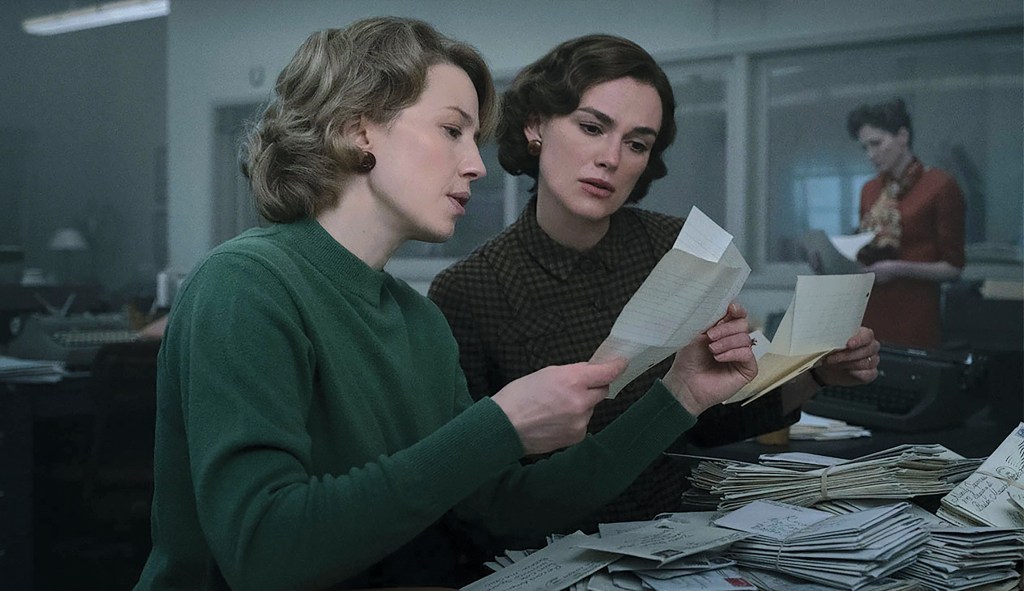
In writer-director Matt Ruskin’s preachy, derivative, largely uninvolving movie Boston Strangler about the real 1960s serial killer of the same moniker, it is not enough for a journalist to overcome the obvious obstacles of helping illuminate a series of heinous crimes. No, since we live in 2023, she must also bear the burdens of her time and gender. She is asked to vanquish not just the Boston Strangler but sexism in the office, gender roles at home, and mansplaining everywhere else.
You would think that if you were making a movie about a famous killer and the journalist who identified the connection between his victims, gave him a name, and pursued every angle of the case, you’d have enough material to go with. Doing all that is certainly a big deal in the career of any journalist, and Loretta McLaughlin of the Boston Record American (played, in the film, by Keira Knightley) made her mark on the world when she demonstrated links between a series of apparently random murders of women in 1960s-era Boston. Yet in the present moment, it’s identity-based oppression, not murder by strangulation, that really grabs Hollywood producers’ attention. Yes, the anti-intellectual and artistically flattening tendency that we are not supposed to be able to identify crisply enough to name “wokeness” has finally come for the true-crime drama.
Real journalism.Trusted by millions.
Unlimited access to in-depth reporting, expert analysis, and the stories that shape our country.
Already a member? Log in